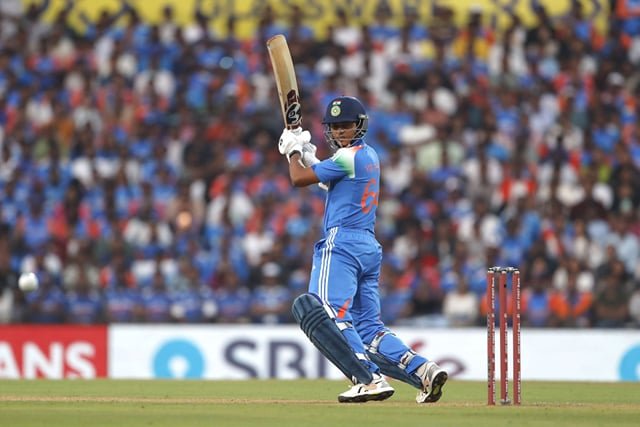
India are set to begin their three-match ODI series against the West Indies on September 27, with the opening contest scheduled in Thiruvananthapuram. Ahead of the series, former India batter Mohammad Kaif has shared his preferred playing XI and suggested an unusual role for Yashasvi Jaiswal in the middle order.
Kaif’s suggestion comes as India manage their squad during the 2026 Asian Games period. With some regular ODI options involved in the continental event, the team has an opportunity to experiment with combinations while also giving important players more match practice.
Rather than using Jaiswal solely as a backup opener, Kaif believes India could move him to No. 4 for the West Indies series. The former cricketer feels such flexibility could allow Jaiswal to get international game time without immediately disturbing the established opening combination of Rohit Sharma and Shubman Gill.
Mohammad Kaif Picks His India Playing XI for the First ODI
Kaif’s proposed lineup features a strong top order, followed by a mixture of experienced players and younger options. His batting order begins with Rohit Sharma and Shubman Gill, followed by Virat Kohli at No. 3.
Jaiswal would then come in at No. 4, with Ruturaj Gaikwad at No. 5 and KL Rahul at No. 6. Ravindra Jadeja would occupy the No. 7 position, while Nitish Kumar Reddy and Kuldeep Yadav would follow.
The final two places would be occupied by fast bowlers.
| Batting Position | Player | Role |
|---|---|---|
| 1 | Rohit Sharma | Opener |
| 2 | Shubman Gill | Opener |
| 3 | Virat Kohli | Top-order batter |
| 4 | Yashasvi Jaiswal | Top-order batter |
| 5 | Ruturaj Gaikwad | Top-order/middle-order batter |
| 6 | KL Rahul | Middle-order batter/wicketkeeper option |
| 7 | Ravindra Jadeja | All-rounder |
| 8 | Nitish Kumar Reddy | All-rounder |
| 9 | Kuldeep Yadav | Spinner |
| 10 | Fast bowler | Bowling |
| 11 | Fast bowler | Bowling |
The final two fast-bowling spots would be selected from India’s available pace options for the series.
Why Kaif Wants Yashasvi Jaiswal at No. 4
Jaiswal is primarily viewed as an opening batter, particularly in India’s longer-term white-ball plans. However, Kaif believes that the West Indies series presents an opportunity to test whether the left-hander can temporarily adapt to a different position.
The logic behind the proposal is straightforward. If Rohit Sharma and Shubman Gill are opening, Jaiswal could still be included in the XI by moving down the order. This would provide him with international match practice while allowing India to maintain their preferred opening combination.
Kaif also pointed toward India’s future plans. According to him, once Rohit eventually moves on from ODI cricket, Jaiswal could return to the opening position. Therefore, using him at No. 4 for a short period would not necessarily change his long-term role.
Speaking on his YouTube channel, Kaif said that India could use some flexibility in white-ball cricket and suggested that the series was an appropriate opportunity to “set” both Jaiswal and Ruturaj Gaikwad.
His proposal reflects a broader principle in limited-overs cricket: players do not always have to remain fixed to one batting position, particularly when a team is managing different combinations across a series.
Rohit Sharma and Shubman Gill Could Continue as Openers
Kaif’s selection keeps Rohit and Gill at the top of the order. That combination would provide India with two established batters capable of handling the new ball and setting the platform for the middle overs.
With Virat Kohli at No. 3, India’s top three would retain significant international experience. Jaiswal’s inclusion at No. 4 would then give the batting lineup a left-handed option in the middle of the top order.
This left-right combination can also provide tactical flexibility during the powerplay and middle overs. However, the actual batting order will ultimately depend on the team management’s plans and the conditions in Thiruvananthapuram.
Kaif’s suggestion should therefore be viewed as his proposed XI rather than confirmation of India’s official playing combination.
Ruturaj Gaikwad Also Gets a Role in Kaif’s Combination
Another notable feature of Kaif’s lineup is Ruturaj Gaikwad at No. 5. Like Jaiswal, Gaikwad is a batter who has spent significant time in top-order positions, particularly in limited-overs cricket.
Moving him down the order would give India another opportunity to assess his adaptability. It would also allow the team to accommodate several top-order players in the same XI.
Kaif’s proposed combination therefore prioritizes giving multiple batters opportunities rather than locking every player into their traditional position.
For a three-match series, such an approach can provide useful information about squad depth. It can also help the management understand which players can adjust when the preferred combination is unavailable.
KL Rahul and Ravindra Jadeja Add Experience
Kaif placed KL Rahul at No. 6 and Ravindra Jadeja at No. 7. Both players have extensive international experience and can provide stability during the middle and lower-middle overs.
Rahul’s versatility is particularly useful because he can contribute as a batter and wicketkeeper when required. His presence at No. 6 would give India another experienced option after the top-order group.
Jadeja, meanwhile, offers an all-round skill set. His ability to contribute with both bat and ball gives the XI additional balance and allows India to build a longer batting lineup without sacrificing bowling resources.
Nitish Kumar Reddy and Kuldeep Yadav Complete the Core
Kaif’s selection also includes Nitish Kumar Reddy at No. 8 and Kuldeep Yadav at No. 9. Nitish provides another all-round option, while Kuldeep adds a specialist spin-bowling threat.
The combination would leave India with multiple bowling choices alongside the two specialist fast bowlers. Jadeja and Kuldeep would provide spin, while Nitish could potentially contribute overs depending on the team’s tactical requirements.
Such a setup could be useful in ODI cricket, where captains have 50 overs to distribute among their bowling options and need to manage workloads across different phases of the innings.
India Have Four Fast Bowlers in the ODI Squad
India have reportedly selected four fast bowlers in the squad for the West Indies ODI series: Prasidh Krishna, Gurnoor Brar, Mohammed Siraj and Nabi.
With Kaif selecting two pace bowlers in his XI, the team management will have to decide which combination best suits the conditions and their tactical plans.
The presence of multiple pace options also gives India an opportunity to assess players who could become part of the wider ODI setup. With the 2027 World Cup approaching, every ODI carries potential value for players competing for places.
Kaif Questions India’s Asian Games Selection Strategy
Jaiswal’s proposed position was not the only selection issue raised by Kaif. The former cricketer also questioned India’s decision to send a strong group of players to the 2026 Asian Games while the ODI series against West Indies is taking place at the same time.
India’s ODI series begins on September 27, while the Indian campaign at the Asian Games is scheduled to begin on September 28 with a quarter-final. The overlapping schedule has created a situation in which some players are unavailable for the ODI series.
Shreyas Iyer, for example, is involved with India’s Asian Games campaign rather than the West Indies ODI series. Kaif also highlighted the absence of other important ODI options and questioned whether India’s priorities should be divided when there are limited ODIs remaining before the 2027 World Cup.
His comments were framed around the value of winning the Asian Games gold medal compared with using the available ODI fixtures to strengthen India’s preparations for the next World Cup.
Why the Timing Matters Ahead of the 2027 ODI World Cup
The scheduling overlap is significant because ODI teams generally use bilateral series to establish combinations before major tournaments. Every match provides an opportunity to assess batting positions, bowling partnerships, fielding combinations and squad depth.
When first-choice players are unavailable, teams may have fewer opportunities to test their preferred combinations together.
At the same time, the Asian Games provide a separate international sporting platform, and participation can offer opportunities to players who might otherwise struggle to get exposure at senior international level.
Kaif’s criticism therefore highlights a strategic question rather than simply a selection issue: how should India balance the immediate objective of competing at a multi-sport event with the longer-term preparation required for ODI cricket?
West Indies Series Gives India a Chance to Test Depth
Despite the absence of some players, the West Indies ODI series gives India an opportunity to assess the depth of their squad.
Kaif’s proposed XI itself demonstrates how many established and emerging batters are available. Rohit, Gill, Kohli, Jaiswal, Gaikwad, Rahul and Jadeja provide multiple options, while Nitish offers additional all-round flexibility.
The challenge for the team management will be finding the right balance between experimentation and maintaining a settled combination.
With the first ODI scheduled for September 27, attention will now turn to the official XI and whether India adopt a conventional batting order or attempt the kind of flexibility suggested by Kaif.
Final Verdict
Mohammad Kaif’s proposed India playing XI for the first ODI against West Indies revolves around flexibility. His most notable suggestion is to use Yashasvi Jaiswal at No. 4 while retaining Rohit Sharma and Shubman Gill as the opening pair.
The idea would give Jaiswal international game time without immediately requiring him to replace an established opener. It would also allow Ruturaj Gaikwad to bat at No. 5 and provide India with an opportunity to test several combinations during the three-match series.
Kaif’s separate concerns over the Asian Games selection highlight another issue facing India: managing different international commitments while preparing for the 2027 ODI World Cup.
Ultimately, the official playing XI will be decided by India’s team management. The first ODI in Thiruvananthapuram should reveal whether the selectors and coaching staff prefer a settled structure or use the series to experiment with players and batting positions.
For breaking news and live news updates, like us on Facebook or follow us on Twitter and Instagram. Read more on Latest Cricket on thefoxdaily.com.






COMMENTS 0