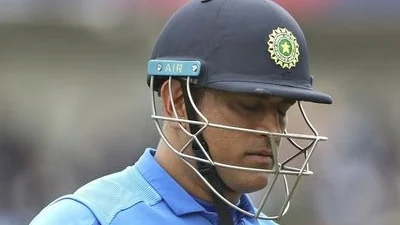
MS Dhoni retirement anniversary marks six years since the former India captain brought an understated end to one of the most influential international careers in Indian Cricket history.
On August 15, 2020, Dhoni announced his retirement from international cricket through a brief social media post. His decision came 13 months after his final international appearance, the 2019 World Cup semifinal against New Zealand at Old Trafford.
MS Dhoni’s final international match came without a farewell
Dhoni’s final international innings came on July 10, 2019, during India’s World Cup semifinal against New Zealand. India were in serious trouble at 92 for six before Ravindra Jadeja and Dhoni rebuilt the chase.
The pair added 116 runs and brought India back into contention. Dhoni eventually scored 50, but his attempt to complete a crucial second run ended when Martin Guptill’s throw from deep square leg found the stumps.
India were eventually eliminated after losing the match by 18 runs. At the time, few knew that Dhoni had played his final international innings.
Dhoni announced his retirement in seven words
For more than a year after the World Cup semifinal, Dhoni remained away from international cricket without officially announcing his retirement.
Then, on August 15, 2020, he posted a short message that brought his international career to an end.
“From 1929 hrs consider me as Retired.”
The announcement was accompanied by a montage of memories and the song Main Pal Do Pal Ka Shayar. There was no farewell match, press conference or ceremonial ending.
MS Dhoni changed Indian cricket’s expectations
Dhoni’s importance went far beyond his statistics. Coming from Ranchi, he became an inspiration for cricketers from smaller cities and towns across India.
Before becoming an international star, Dhoni worked as a railway ticket collector. His unconventional rise challenged the idea that India’s biggest cricketing talents had to emerge from established metropolitan centres.
His powerful batting, wicketkeeping skills and leadership eventually transformed the expectations placed on an Indian wicketkeeper. Dhoni became a player capable of changing matches in multiple ways.
From 148 against Pakistan to 183 against Sri Lanka
Dhoni announced himself on the international stage with his aggressive batting style. His 148 against Pakistan in Visakhapatnam in 2005 showcased his ability to dominate bowling attacks.
Later that year, he produced one of the most memorable ODI innings of his career, scoring an unbeaten 183 against Sri Lanka in Jaipur.
The innings remains the highest individual ODI score by a wicketkeeper in men’s international cricket and helped establish Dhoni as one of the world’s most dangerous limited-overs batters.
Dhoni’s captaincy transformed India’s limited-overs cricket
Dhoni’s leadership became another defining part of his career. His first major international triumph as captain came at the inaugural 2007 T20 World Cup in South Africa.
In the final against Pakistan, India defended 13 runs from the final over with only one wicket remaining. Dhoni handed the ball to Joginder Sharma, a decision that ultimately worked when Sreesanth caught Misbah-ul-Haq to seal India’s victory.
That moment established an important feature of Dhoni’s captaincy: his willingness to trust decisions that could initially appear unconventional.
2011 World Cup final produced Dhoni’s most iconic finish
Perhaps no moment defines Dhoni’s career more strongly than the 2011 World Cup final against Sri Lanka at Mumbai’s Wankhede Stadium.
India were chasing 275 when Virat Kohli was dismissed. Instead of sending in Yuvraj Singh, Dhoni promoted himself up the batting order.
The decision proved decisive. Dhoni remained unbeaten on 91 and finished the chase with a six against Nuwan Kulasekara.
The shot became one of the most recognisable moments in Indian sporting history as India won the World Cup on home soil.
Dhoni completed the ICC trophy collection in 2013
Two years after the World Cup triumph, Dhoni led India to another major ICC title in the 2013 Champions Trophy in England.
India defeated England in a rain-shortened final in Birmingham, giving Dhoni a unique collection of major ICC limited-overs trophies.
Under his leadership, India also reached the top of the ICC Test rankings for the first time in 2009.
Dhoni’s finishing ability became his trademark
Dhoni’s batting approach was built around controlling the final stages of a chase. Rather than attempting to dominate every delivery, he often focused on keeping the required equation manageable before attacking at the right moment.
His ability to remain calm when the required run rate increased made him one of the most trusted finishers in international cricket.
The helicopter shot, powerful hitting and exceptional awareness of match situations became closely associated with his batting identity.
Manchester became an unexpected final chapter
The 2019 World Cup semifinal provided an unusually painful ending to Dhoni’s international career.
India needed 25 runs from the final 10 balls when Dhoni was run out. The dismissal ended India’s hopes and, ultimately, marked the final international innings of his career.
For a player who had spent years producing dramatic finishes, the final chapter ended without the victory that many expected.
MS Dhoni’s international legacy
Dhoni finished his international career with 538 matches, 17,266 runs and 829 dismissals as a wicketkeeper, according to the source article.
However, his legacy cannot be measured only through numbers. He changed how Indian cricket viewed leadership, wicketkeeping, finishing and talent from smaller cities.
His career was filled with decisions that carried risk, but his confidence under pressure allowed him to turn many of those decisions into defining moments.
Six years after retirement, Dhoni’s impact remains
Six years after his retirement announcement, Dhoni continues to be remembered through moments rather than statistics alone: the final over against Pakistan in 2007, the World Cup-winning six in 2011, the Champions Trophy triumph in 2013 and the final run-out at Manchester.
His retirement was as understated as much of his public persona. There was no elaborate farewell and no long explanation. A short social media message was enough.
For nearly 15 years, Indian cricket trusted MS Dhoni to decide how matches ended. When it came to his own international career, he chose an ending that was unmistakably his own: quiet, simple and without unnecessary drama.
For breaking news and live news updates, like us on Facebook or follow us on Twitter and Instagram. Read more on Latest Cricket on thefoxdaily.com.






COMMENTS 0