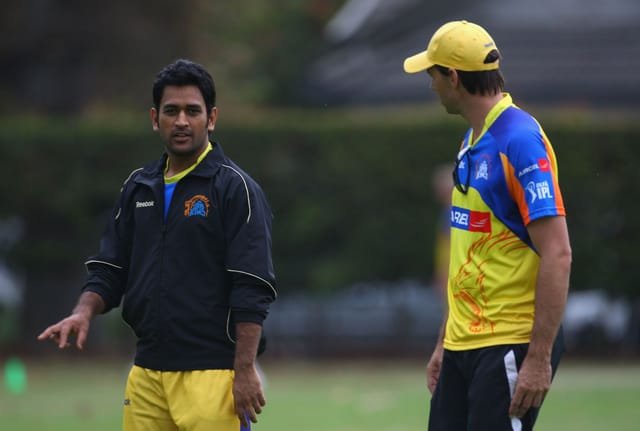
MS Dhoni-Stephen Fleming dynamic has become a major talking point after Chennai Super Kings and Fleming mutually ended their remarkable 19-year association following the 2026 IPL season. Former CSK batter Robin Uthappa believes the franchise’s contrasting fortunes before and after Dhoni’s captaincy transition reveal something significant about how the team’s famous leadership structure operated.
Fleming joined CSK as head coach in 2009 after representing the franchise during the inaugural IPL season in 2008. Dhoni, meanwhile, led CSK from 2009 until 2023, overseeing all five of the franchise’s IPL title-winning campaigns.
Their partnership became one of the most successful player-coach combinations in T20 cricket. Dhoni provided leadership, tactical instincts and authority on the field, while Fleming developed the systems, managed personalities and helped create the environment in which CSK repeatedly competed for major trophies.
But the equation changed after Dhoni handed the captaincy to Ruturaj Gaikwad ahead of IPL 2024. CSK subsequently missed the playoffs in each of the next three seasons and finished at the bottom of the table for the first time in franchise history in 2025.
For Uthappa, that contrast cannot simply be dismissed as coincidence.
Robin Uthappa sees the post-Dhoni period as an important clue
Speaking on the Commbox with Deepak Goyal YouTube channel, Uthappa highlighted Fleming’s record after Dhoni stopped being CSK’s captain.
His argument was not that Fleming suddenly became a poor coach. Instead, he suggested that Fleming’s success at CSK had always been connected to a particular leadership structure in which Dhoni’s decision-making played an enormous role.
“If you look deeply into that, it probably tells a story.”
That observation provides an interesting way to understand CSK’s transformation.
For almost 15 years, Fleming did not have to operate as the sole strategic authority. Dhoni was effectively another major decision-maker within the system, and his ability to interpret situations on the field gave CSK an additional tactical layer.
How Dhoni and Fleming complemented each other
The Dhoni-Fleming partnership worked because their responsibilities were different but complementary.
Fleming’s role involved preparation, planning, communication, player management and creating tactical options. Dhoni then had the responsibility of interpreting what was happening in real time and deciding which option made the most sense.
Uthappa described this relationship as Fleming giving Dhoni multiple possibilities while Dhoni’s instincts helped determine the final decision.
That distinction is crucial.
A coach can prepare a team for numerous scenarios, but cricket is ultimately played in an unpredictable environment. A captain must respond to factors that cannot always be anticipated during pre-match planning.
Dhoni’s ability to make those decisions under pressure became one of CSK’s biggest competitive advantages.
The coach supplied the system, while the captain interpreted the moment
Uthappa’s comments suggest that Fleming and Dhoni were not competing for control. Their strengths fitted together.
Fleming could focus on creating a stable team environment and ensuring players understood their roles. Dhoni could then use his experience to make tactical adjustments when circumstances changed.
This arrangement also reduced the pressure on either individual.
Fleming did not need to micromanage every tactical decision, while Dhoni did not need to build the entire organizational system himself.
The result was a leadership structure in which preparation and instinct worked together.
CSK’s five IPL titles during the Dhoni-Fleming era
The strongest evidence for the success of their partnership is CSK’s trophy record.
Under Dhoni’s captaincy and Fleming’s coaching, Chennai won five IPL championships, establishing itself as one of the most successful teams in tournament history.
The consistency was arguably even more impressive than the individual titles. CSK repeatedly remained competitive despite changes in personnel, injuries, aging players and shifting trends in T20 cricket.
That consistency became closely associated with the franchise’s leadership culture.
| Period | CSK leadership context | Key outcome |
|---|---|---|
| 2009-2023 | MS Dhoni as captain, Stephen Fleming as head coach | CSK won five IPL titles |
| 2024 | Ruturaj Gaikwad took over as captain | Beginning of the post-Dhoni captaincy transition |
| 2025 | Gaikwad-led CSK | CSK finished bottom of the IPL table for the first time |
| 2026 | Post-Dhoni transition continued | CSK missed the playoffs for a third consecutive season |
| 2009-2026 | Fleming’s CSK coaching tenure | 19-year association with the franchise |
Why replacing Dhoni as captain was always going to be difficult
One of the biggest challenges facing CSK was that Dhoni’s role extended beyond ordinary captaincy.
He had been the central figure of the franchise for more than a decade. Players had grown accustomed to his leadership style, decision-making and presence during high-pressure situations.
Replacing a captain is normally difficult. Replacing someone who has become synonymous with a franchise is an entirely different challenge.
Ruturaj Gaikwad inherited the captaincy under enormous expectations. The transition also required the team to develop a different leadership identity while simultaneously managing changes in the playing squad.
That meant CSK were not simply changing captains. They were attempting to move away from a leadership model that had been successful for years.
Ruturaj Gaikwad’s captaincy exposed the difficulty of the transition
Gaikwad’s appointment represented a logical attempt to establish continuity with a younger leader, but the results were difficult.
CSK missed the playoffs in three consecutive IPL seasons after Dhoni’s captaincy ended, including the historic bottom-place finish in 2025.
Those results naturally intensified questions about whether the franchise had underestimated the influence of Dhoni’s tactical role.
However, it would be overly simplistic to blame the entire decline on one leadership change.
T20 franchises are complex systems. Squad composition, player availability, injuries, form, recruitment and tactical evolution all influence results.
The more reasonable interpretation of Uthappa’s argument is that Dhoni’s departure from the captaincy removed one important component of CSK’s previously successful system.
Fleming’s coaching strengths were not limited to tactics
Uthappa was also careful to praise Fleming’s qualities as a coach.
Having played under Fleming during CSK’s 2021 and 2022 campaigns, Uthappa described him as an excellent man-manager with a strong communication style.
“He’s a very good man-manager with excellent systems and communication style.”
That aspect of Fleming’s coaching is important because successful T20 teams require more than tactical knowledge.
A coach has to manage players with different personalities, expectations and levels of experience. Some players need technical guidance, others require confidence, while senior players may need freedom rather than constant instruction.
Fleming’s reputation has been built partly on his ability to create that balance.
Why player freedom became part of Fleming’s coaching philosophy
According to Uthappa, Fleming allowed players to express themselves and provided them with considerable freedom.
That philosophy can be particularly valuable in T20 cricket, where players frequently have to make decisions in seconds.
A batter cannot wait for instructions from the dugout before playing a shot. A bowler must adjust to conditions and opposition tactics immediately. Fielders also have to react without waiting for coaching input.
Giving players freedom therefore helps develop independent decision-making.
Fleming’s contribution may have been less about controlling every action and more about building a structure in which players trusted themselves.
The importance of communication inside a franchise
Uthappa’s praise for Fleming’s communication style also explains why he remained successful for such a long period at CSK.
Franchise cricket creates a unique environment because players come from different countries, cultures and domestic systems and may spend only a few weeks or months together.
A coach must establish clarity quickly.
Players need to understand what is expected from them, what their role is and how they fit into the team’s broader strategy.
Fleming’s ability to communicate those expectations reportedly helped create a comfortable environment where players could perform without constantly worrying about their position.
Did Fleming struggle when he had more control?
This is where Uthappa’s comments become particularly intriguing.
He suggested that Fleming’s role expanded as CSK moved through its leadership transition, with the coach having more influence over the overall setup.
According to Uthappa, the transition did not fully settle before CSK and Fleming eventually decided to part ways.
This does not necessarily mean that Fleming was unable to coach without Dhoni. His career outside CSK provides a broader picture, and his appointment as England’s Test head coach demonstrates that his reputation remains extremely strong.
Instead, the situation may reveal that the particular combination of Fleming and Dhoni was unusually effective.
Fleming’s wider coaching record makes the debate more complicated
Uthappa’s remarks come at an interesting moment because Fleming has experienced mixed results in other coaching environments.
His tenure with Joburg Super Kings in the SA20 did not produce a championship during the franchise’s first four seasons from 2023 through 2026.
That record does not diminish his achievements with CSK, but it does provide context for the argument that coaching success depends heavily on the environment around the coach.
A coach may have an outstanding tactical brain and still need the right leadership group, squad and organizational structure to translate those strengths into trophies.
Why the Dhoni-Fleming partnership was more than captain and coach
The relationship between Dhoni and Fleming can be viewed as a broader organizational partnership.
Dhoni was the public leader on the field, while Fleming operated extensively behind the scenes. Their combined approach allowed CSK to maintain continuity even as individual players changed.
That continuity became one of CSK’s defining characteristics.
The team often appeared comfortable in situations where other franchises panicked. Players seemed to understand their roles, and tactical changes were usually made without creating visible chaos.
This stability was not accidental. It developed through years of working together.
CSK’s recent decline raises a larger question about sporting dynasties
The CSK situation provides a valuable lesson that extends beyond the IPL.
Successful sporting dynasties are often built around combinations of personalities rather than individual stars.
Remove one component and the entire system can behave differently.
In CSK’s case, Dhoni’s departure from the captaincy changed the decision-making structure. Fleming subsequently had to operate in a different environment, while a younger captain was tasked with leading a franchise that had become accustomed to Dhoni’s presence.
The challenge was therefore not simply replacing a player. It was replacing an established method of operating.
What CSK can learn from the Fleming-Dhoni era
The most useful lesson for CSK may be that successful systems need to evolve before their central figures leave.
A franchise cannot expect a leadership structure built over more than a decade to disappear overnight and produce identical results.
The transition should ideally begin while the established leaders are still involved.
That allows younger players and future leaders to gradually take on responsibility rather than being forced to carry the entire burden immediately.
CSK’s post-2023 struggles demonstrate just how difficult that process can be.
Fleming’s England appointment gives him a new test
Despite the end of his CSK chapter, Fleming’s next assignment could become one of the most important stages of his coaching career.
He has been appointed as England’s Test head coach, replacing his former New Zealand teammate Brendon McCullum.
The move gives Fleming an opportunity to demonstrate that his coaching strengths can translate into a completely different international environment.
Test cricket requires different preparation, patience and tactical planning compared with franchise T20 cricket. Managing an international team also involves selection, long-term development and balancing players from different domestic systems.
If Fleming succeeds with England, it could further reinforce the argument that his coaching ability extends well beyond the unique CSK ecosystem.
Final analysis: Dhoni and Fleming created a system that was difficult to replace
Robin Uthappa’s comments on the MS Dhoni-Stephen Fleming dynamic offer a compelling explanation for why CSK’s post-Dhoni period has looked so different.
Dhoni’s tactical instincts and leadership were perfectly complemented by Fleming’s systems, communication and man-management. Neither necessarily needed to dominate the other. Instead, their strengths worked together.
The five IPL titles won during their leadership partnership provide the clearest evidence of how effective that combination became.
When Dhoni stepped away from captaincy, CSK entered a transition that proved far more complicated than simply handing the leadership role to a younger player. The franchise missed the playoffs for three straight seasons, including its first-ever bottom-place finish in 2025.
That record does not prove that Fleming could succeed only with Dhoni, nor does it mean that every CSK problem was caused by the captaincy change. But it does underline how important their combined leadership model was to the franchise’s sustained success.
Perhaps the biggest lesson is that great teams are often built around relationships and systems that are difficult to see from the outside. Dhoni made the decisions in the heat of the game, Fleming created the environment and options around him, and CSK repeatedly benefited from the combination.
Now that their 19-year partnership has ended, both men enter different chapters. Dhoni’s legacy at CSK remains firmly established, while Fleming has the opportunity to build a new chapter with England.
For CSK, meanwhile, the challenge is much bigger than replacing one coach or one captain. The franchise must discover whether it can create a new leadership formula capable of producing the same calm, clarity and consistency that defined the Dhoni-Fleming era.
For breaking news and live news updates, like us on Facebook or follow us on Twitter and Instagram. Read more on Latest Cricket on thefoxdaily.com.






COMMENTS 0