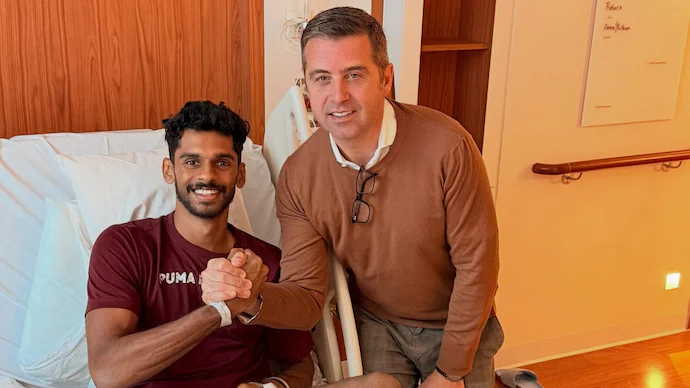
Indian long jumper Murali Sreeshankar has undergone surgery on his right ankle following an injury at the Asian Games in Japan, adding another rehabilitation period to his career as he targets a return to international competition in 2027. The Commonwealth Games silver medallist is now focusing on regaining full fitness ahead of the 2027 World Athletics Championships in Beijing and the Los Angeles Olympics in 2028.
The 27-year-old underwent minor ligament reconstruction surgery at Fortius Clinic in London on October 13 under the supervision of Dr Pieter D’Hooghe. The procedure followed an injury sustained during the men’s long jump event at the Asian Games on September 28, when Sreeshankar slipped on the rain-soaked take-off board during his fourth attempt and twisted his right ankle.
Despite the injury, Sreeshankar managed to secure the silver medal with a jump of 8.07 metres in his second attempt. However, the ankle problem forced him to withdraw from his final two attempts, raising concerns about his recovery and preparations for the upcoming season.
After further medical consultations and investigations, surgery was deemed necessary to stabilise the ankle. Sreeshankar has now set his sights on returning stronger, with the major international championships in 2027 and 2028 serving as his primary targets.
Why Murali Sreeshankar Needed Ankle Surgery After Asian Games Injury
Sreeshankar’s latest injury occurred during the Asian Games on September 28. Competing in the men’s long jump event, the Indian athlete slipped on the wet take-off board during his fourth attempt, twisting his right ankle and damaging the ligaments.
The incident came at a crucial stage of the competition. Although he had already produced a second-round jump of 8.07 metres that earned him the silver medal, the injury prevented him from completing his remaining attempts.
Initially, there had been hope that rest and rehabilitation would be enough to manage the problem. However, subsequent consultations and medical investigations indicated that surgery would be required to ensure the ankle regained the necessary stability.
In a social media post, Sreeshankar explained the reasoning behind the decision and outlined his long-term ambitions.
“Courtesy of the slip off the takeoff board during the Asian Games, I injured my ligaments. After further consultations and investigations, surgery was deemed necessary to ensure that my ankle is stable and ready for the upcoming season, with the World Championships 2027 in Beijing and, most importantly, LA 2028,” he wrote.
The operation was performed at Fortius Clinic in London on October 13 under the supervision of Dr Pieter D’Hooghe. The immediate objective is to restore stability to the injured ankle and allow Sreeshankar to progress through rehabilitation before returning to the demands of elite long jump competition.
For an athlete whose event depends on explosive acceleration, powerful take-offs and controlled landings, ankle stability is particularly important. Sreeshankar’s rehabilitation will therefore be a crucial stage in his preparations for his next competitive season.
Another Comeback Begins for the Indian Long Jumper
The ankle surgery represents another challenge for Sreeshankar, who only returned to competitive action in 2025 after undergoing left knee surgery in April 2024. That earlier operation forced him to miss the Paris Olympics, interrupting his preparations for one of the biggest competitions of his career.
His return to competition in 2025 marked an important step in rebuilding his fitness and getting back to international athletics. The silver medal at the 2026 Commonwealth Games, followed by another silver at the Asian Games, demonstrated that he had continued to compete at a high level despite his previous injury setback.
However, the latest ankle problem means the long jumper must once again concentrate on recovery rather than immediately pursuing further competition.
Sreeshankar has acknowledged that repeated injuries can be difficult to understand and accept. Nevertheless, he has made it clear that he does not intend to spend his energy searching for explanations that cannot change the situation.
“Some of you might be wondering why this guy keeps getting injured again and again. Tbh (to be honest), I don’t have an answer to that. I could simply blame it on the wet takeoff board or perhaps my fate, but neither is going to help me. I’d rather accept what has happened and keep working towards becoming the best version of myself,” he said.
His comments reflect a determination to approach the latest setback with patience and a focus on the future. Rather than allowing frustration over repeated injuries to dominate his preparations, Sreeshankar is concentrating on completing rehabilitation and returning to the sport.
Sreeshankar Draws Inspiration From Kobe Bryant’s Mamba Mentality
Despite facing another period away from competition, Sreeshankar remains confident in his ability to make a successful comeback. The Indian athlete has drawn inspiration from basketball legend Kobe Bryant, whose competitive mentality and determination have become widely associated with perseverance in elite sport.
For Sreeshankar, that mindset offers a way to approach the challenges of rehabilitation. Recovering from an injury requires consistency, patience and a willingness to continue working towards long-term goals even when immediate progress is difficult to see.
He expressed his belief that the same determination would help him overcome the latest setback.
“But one thing I know for sure is that I have that extra comeback gene and the Mamba Mentality in me. That will do the job,” he added.
The reference to Bryant’s mentality underlines Sreeshankar’s intention to remain focused on his ambitions. While his recovery timeline will depend on his rehabilitation, the athlete has made clear that he wants to return to competition rather than allow another injury to define his career.
His immediate challenge is to translate that determination into a carefully managed recovery programme, with the goal of regaining the fitness and confidence needed to compete at the highest level.
2027 World Athletics Championships in Beijing the Next Major Target
The 2027 World Athletics Championships in Beijing have emerged as a key target for Sreeshankar as he plans his return to international competition. The championships would provide an opportunity for the Indian long jumper to compete against the world’s leading athletes after another period of rehabilitation.
Beyond the 2027 season, the Los Angeles Olympics in 2028 remain his most important long-term objective. Sreeshankar specifically identified the Olympic Games as a major priority when explaining why he and his medical team decided that surgery was necessary.
His return to competition will depend on how effectively he recovers from the ankle procedure and when he can safely resume full training. The surgery is intended to improve the stability of the injured ankle, but the process of returning to competitive long jump will require time and careful management.
The latest injury comes after Sreeshankar had worked his way back from the left knee operation that ruled him out of the Paris Olympics. His performances in 2025 and 2026 had marked progress in that comeback, making the Asian Games injury another frustrating interruption.
Nevertheless, his stated goals remain unchanged. The focus is now on preparing for the 2027 World Championships and building towards the Los Angeles Olympics, rather than rushing back before he is ready.
Silver Medals at the Commonwealth Games and Asian Games Highlight His Return
Sreeshankar’s recent achievements provide important context for his determination to return. After missing the Paris Olympics because of his left knee surgery in April 2024, he rebuilt his fitness and resumed competition in 2025.
He subsequently won a silver medal at the 2026 Commonwealth Games and added another silver at the Asian Games. His jump of 8.07 metres in the second round of the Asian Games long jump final was enough to secure a place on the podium despite the injury that followed.
The result demonstrated that he remained capable of producing a significant performance at a major competition. However, the circumstances of the final also highlighted how quickly an injury can disrupt an athlete’s plans.
Having been forced to withdraw from his final two attempts in Japan, Sreeshankar must now turn his attention to rehabilitation. His next objective is to regain the stability and fitness required to build on the progress he made after his previous knee operation.
The medals from the Commonwealth Games and Asian Games provide encouragement as he begins another comeback, although his return to major competition will depend on the progress of his recovery.
Father and Coach S Murali Supports the Decision to Operate
Sreeshankar’s father and coach, S Murali, was involved in the decision-making process following further medical consultations. The family ultimately opted for surgery after it became clear that additional treatment was needed to prepare the athlete’s ankle for the demands of the upcoming season.
The decision reflects the importance of addressing the underlying ligament damage rather than relying solely on rest and rehabilitation. For a long jumper, the ankle must withstand the forces generated during the approach, take-off and landing phases, making stability an essential component of competitive readiness.
Sreeshankar will now have to work through the recovery process before returning to full training. The timing of his comeback will depend on his progress, with the 2027 World Championships and the 2028 Olympics providing longer-term goals.
The athlete also thanked the Sports Authority of India and the Athletics Federation of India, among others, for helping him access specialist medical care.
His appreciation highlights the support available to him as he begins another rehabilitation period. The immediate priority remains recovering from the surgery and ensuring that his ankle is ready for the physical demands of elite competition.
What Sreeshankar’s Injury Means for His 2027 Comeback
Sreeshankar’s ankle surgery means that his preparations will now centre on recovery and rebuilding his fitness. Although the 2027 World Championships remain a major target, his return to competition will depend on the rehabilitation process rather than a fixed timetable.
The fact that surgery was recommended after further consultations suggests that restoring ankle stability was considered necessary before he could safely prepare for the upcoming season. His previous experience of recovering from left knee surgery may provide perspective as he navigates another lengthy rehabilitation process, although the two injuries affect different parts of the body.
For now, there is no confirmed date for his return to competition in the supplied announcement. The key milestones will be his progress after surgery, the restoration of ankle stability and his eventual return to full training.
Sreeshankar has nevertheless made his intentions clear. He wants to return to the international stage and compete for major medals again, with Beijing 2027 and Los Angeles 2028 at the centre of his plans.
“And yeah, here we go again!! Comeback 2.0, to chase down another set of major medals!!” he wrote.
The message captures the attitude with which he is approaching the latest challenge. After missing the Paris Olympics and rebuilding his career, Sreeshankar now faces another test of patience and determination.
Frequently Asked Questions
Why did Murali Sreeshankar undergo ankle surgery?
Sreeshankar underwent minor ligament reconstruction surgery on his right ankle after slipping on the rain-soaked take-off board during the Asian Games on September 28. Further medical consultations and investigations led to the decision to operate to restore ankle stability.
When did Murali Sreeshankar undergo surgery?
The Indian long jumper underwent surgery on October 13 at Fortius Clinic in London under the supervision of Dr Pieter D’Hooghe.
When is Sreeshankar expected to return to competition?
Sreeshankar is targeting a return during the 2027 season. The supplied announcement does not specify an exact competition or return date, as his timeline will depend on his recovery and rehabilitation.
Which major competitions is Murali Sreeshankar targeting?
His main targets are the 2027 World Athletics Championships in Beijing and the 2028 Los Angeles Olympics.
What medal did Sreeshankar win at the Asian Games?
Sreeshankar won silver in the men’s long jump with a second-round effort of 8.07 metres. He later withdrew from his final two attempts because of his right ankle injury.
What injury previously forced Sreeshankar to miss the Paris Olympics?
Sreeshankar underwent left knee surgery in April 2024, which ruled him out of the Paris Olympics. He returned to competitive action in 2025 before winning silver medals at the 2026 Commonwealth Games and Asian Games.
Conclusion
Murali Sreeshankar has undergone minor ligament reconstruction surgery on his right ankle after sustaining an injury during the Asian Games, forcing him to begin another rehabilitation journey. The 27-year-old had initially hoped that rest and recovery would be sufficient, but further medical investigations led to the decision to operate.
Despite the setback, Sreeshankar remains determined to return to competition in 2027, with the World Athletics Championships in Beijing and the Los Angeles Olympics in 2028 serving as his major objectives. His recent silver medals at the Commonwealth Games and Asian Games provide encouragement as he works towards another comeback.
For now, the focus is on restoring ankle stability, completing rehabilitation and returning to full training when ready. As Sreeshankar begins what he calls “Comeback 2.0”, his ability to recover carefully and rebuild his competitive fitness will be crucial to his pursuit of further international medals.
For breaking news and live news updates, like us on Facebook or follow us on Twitter and Instagram. Read more on Latest Sports on thefoxdaily.com.





COMMENTS 0