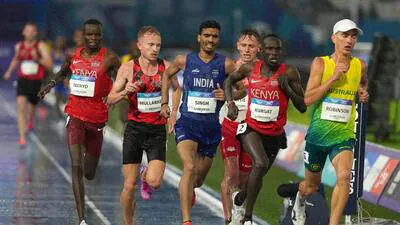
Gulveer Singh Commonwealth Games 2026 silver medal is more than just another podium finish for India—it marks a historic breakthrough in one of athletics’ toughest events. Battling relentless rain, strong winds, and a field stacked with elite runners from Kenya, Uganda, Australia, and England, the Indian distance runner delivered a perfectly timed race to secure silver in the men’s 10,000m at the Commonwealth Games in Glasgow.
The achievement is historic because no Indian athlete had previously won a medal in the men’s 10,000m at the Commonwealth Games. Gulveer’s performance not only rewrites India’s athletics record books but also signals the country’s growing strength in endurance running, a discipline traditionally dominated by East African nations.
The race also highlighted the evolution of Indian Athletics, where scientific training, international exposure, disciplined race strategy, and mental toughness are increasingly helping athletes compete with the world’s best.
Gulveer Singh Makes Commonwealth Games History
Gulveer Singh entered the 2026 Commonwealth Games as India’s leading distance runner, carrying the confidence of multiple national records and consistent performances over the past few seasons. Yet even with those credentials, few expected him to challenge a field featuring internationally established athletes from distance-running powerhouses.
Instead of being intimidated, Gulveer executed a patient tactical race before unleashing an explosive finishing sprint over the final lap to secure silver with a timing of 27:49.78.
Australia’s Ky Robinson claimed gold in 27:48.93, while David Mullarkey secured bronze after another dramatic sprint finish.
For Indian athletics, the silver medal represents a watershed moment. It demonstrates that Indian distance runners can now compete for medals against nations that have historically dominated global long-distance events.
Race Results at a Glance
| Position | Athlete | Country | Time |
|---|---|---|---|
| Gold | Ky Robinson | Australia | 27:48.93 |
| Silver | Gulveer Singh | India | 27:49.78 |
| Bronze | David Mullarkey | Isle of Man | 27:50.28 |
How Gulveer Singh Won Silver Through Tactical Perfection
Unlike shorter track races that often demand aggressive early speed, championship 10,000m races are won through patience, positioning, and timing.
Gulveer understood this perfectly.
For much of the 25-lap contest, he remained within touching distance of the leaders without wasting unnecessary energy. While several competitors jostled for position, he focused on maintaining rhythm and conserving strength for the decisive final kilometers.
Even after briefly slipping down the order around the halfway stage, Gulveer never allowed a significant gap to develop. Instead, he gradually worked his way back into contention while staying composed despite the slippery conditions.
The decisive move came inside the final kilometer. As the pace increased, Gulveer accelerated with remarkable confidence, overtaking several highly accomplished runners and moving into medal position.
His final-lap acceleration nearly brought him level with race leader Ky Robinson, creating one of the most exciting finishes of the athletics programme.
Weather Added Another Layer of Difficulty
The Glasgow weather turned the race into an even greater test of endurance and concentration.
Continuous rainfall made the track slippery, while strong winds forced athletes to constantly adjust their pacing and positioning.
Distance runners often prefer cooler temperatures over extreme heat, but persistent rain creates its own challenges by reducing traction and increasing fatigue.
Maintaining balance, conserving energy, and choosing the right moment to attack become even more important under such conditions.
Gulveer adapted exceptionally well, proving that elite racing is as much about decision-making as physical fitness.
The Sprint That Changed Indian Athletics
One of the defining moments of the race came during the final 400 metres.
Gulveer covered the closing lap in approximately 56.5 seconds, an astonishing pace after nearly 10 kilometres of racing.
His explosive finishing speed allowed him to surge past several internationally accomplished runners, including athletes with strong championship credentials.
Such finishing ability is rarely associated with Indian distance runners, making the performance even more significant.
It reflected months of specialized speed endurance training designed specifically for championship racing rather than simply running fast times.
The Influence of International Training
Modern distance running increasingly relies on scientific coaching, altitude conditioning, biomechanics, and carefully planned race preparation.
Gulveer’s training stint in Colorado Springs, USA, played a vital role in developing these qualities.
Training at altitude helps athletes improve aerobic capacity by encouraging physiological adaptations that enhance oxygen delivery during competition.
Equally valuable was the opportunity to train alongside elite international runners, allowing Gulveer to experience the intensity and professionalism required at the highest level.
That exposure translated directly into the confidence he displayed during the Commonwealth Games final.
Army Discipline Helped Shape a Champion
Before becoming one of India’s leading distance runners, Gulveer Singh served in the Indian Army as a Naib Subedar.
Military life demands discipline, resilience, adaptability, and mental toughness—qualities that become invaluable in endurance sports.
Whether serving in freezing mountain conditions or intense desert heat, those experiences helped prepare him for the physical and psychological demands of international competition.
Long-distance running rewards athletes who remain calm under pressure, manage discomfort, and stay committed to their race plan. Gulveer demonstrated all of those characteristics in Glasgow.
Why This Silver Medal Matters Beyond One Race
The significance of Gulveer’s medal extends far beyond the Commonwealth Games podium.
For decades, India’s greatest athletics successes largely came in field events, race walking, javelin, shooting, wrestling, boxing, and badminton. Long-distance track running remained an area where medals at major global competitions were exceptionally rare.
Gulveer’s breakthrough challenges that perception.
It shows that with improved coaching, sports science, nutrition, and international competition exposure, Indian endurance athletes can realistically compete against the world’s strongest runners.
Comparison With Avinash Sable’s Historic Achievement
Indian athletics has witnessed several landmark performances in recent years, and Gulveer’s silver naturally draws comparisons with Avinash Sable’s memorable Commonwealth Games medal in the 3000m steeplechase.
Both athletes achieved something previously considered extremely difficult—breaking the long-standing dominance of traditional distance-running nations.
While Sable inspired a new generation in steeplechase, Gulveer’s success could have a similar impact on the 5,000m and 10,000m disciplines.
Together, these performances suggest that Indian distance running is entering its strongest phase in history.
The Science Behind Championship Racing
Winning championship medals requires a different skill set than simply posting fast personal bests.
Elite runners must master several components simultaneously:
- Efficient energy conservation.
- Maintaining ideal positioning within the pack.
- Responding to sudden pace changes.
- Executing a powerful finishing sprint.
- Remaining mentally composed under pressure.
- Adjusting tactics according to weather conditions.
Gulveer excelled in every one of these areas during the Commonwealth Games final.
Indian Athletics Is Experiencing a Transformation
Over the last decade, India’s athletics ecosystem has improved dramatically through greater investment in coaching, sports science, overseas exposure, nutrition, recovery, and athlete development.
Distance running, once considered India’s weakest track discipline internationally, is gradually becoming increasingly competitive.
The emergence of athletes like Gulveer Singh reflects this broader transformation rather than an isolated success.
Young runners now have stronger domestic competitions, improved training facilities, and better access to international coaching methods than previous generations.
What Comes Next for Gulveer Singh?
The Commonwealth Games campaign is far from over.
Following his historic silver medal, Gulveer will shift his focus to the men’s 5,000m event, where another strong performance could further elevate his status among the world’s leading distance runners.
Looking beyond Glasgow, his continued progress could make him one of India’s biggest medal hopes at future global championships and multi-sport events.
Maintaining consistency against the world’s elite will remain challenging, but this breakthrough has demonstrated that he possesses both the physical ability and tactical maturity required at the highest level.
Future Outlook: A Turning Point for Indian Distance Running?
Historic sporting achievements often inspire the next generation more than statistics ever can.
Young athletes watching Gulveer challenge—and beat—world-class competitors may now view distance running as a realistic pathway to international success.
If India continues investing in endurance programs, altitude training opportunities, coaching expertise, and grassroots talent identification, performances like this could become increasingly common rather than exceptional.
That possibility may ultimately become Gulveer Singh’s greatest legacy.
Conclusion
Gulveer Singh’s Commonwealth Games 2026 silver medal represents one of the finest achievements in Indian athletics history. His patient tactics, exceptional endurance, fearless racing, and devastating finishing sprint combined to deliver India’s first-ever men’s 10,000m medal at the Commonwealth Games.
Beyond rewriting the record books, the performance symbolizes the remarkable progress Indian distance running has made in recent years. It proves that Indian athletes can now compete toe-to-toe with the world’s strongest endurance runners when equipped with world-class preparation, scientific training, and unwavering belief.
As Gulveer prepares for future competitions, his historic run in Glasgow will be remembered not only as a silver medal-winning performance but also as a defining moment in the evolution of Indian athletics.
For breaking news and live news updates, like us on Facebook or follow us on Twitter and Instagram. Read more on Latest Sports on thefoxdaily.com.






COMMENTS 0