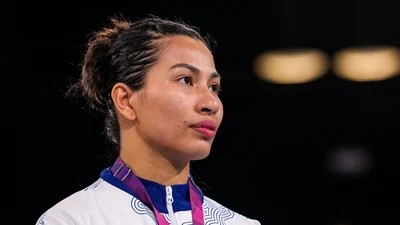
India’s successful campaign at the Commonwealth Games 2026 ended with celebrations, but one post-event incident quickly became a major talking point. Olympic bronze medallist and Commonwealth Games silver medallist Lovlina Borgohain publicly highlighted an inaccurate depiction of India’s map at a Glasgow restaurant where members of the Indian boxing contingent had gathered for dinner.
The issue drew significant attention because the logo displayed by the restaurant omitted India’s North-Eastern region. Lovlina, who hails from Assam, explained that seeing the incorrect representation was personally hurtful and requested that it be corrected. Within hours, the restaurant issued a public apology, promised to redesign its logo, and later removed its Instagram account, further fueling online discussion.
What Happened at the Glasgow Restaurant?
Following India’s impressive boxing campaign at the Commonwealth Games, members of the national team visited Mister Singh’s India, a well-known Indian restaurant in Glasgow, for a celebratory meal.
During the visit, Lovlina noticed that the restaurant’s branding—including its napkins and exterior signage—featured a map of India that did not include the North-Eastern states. She recorded a video explaining why the omission was significant and urged the establishment to update its branding.
Rather than creating confrontation, Lovlina addressed the matter respectfully, emphasizing that her intention was simply to ensure greater awareness and accuracy.
Why the Missing North-East Matters
The North-Eastern region is an integral part of India and consists of eight states:
- Arunachal Pradesh
- Assam
- Manipur
- Meghalaya
- Mizoram
- Nagaland
- Sikkim
- Tripura
For millions of Indians, particularly those from the North-East, incorrect representations of the country’s map are more than simple design mistakes. They can create feelings of exclusion and misrepresentation, especially when displayed publicly by businesses or organizations.
Lovlina’s reaction reflected this sentiment. Coming from Assam, she explained that seeing her region missing from India’s map was emotionally painful and hoped similar mistakes would be avoided in the future.
Restaurant Responds with Public Apology
After the video gained widespread attention online, the restaurant issued a public statement acknowledging the error.
The management apologized for displaying an incorrect map, clarified that there had been no intention to offend anyone, and announced that the logo would be redesigned using the correct map of India. The statement also expressed pride in serving the Indian boxing team following their remarkable Commonwealth Games performances.
Soon after publishing the clarification, however, the restaurant’s Instagram account became unavailable, attracting additional attention on social media.
Boxing Federation of India Confirms Peaceful Resolution
Boxing Federation of India President Ajay Singh later confirmed that there was no confrontation between the Indian delegation and the restaurant.
According to him, the issue was calmly pointed out by Lovlina and himself. The restaurant acknowledged the mistake immediately and assured the delegation that corrective action would be taken.
This measured approach prevented the matter from escalating into a larger dispute while still ensuring that the concern received appropriate attention.
Lovlina Borgohain’s Message Resonated Beyond Sports
Although Lovlina had just completed another successful international tournament by winning a Commonwealth Games silver medal, her comments extended beyond boxing.
Her message highlighted how athletes often become ambassadors for their countries outside the sporting arena. Their actions, observations and public statements can influence conversations on identity, representation and respect.
Many observers noted that Lovlina chose a constructive tone. Instead of demanding punitive action, she simply explained why the map mattered and encouraged the restaurant to make the necessary correction.
India’s North-East Continues to Shape Indian Sports
The incident also renewed focus on the enormous contribution of North-Eastern athletes to Indian sports.
Over the past two decades, the region has consistently produced world-class competitors across multiple disciplines, including boxing, weightlifting, football, athletics, archery and martial arts.
| Sport | Notable Athletes from North-East India | Major Achievements |
|---|---|---|
| Boxing | Lovlina Borgohain, MC Mary Kom | Olympic and World Championship medals |
| Weightlifting | Mirabai Chanu | Olympic silver, Commonwealth Games champion |
| Football | Numerous Indian internationals | National team representation |
| Athletics | Multiple international competitors | Asian and Commonwealth participation |
The achievements of athletes from the region have significantly strengthened India’s international sporting reputation, making accurate representation even more meaningful.
India’s Historic Boxing Campaign at Commonwealth Games 2026
The controversy emerged during what was otherwise a memorable tournament for Indian boxing.
India finished the Commonwealth Games boxing competition with an outstanding haul of 10 medals, including seven gold and three silver, making it one of the country’s strongest performances at the Games.
Lovlina added another major medal to her distinguished international career by securing silver after reaching the final of her weight category.
The team’s achievements reinforced India’s position as one of the leading boxing nations within the Commonwealth.
Why Accurate Maps Matter in International Business
Businesses operating internationally frequently serve customers from diverse cultural and national backgrounds. Visual branding, including maps and national symbols, carries significant meaning and should be designed carefully.
Even when mistakes are unintentional, inaccurate depictions can create misunderstanding and damage trust among customers. Many international companies now review their branding through legal, cultural and geographic experts before launching campaigns or products.
This incident serves as a reminder that attention to detail extends beyond food, hospitality or customer service—it also includes respecting national identities.
Social Media’s Role in Driving Accountability
Without social media, the incorrect logo may have remained unnoticed for years. Instead, a short video recorded by an internationally recognized athlete rapidly reached audiences across multiple countries.
The speed with which the restaurant acknowledged the issue demonstrates how digital platforms now influence corporate responses. Public concerns can spread globally within hours, encouraging businesses to respond more transparensively and quickly than ever before.
For organizations, the lesson is clear: proactive correction often earns greater public respect than ignoring criticism.
A Constructive Example of Raising Concerns
One notable aspect of this episode was the respectful manner in which it unfolded.
Lovlina expressed her disappointment without hostility, while the restaurant accepted responsibility instead of denying the issue. The Boxing Federation of India also clarified that discussions remained cordial throughout.
This approach demonstrates that cultural concerns can often be resolved effectively through dialogue rather than conflict.
Lessons for Global Brands and Cultural Institutions
The Glasgow restaurant episode highlights several broader lessons that extend well beyond one establishment.
- Verify geographic and national symbols before using them commercially.
- Consult reliable references when creating logos involving countries.
- Respond promptly and transparently if genuine mistakes are identified.
- Recognize that cultural representation carries emotional significance for communities.
- Treat customer feedback as an opportunity to improve rather than a public relations challenge.
As international travel, sporting events and cultural exchanges continue to increase, businesses will likely face greater expectations regarding accuracy and inclusivity.
Could This Incident Influence Future International Events?
Major sporting competitions bring together athletes, officials and supporters from every corner of the world. Host cities, restaurants, hotels and local businesses increasingly become part of that international experience.
This incident may encourage businesses associated with future global tournaments to conduct more thorough reviews of their branding, promotional materials and visual identity before welcoming international delegations.
Such preventive measures can help avoid unintended controversies while creating a more inclusive environment for visiting athletes.
Conclusion
The discussion surrounding the incorrect map at a Glasgow restaurant became far more than a branding issue. It highlighted the importance of accurate representation, cultural awareness and respectful communication in an increasingly connected world.
Lovlina Borgohain’s calm yet firm response ensured that an important concern received attention without unnecessary confrontation. The restaurant’s apology and commitment to redesign its logo demonstrated how constructive dialogue can lead to positive action.
While India’s remarkable boxing achievements remained the defining sporting story of the Commonwealth Games 2026, this episode also underscored another important lesson: symbols matter. Accurate representation of national identity is not merely a design choice—it reflects respect, inclusion and understanding, values that are just as important off the field as excellence is on it.
For breaking news and live news updates, like us on Facebook or follow us on Twitter and Instagram. Read more on Latest Sports on thefoxdaily.com.





COMMENTS 0