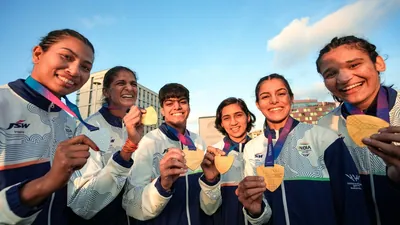
India wrapped up its Commonwealth Games 2026 campaign in Glasgow with a total of 39 medals (13 gold, 17 silver and 9 bronze). Although the tally fell below the 50-medal mark achieved in every edition since 2002, the overall performance cannot be judged purely by numbers.
The Glasgow Games featured a significantly reduced sports programme, with several medal-rich disciplines removed from the schedule. Despite those limitations, Indian athletes produced some of the nation’s finest performances in Commonwealth Games history. Historic achievements in boxing, para sports, judo and athletics proved that the quality of India’s medals outweighed the quantity.
More importantly, the Games introduced a new generation of champions while reinforcing India’s emergence as one of the Commonwealth’s strongest sporting nations across multiple disciplines.
India’s Commonwealth Games 2026 Medal Tally
| Medal | Total |
|---|---|
| Gold | 13 |
| Silver | 17 |
| Bronze | 9 |
| Total | 39 |
While the overall medal count was lower than previous editions, the campaign featured several historic firsts that may prove even more significant for Indian sport in the long run.
Why 39 Medals Tell Only Half the Story
Comparisons with previous Commonwealth Games can be misleading because the Glasgow edition featured fewer sporting events after major programme changes.
Traditional Indian strengths such as wrestling and shooting were absent, automatically reducing medal opportunities. As a result, India’s athletes had fewer chances to compete compared to previous Games.
Against that backdrop, finishing with 39 medals represents a highly competitive performance rather than a disappointing one.
Boxing Delivered India’s Greatest Commonwealth Games Success
The standout story of India’s campaign came inside the boxing ring.
Indian boxers rewrote Commonwealth Games history by winning seven gold medals and three silver medals, making it the most successful boxing campaign by any country in the history of the Games.
The women’s team led the charge with five gold medals, while the men’s squad added two more titles to complete a truly historic performance.
| Boxing Achievement | Result |
|---|---|
| Gold Medals | 7 |
| Silver Medals | 3 |
| Total Boxing Medals | 10 |
| Historic Record | Best boxing performance by any nation at a Commonwealth Games |
Weightlifting Began India’s Medal Rush
India’s campaign started strongly in weightlifting, with experienced lifters once again delivering consistent results.
The team collected eight medals, including one gold, six silver and one bronze.
Leading the way was Olympic champion Mirabai Chanu, who created history by winning her third consecutive Commonwealth Games gold medal, further cementing her legacy as one of India’s greatest weightlifters.
Para Athletes Produced a Landmark Performance
Perhaps the most inspiring chapter of India’s Glasgow campaign came from its para athletes.
The 28-member para contingent returned with seven medals, including three gold, two silver and two bronze.
Remarkably, the team matched India’s cumulative para medal tally from all previous Commonwealth Games editions while improving the overall quality of those medals.
Gold medals from athletes such as Sharmila Dhankar, Dilip Mahadu Gavit and Soman Rana highlighted the growing depth of Indian para sports.
Judo Reached New Heights
Indian judo enjoyed its finest Commonwealth Games campaign ever.
Harsh Singh and Asmita Dey became India’s first-ever Commonwealth Games judo gold medallists, creating history for the sport.
Additional medals from Yamini Mourya and Unnati Sharma ensured India recorded its best-ever performance in Commonwealth Games judo.
Athletics Continued Its Steady Progress
Indian athletics contributed ten medals to the overall tally and witnessed several memorable milestones.
- Tejaswin Shankar became India’s first Commonwealth Games decathlon medallist.
- Gulveer Singh became the first Indian athlete to win two athletics medals at a single Commonwealth Games.
- Neeraj Chopra returned to the Commonwealth Games podium with a silver medal in javelin.
These achievements underline India’s improving competitiveness across multiple athletics disciplines.
Key Historic Achievements
| Achievement | Historic Significance |
|---|---|
| Boxing | Best performance by any nation in CWG history |
| Para Sports | India’s highest-quality para campaign |
| Judo | First-ever Indian CWG gold medals |
| Decathlon | India’s first CWG medal in the event |
| Gulveer Singh | First Indian to win two athletics medals at one CWG |
What Happened on the Final Day?
India entered the final day hoping to increase its medal tally through judo and cycling.
Judoka Ishroop Narang kept medal hopes alive after winning her repechage contest but narrowly missed out on bronze following a hard-fought defeat in the medal match.
Earlier, Yash Ghangas and Avtar Singh exited in the Round of 16.
In cycling, Ronaldo Singh Laitonjam, Harshveer Singh Sekhon and Dinesh Kumar were unable to secure podium finishes, leaving India’s final medal tally unchanged at 39.
The Rise of New Indian Champions
One of the biggest positives from Glasgow was the emergence of several young athletes capable of leading Indian sport over the next Olympic and Commonwealth cycle.
From boxing and para athletics to judo and track events, India demonstrated impressive depth beyond its established stars.
This transition will be crucial as the nation prepares for major international competitions over the next four years.
Why Quality Was More Important Than Quantity
Although previous Commonwealth Games produced larger medal totals, Glasgow highlighted India’s growing ability to succeed in technically demanding sports rather than relying only on traditional medal-winning disciplines.
Historic breakthroughs in boxing, para sports and judo indicate that India’s sporting ecosystem is becoming more balanced and sustainable.
This diversification may ultimately prove more valuable than simply winning a higher number of medals.
Looking Ahead to Ahmedabad 2030
With India set to host the 2030 Commonwealth Games in Ahmedabad, the Glasgow campaign provides a strong foundation for future success.
Hosting the Games is expected to accelerate investment in sports infrastructure, coaching, talent identification and athlete development across the country.
Many of Glasgow’s medal winners are likely to remain key members of the Indian contingent when the Commonwealth Games return to Indian soil.
Future Outlook
The Commonwealth Games 2026 demonstrated that Indian sport is evolving beyond dependence on a handful of traditional disciplines. The emergence of champions in boxing, para sports, judo and athletics reflects stronger grassroots development and improved high-performance systems across the country.
As preparations begin for future global events, including the Commonwealth Games 2030 in Ahmedabad, India’s focus will likely shift from increasing medal numbers to consistently producing world-class athletes capable of competing at the highest level. Glasgow has shown that India’s sporting future is built not only on established stars but also on an exciting new generation of champions.
Conclusion
India’s 39-medal campaign at the Commonwealth Games 2026 will be remembered less for the final tally and more for the historic milestones achieved along the way. Record-breaking boxing performances, unprecedented success in para sports, landmark achievements in judo and continued progress in athletics highlighted a transformative Games for Indian sport. While the medal count may have been smaller than previous editions, the quality of performances and the emergence of new champions suggest that Indian sport is moving confidently toward an even brighter future.
For breaking news and live news updates, like us on Facebook or follow us on Twitter and Instagram. Read more on Latest Sports on thefoxdaily.com.






COMMENTS 0