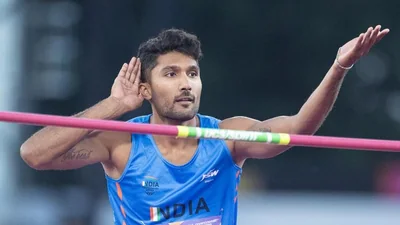
Tejaswin Shankar’s contribution to Sarvesh Kushare’s Commonwealth Games 2026 silver medal is a story that extends far beyond statistics and podium finishes. While Kushare’s historic silver will forever be remembered in India’s athletics record books, the performance also highlighted the power of teamwork, sportsmanship, and the often-overlooked role elite athletes play in helping one another succeed under immense pressure.
On a dramatic evening at Scotstoun Stadium in Glasgow, Kushare became only the second Indian man to win a Commonwealth Games medal in the high jump after clearing 2.25 metres. However, behind that milestone was an inspiring act from Tejaswin Shankar, whose own competition ended almost before it began due to a recurring knee injury.
How Tejaswin Shankar Helped Sarvesh Kushare Create Commonwealth Games History
Entering the competition, Tejaswin Shankar was among India’s strongest medal contenders. Having won bronze at the Birmingham 2022 Commonwealth Games and established himself among the world’s leading high jumpers, expectations were naturally high.
Unfortunately, those hopes disappeared during the warm-up. Shankar experienced severe pain in his patellar tendon, commonly referred to as “jumper’s knee,” a condition that frequently affects elite high jumpers because of the enormous stress placed on the knees during repeated explosive take-offs.
Despite the discomfort, he attempted to continue, hoping the pain would ease once the competition began. After failing his opening attempt, however, he realized his body would not allow him to compete safely and reluctantly withdrew.
Many athletes in such circumstances would have left the stadium immediately. Instead, Shankar chose to remain at the venue and support fellow Indian Sarvesh Kushare during the biggest competition of his career.
The Advice That Changed Kushare’s Competition
As the event entered its decisive phase, Kushare encountered his biggest challenge at 2.25 metres. After comfortably clearing previous heights on his first attempts, his rhythm suddenly disappeared.
His run-up became inconsistent, his stride shortened, and the pressure of a potential Commonwealth Games medal began to build.
Watching closely from the sidelines, Shankar noticed the technical issue almost immediately.
Rather than allowing his own disappointment to take over, he analyzed Kushare’s approach and suggested a simple but vital adjustment—moving slightly forward in his run-up to restore rhythm before take-off.
“During 2.25 metres, my rhythm was affected and my stride became shorter. Tejaswin told me to move forward in my run-up, and that helped,” Kushare explained after securing the silver medal.
The adjustment worked perfectly. Kushare cleared the height on his final attempt, ultimately securing India’s best-ever Commonwealth Games finish in the men’s high jump.
Why Small Technical Changes Matter in High Jump
To casual fans, changing a run-up position by a few centimeters may appear insignificant. In reality, it can completely transform a jump.
The high jump depends on precision. Every stride determines:
- The athlete’s speed before take-off.
- The angle of approach to the bar.
- The timing of the final plant foot.
- The body’s rotational movement while clearing the bar.
- The maximum height generated during flight.
If an athlete begins even slightly too far away or too close to the take-off point, the jump can lose efficiency, making successful clearance extremely difficult.
Shankar’s experience at international competitions enabled him to recognize the problem immediately and provide advice that only another elite high jumper could identify under intense pressure.
Commonwealth Games 2026 Men’s High Jump Final Results
| Position | Athlete | Country | Best Clearance |
|---|---|---|---|
| Gold | Romaine Beckford | Jamaica | 2.25m (won on countback) |
| Silver | Sarvesh Kushare | India | 2.25m |
| Bronze | Kimani Jack | England | 2.20m |
Tejaswin Shankar’s Injury Explained
Following his withdrawal, Shankar revealed that the setback was caused by a flare-up of chronic patellar tendonitis rather than a completely new injury.
Known throughout athletics as “jumper’s knee,” the condition develops from repeated explosive jumping over many years of training and competition.
The injury affects the tendon connecting the kneecap to the shinbone, often causing sharp pain during take-off and landing—two movements that are unavoidable in high jump.
“I felt a shooting pain in my knee during the warm-up. It’s something many high jumpers deal with, but unfortunately it flared up on the day of the competition,” Shankar said.
Although heartbreaking, the injury does not necessarily signal the end of his Commonwealth Games campaign.
Can Tejaswin Still Compete in the Decathlon?
One of the remarkable aspects of Shankar’s determination is his refusal to give up on the Games altogether.
The Indian athlete remains hopeful of competing in the decathlon, despite the demanding nature of the event.
The decathlon consists of ten disciplines spread across two days, including:
- 100 metres
- Long jump
- Shot put
- High jump
- 400 metres
- 110m hurdles
- Discus throw
- Pole vault
- Javelin throw
- 1500 metres
His greatest concern remains the jumping events, where the injured patellar tendon experiences maximum stress.
Nevertheless, Shankar has expressed confidence that if he can successfully navigate those disciplines, he can remain competitive throughout the remainder of the event.
Why Sarvesh Kushare’s Silver Is a Landmark for Indian Athletics
Kushare’s silver medal represents far more than a personal achievement.
For years, Indian athletics has produced success in throwing events, javelin, race walking, and long-distance competitions. High jump, however, has remained one of the country’s most difficult disciplines on the international stage.
The Glasgow result continues India’s steady rise in the event and demonstrates the growing quality of coaching, sports science, and athlete development within the national program.
It also shows the value of experienced athletes mentoring teammates, even during competition.
Comparison: Birmingham 2022 vs Glasgow 2026
| Commonwealth Games | Indian Medalist | Medal | Significance |
|---|---|---|---|
| Birmingham 2022 | Tejaswin Shankar | Bronze | First Indian men’s high jump CWG medal |
| Glasgow 2026 | Sarvesh Kushare | Silver | India’s best-ever Commonwealth Games men’s high jump finish |
The Hidden Value of Leadership in Elite Sport
Elite athletes are often remembered for medals, records, and victories. Yet leadership is frequently displayed away from the podium.
Shankar’s willingness to remain involved despite personal disappointment illustrates the culture successful sporting nations strive to build—where individual setbacks do not prevent collective success.
Such moments rarely appear in official statistics but can influence the outcome of major competitions.
For younger Indian athletes, the episode serves as a powerful reminder that leadership is measured not only by winning medals but also by helping teammates perform when it matters most.
What This Means for Indian High Jump Ahead of Future Championships
With Kushare reaching new heights and Shankar expected to recover, India now possesses two internationally competitive high jumpers capable of challenging for medals at upcoming Asian Championships, Asian Games, World Championships, and future Commonwealth Games.
The healthy rivalry between the pair could push both athletes to achieve even greater heights while strengthening India’s presence in a discipline traditionally dominated by European, Caribbean, and African nations.
Conclusion
Tejaswin Shankar’s role in Sarvesh Kushare’s Commonwealth Games 2026 silver medal proves that sporting greatness is not always measured by medals alone. Forced out of the competition by injury, Shankar could easily have focused on his own disappointment. Instead, he stayed, observed, advised, and ultimately helped a teammate achieve a historic result for India.
For Kushare, the silver medal marked the biggest achievement of his career. For Indian athletics, it represented another breakthrough in the men’s high jump. And for Tejaswin Shankar, it reinforced an enduring lesson in elite sport: sometimes the greatest contribution an athlete makes comes not through personal victory, but by helping someone else reach the podium.
For breaking news and live news updates, like us on Facebook or follow us on Twitter and Instagram. Read more on Latest Sports on thefoxdaily.com.






COMMENTS 0