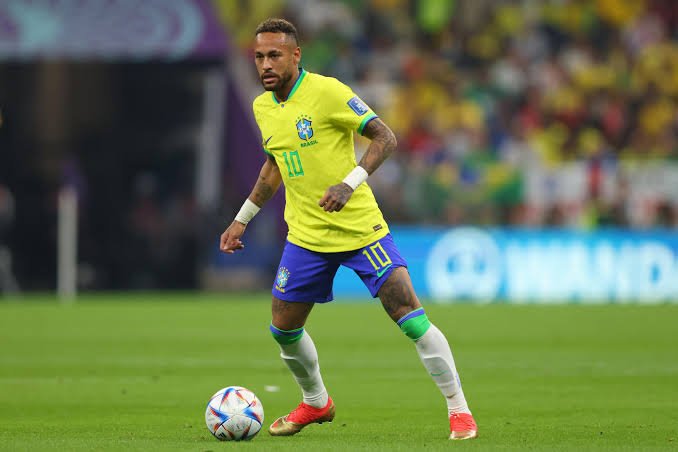
Few selections in international football generate as much discussion as Neymar’s inclusion in Brazil’s FIFA World Cup squad. The Santos forward has been the face of the Selecao for more than a decade, but his call-up for the 2026 tournament has divided fans, pundits, and former players.
At the center of the debate is a simple question: should a player recovering from injury occupy one of the most valuable spots in a World Cup squad?
Former Brazil midfielder and 2002 World Cup winner Vampeta believes the answer is no.
His criticism of Neymar’s selection reflects broader concerns about balancing loyalty to iconic players with the practical demands of winning football’s biggest prize.
Why Neymar’s World Cup Selection Has Become So Controversial
Neymar was included in Carlo Ancelotti’s 26-man Brazil squad despite suffering a calf injury in May that has kept him out of competitive action.
Early reports suggest the forward could miss Brazil’s entire group-stage campaign and may not return until the knockout rounds, assuming the team progresses.
That uncertainty has fueled criticism from former players and supporters who believe fully fit alternatives deserved an opportunity.
Vampeta expressed concern that selecting an injured player effectively denied another footballer the chance to realize a lifelong dream.
“It took the dream away from another player.”
His comments highlight a recurring dilemma in international football: should teams prioritize proven stars even when their fitness is uncertain?
The Emotional Value of Neymar vs. The Practical Reality
Few players in modern football have carried the expectations of an entire nation like Neymar.
Since making his Brazil debut in 2010, he has become one of the country’s most influential players, combining creativity, goalscoring ability, and commercial appeal.
His résumé includes appearances at three previous FIFA World Cups and a central role in Brazil’s international campaigns for more than a decade.
However, injuries have increasingly defined the latter stages of his career.
Major tournaments have repeatedly been interrupted by physical setbacks, raising questions about whether Brazil can continue building their plans around him.
The challenge for Ancelotti is determining whether Neymar’s potential impact in the knockout stages outweighs the risk of carrying a player who may not be fully fit.
Carlo Ancelotti’s Calculated Gamble
Selecting injured players for major tournaments is not uncommon.
National team coaches often believe that an experienced star returning late in the competition can make a decisive difference.
For Ancelotti, the decision likely involves more than Neymar’s on-field contributions.
- His leadership within the squad.
- His experience in high-pressure matches.
- His ability to influence opponents tactically.
- His connection with teammates and supporters.
Even when unavailable, elite players can shape a team’s mentality and confidence.
Yet the risks are equally significant.
If Neymar suffers a setback or fails to regain match fitness, Brazil may find themselves effectively operating with a reduced squad.
Vampeta’s Criticism Reflects a Growing Concern
Vampeta’s comments resonated because they addressed concerns many supporters already share.
Modern World Cups are shorter, faster, and more physically demanding than ever before.
Teams cannot afford passengers, regardless of reputation.
The former midfielder argued that recovering from a grade-two calf injury involves more than simply leaving the treatment room.
Returning to competition requires a carefully managed transition that includes:
- Rebuilding match fitness.
- Regaining confidence in movement.
- Restoring sharpness and timing.
- Adjusting to the intensity of elite competition.
These concerns become even more relevant during a World Cup, where every match carries enormous pressure.
Neymar’s Injury History: A Persistent Challenge
Injuries have become a recurring obstacle throughout Neymar’s career.
Several major tournaments have been disrupted by fitness issues, preventing him from consistently performing at his peak on football’s biggest stage.
| Tournament | Issue | Impact |
|---|---|---|
| 2014 FIFA World Cup | Back injury | Missed final stages |
| 2018 FIFA World Cup | Recovery from foot injury | Limited preparation |
| 2022 FIFA World Cup | Ankle injury | Missed group-stage matches |
| 2026 FIFA World Cup | Calf injury | Availability uncertain |
This pattern has contributed to growing concerns over whether Brazil’s long-term success should depend so heavily on one player.
Can Brazil Succeed Without Neymar?
One reason Ancelotti may feel comfortable taking a calculated risk is Brazil’s squad depth.
The Selecao possess one of the most talented attacking groups in international football.
Even without Neymar, Brazil can rely on a blend of youth and experience across the pitch.
The opening draw against Morocco demonstrated that the team still needs time to adapt to Ancelotti’s methods, but it also highlighted the quality available throughout the squad.
The challenge now is finding the right balance between individual brilliance and collective cohesion.
Brazil’s recent history suggests that teams overly dependent on a single star often struggle when adversity strikes.
What Brazil Need Against Haiti
After opening their campaign with a disappointing draw against Morocco, Brazil enter their second group-stage match under pressure.
Facing Haiti presents an opportunity to regain momentum and strengthen their position in the group.
Although Brazil have historically dominated this fixture, World Cup matches rarely follow expectations.
Haiti’s narrow defeat in their opening match demonstrated that they are capable of frustrating more established opponents.
For Brazil, three priorities stand out:
- Improve finishing efficiency.
- Increase attacking fluidity.
- Build confidence ahead of the knockout rounds.
Whether Neymar returns later in the tournament or not, Brazil must prove they can function effectively without relying exclusively on their most recognizable star.
The Bigger Question: Legacy or Merit?
Neymar’s inclusion raises a broader issue that every major football nation eventually faces.
How long should legendary players remain central to a team’s plans?
There is no simple answer.
Experience can be invaluable during high-pressure moments, but international football is ultimately driven by performance and availability.
Coaches must constantly balance sentiment with practicality.
Ancelotti’s decision suggests he believes Neymar still has a role to play in Brazil’s pursuit of a sixth World Cup title.
Whether that belief proves justified may become one of the defining storylines of the tournament.
Conclusion: A High-Risk, High-Reward Decision
Neymar’s selection for the 2026 FIFA World Cup squad represents a significant gamble for Brazil.
Supporters who back the decision see a proven match-winner capable of changing the course of a tournament.
Critics, including Vampeta, view it as an unnecessary risk that could deny opportunities to fully fit players.
Ultimately, the debate will only be settled on the pitch.
If Neymar returns and inspires Brazil to another World Cup triumph, Ancelotti’s decision will be celebrated as a masterstroke.
If injuries continue to limit his impact, questions about loyalty, squad selection, and long-term planning will only grow louder.
For now, Brazil wait—and so does Neymar’s World Cup story.
For breaking news and live news updates, like us on Facebook or follow us on Twitter and Instagram. Read more on Latest Sports on thefoxdaily.com.






COMMENTS 0