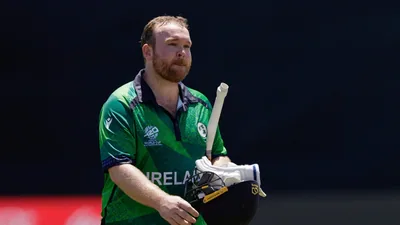
Paul Stirling ODI World Cup format criticism has brought renewed attention to the difficulties associate nations face when major tournament structures change. The Ireland batter believes the revised qualification pathway creates an additional obstacle for teams that had planned for a 14-team World Cup under the previously announced system.
Stirling’s comments come as Ireland prepares for another important phase of its international cricket journey. The veteran batter remains one of the country’s most experienced players and is also competing in the inaugural European T20 Premier League, a competition designed to strengthen cricket’s presence across Europe.
His concerns highlight a broader issue in international cricket: tournament expansion can create opportunities, but changes to qualification systems can also make the path to major events more complicated for nations outside the established group of full members.
Why Paul Stirling Is Disappointed With the New World Cup Structure
Stirling’s frustration is largely connected to preparation. Ireland and other teams had spent a considerable period planning around the expectation of a 14-team ODI World Cup.
When a tournament format changes after teams have already built their long-term plans around it, the impact is not limited to one qualification campaign. Coaches may need to adjust schedules, players may have to rethink preparation priorities and boards may need to reconsider how they allocate resources.
For a smaller cricket nation, those adjustments can be particularly significant because the depth of the player pool and the number of high-level fixtures are generally more limited than those available to the biggest cricketing countries.
Stirling described the revised pathway as another hurdle, while also acknowledging that teams have had some time to adjust since the change was announced.
How the Revised Qualification Challenge Could Affect Associate Teams
The major concern for associate nations is that every additional qualification stage increases the importance of consistency.
In a short tournament, one poor performance can have a much greater effect than it would over a longer bilateral series. Teams must arrive in strong form, manage injuries carefully and adapt quickly to unfamiliar opponents and conditions.
For Ireland, the upcoming qualifier therefore represents the immediate priority rather than the eventual World Cup itself.
Stirling emphasised the need to take the process step by step. That approach reflects a practical reality of qualification cricket: looking too far ahead can become a distraction when the first hurdle remains extremely competitive.
Ireland Cannot Afford to Underestimate the Qualifier
Ireland’s experience at international level gives the team plenty of confidence, but Stirling stressed that there will be no easy victories in the qualifying competition.
Associate cricket has developed considerably over the past decade. Teams outside the traditional elite group have improved their domestic structures, increased exposure to franchise cricket and produced players capable of competing against established international sides.
That means Ireland cannot rely solely on reputation.
Strong starts, disciplined bowling and reliable batting partnerships will all be important during the qualification process. A single off-day could potentially have a much larger consequence in a compressed tournament.
Why Ireland’s Recent Win Over India Matters
Ireland’s confidence has also been strengthened by its recent success against India in a two-match T20I series earlier in the year.
Stirling described the achievement as one of the country’s best victories or series wins. Ireland took advantage of home conditions at Stormont, while India’s squad also had players unavailable because of injuries.
For Ireland, the significance went beyond the result.
The series created opportunities for players who might otherwise have remained outside the immediate international picture. Several of those players subsequently became involved in the European T20 Premier League, giving them additional competitive experience.
This is exactly the type of pathway that associate nations need if they want isolated victories to become sustained improvement.
The European T20 Premier League Could Change Ireland’s Cricket Ecosystem
While Stirling was critical of the World Cup format change, he was highly positive about the inaugural European T20 Premier League.
The six-team competition includes franchises representing Dublin, Belfast, Edinburgh, Glasgow, Rotterdam and Amsterdam. It is backed by Cricket Ireland, Cricket Scotland and the Royal Dutch Cricket Association and has received ICC sanction.
The tournament is intended to bring greater visibility and professional opportunities to European cricket while connecting developing local players with experienced international cricketers.
For Ireland, this could become particularly important because young players need more opportunities to compete against high-level opponents without having to leave the region.
Why Overseas Players Could Accelerate Young European Talent
Stirling believes one of the biggest benefits of the European T20 Premier League is the presence of experienced overseas players.
Young European cricketers can learn by training and playing alongside players who have spent years competing at international and franchise level. That learning can cover much more than technique.
Young players can observe how experienced professionals prepare for matches, manage pressure, analyse opponents and adapt to different conditions.
Those lessons can sometimes be difficult to reproduce in purely domestic competitions where most players have similar levels of experience.
The long-term value of the league will therefore depend partly on whether those lessons translate into stronger performances for European national teams.
Glenn Maxwell’s Role With Belfast Wolves Adds Another Dimension
Stirling is part of the Belfast Wolves setup, with Australian all-rounder Glenn Maxwell involved as a co-owner and active figure within the franchise.
Stirling spoke positively about Maxwell’s leadership and his involvement both on and off the field.
The arrangement is unusual compared with traditional franchise structures because an active international player is not simply appearing as a contracted overseas professional. Maxwell is also connected to the ownership side, creating a closer link between playing experience and franchise management.
For emerging European leagues, personalities with international reputations can help attract attention while also contributing practical knowledge about professional cricket.
Indian Cricket’s Presence Could Increase ETPL Visibility
Another major attraction of the European T20 Premier League is its involvement with prominent Indian cricket figures.
Ravichandran Ashwin and Ajinkya Rahane are among the Indian players associated with the competition, while Rahul Dravid is involved as an owner.
Stirling believes Indian participation can have a major impact because of the enormous global following for Indian cricket.
That could benefit the league in two ways. First, Indian players can attract additional viewers and supporters. Second, their presence could expose European players to different tactical approaches and professional standards.
For a young competition, visibility matters. A league that attracts international attention has a better chance of creating commercial opportunities, developing stronger facilities and encouraging more young players to take up the sport.
Why T20 Could Be Important for Cricket’s European Expansion
Stirling also sees T20 cricket as an important vehicle for expanding the sport globally.
The format is relatively compact compared with Test and ODI cricket, making it easier to fit into modern sporting schedules. Its shorter duration can also make it more accessible to new audiences who may not yet have a strong connection with cricket.
For European countries where cricket competes with established sports, a shorter format can provide a practical entry point.
But T20 should not necessarily replace longer formats. Instead, it can serve as a gateway that brings new players and spectators into the wider cricket ecosystem.
ETPL’s Biggest Test Will Be Long-Term Sustainability
The first season’s reception has reportedly been encouraging, but one successful tournament is not enough to establish a sustainable cricket league.
The real test will be whether the competition can continue attracting spectators, broadcasters, sponsors, international players and local talent over several seasons.
Stirling hopes the league can remain active for at least five years and beyond. That would give young European players enough time to progress through multiple seasons and potentially strengthen their national teams.
Consistency is also important for supporters. Building a regular cricket audience requires people to know when and where they can watch their local teams each year.
Paul Stirling’s Dual Perspective on European Cricket
Stirling’s position is particularly interesting because he is viewing European cricket from two angles.
As an Ireland international, he understands the challenges associated with qualification and competing against stronger cricketing nations. As a player in the European T20 Premier League, he is experiencing the benefits of a new professional competition designed to strengthen the regional game.
Those two perspectives reveal a wider contrast.
European cricket needs more high-quality competitions to improve its players, but international governing structures must also provide realistic and stable pathways for those players to reach the biggest tournaments.
Developing one side without improving the other would limit progress.
What Ireland Needs to Do Next
Ireland’s immediate objective is qualification. The team cannot afford to focus on the main World Cup tournament until it has successfully navigated the stages ahead.
That makes preparation especially important.
- Build batting depth: Ireland needs enough reliable run-scorers to withstand pressure in qualification matches.
- Develop bowling flexibility: Different venues may require different combinations and tactical approaches.
- Use experienced players wisely: Veterans such as Stirling can provide stability while younger players gain experience.
- Prepare for short tournaments: Consistency becomes crucial when there are fewer opportunities to recover from defeats.
- Develop the next generation: Players emerging through competitions such as the ETPL can strengthen Ireland’s future squad depth.
The Bigger Debate Around ODI World Cup Expansion
The disagreement over the format highlights a difficult challenge for the ICC.
Expanding global cricket requires more nations to have meaningful opportunities to qualify for major tournaments. At the same time, the governing body has to design competitions that remain commercially attractive and competitively balanced.
Those objectives do not always align easily.
For associate nations, the qualification pathway is more than a tournament structure. It determines how often players can compete at the highest level and how much attention their cricket receives.
A stable format can allow developing teams to plan years in advance. Frequent changes may force them to adapt more quickly, which can be difficult for boards with smaller resources.
Can Ireland Turn Recent Progress Into World Cup Qualification?
Ireland’s recent progress provides reasons for optimism. The win over India demonstrated that the team can exploit conditions and challenge a major cricketing nation when the opportunity arises.
The emergence of new players from those matches is equally important because a national team cannot depend indefinitely on one generation.
The European T20 Premier League could strengthen that development by giving players more high-quality cricket close to home.
However, success in the ETPL and success in international qualification are not automatically connected. Ireland will still need to translate individual improvement into collective performances in ODI cricket.
Conclusion: Another Hurdle, But Also Another Opportunity
Paul Stirling’s criticism of the revised ODI World Cup pathway reflects the frustration that can arise when teams have prepared for one structure only to face another.
For Ireland, however, the response cannot be to dwell on the change. The immediate challenge is to adapt, prepare carefully and navigate the qualifier one match at a time.
At the same time, the growth of the European T20 Premier League offers a positive development. More professional cricket, greater exposure to international players and increased attention could help build a stronger cricket ecosystem across the region.
The long-term objective is bigger than one World Cup qualification campaign. Ireland needs a sustainable pathway in which young players can develop, experienced players can contribute and European cricket can continue attracting global attention.
Stirling’s message ultimately captures both sides of the current situation: the road to the World Cup may have become more complicated, but Ireland’s wider cricket journey is continuing to expand.
For breaking news and live news updates, like us on Facebook or follow us on Twitter and Instagram. Read more on Latest Cricket on thefoxdaily.com.






COMMENTS 0