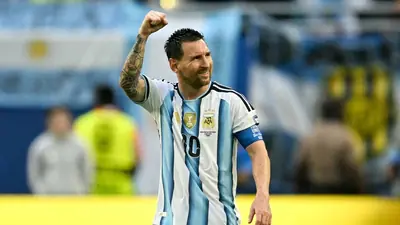
The FIFA World Cup 2026 is rapidly moving toward its most dramatic stage, and one storyline is already capturing the imagination of football fans worldwide: the possibility of a Spain vs Argentina final. The conversation gained momentum after Spain midfielder Pedri openly praised Lionel Messi, describing the Argentine legend as the greatest player in football history and expressing hope for a future showdown between the two footballing giants.
While both nations still face significant challenges in the knockout rounds, the prospect of Spain and Argentina meeting in the tournament’s final has become one of the most intriguing narratives of the competition. Such a clash would not only pit two elite footballing cultures against each other but would also symbolize a battle between generations, philosophies, and legacies.
At the center of the discussion stands Lionel Messi, who continues to redefine expectations despite being in the latter stages of an extraordinary career. Alongside emerging stars like Pedri, the tournament is showcasing how football’s future and present are colliding on the world’s biggest stage.
Why Pedri’s Comments About Lionel Messi Matter
In modern football, praise for Lionel Messi is hardly unusual. Players, coaches, analysts, and former legends have spent nearly two decades attempting to describe the Argentine’s impact on the game. Yet Pedri’s comments carry special significance because they come from one of football’s brightest young midfielders—a player often viewed as a future leader of Spain and Barcelona.
Having shared a dressing room with Messi during their time at Barcelona, Pedri offers a unique perspective. Unlike fans who admire Messi from afar, he witnessed firsthand the Argentine’s training habits, technical brilliance, decision-making, and influence on teammates.
His admiration reflects a broader sentiment across football: even younger generations who grew up watching Messi continue to regard him as the benchmark against which greatness is measured.
The respect shown by Pedri also highlights how Messi’s legacy extends beyond trophies and statistics. His influence can be seen in the way modern midfielders interpret space, creativity, ball progression, and attacking intelligence.
Lionel Messi’s Remarkable FIFA World Cup 2026 Campaign
One of the biggest stories of the tournament has been Messi’s ability to remain among football’s elite goalscorers despite approaching 40 years of age.
Many observers expected younger stars to dominate headlines. Instead, Messi has continued to demonstrate why longevity at the highest level is often a hallmark of true greatness.
His performances have combined experience, technical mastery, and tactical intelligence. While younger forwards may rely heavily on explosive pace, Messi has evolved his game to maximize positioning, vision, and decision-making.
This adaptation is a lesson in elite sporting longevity. Great athletes rarely remain dominant by playing the same way throughout their careers. Instead, they reinvent themselves, and Messi has arguably become one of the greatest examples of that transformation.
| Factor | Messi’s Advantage |
|---|---|
| Experience | Multiple World Cup campaigns and pressure situations |
| Vision | Elite ability to create chances from limited spaces |
| Positioning | Exceptional movement that reduces physical demands |
| Leadership | Guides younger teammates in high-pressure matches |
| Technical Quality | Maintains world-class ball control and finishing |
These qualities help explain why Messi remains one of the tournament’s most influential figures despite competing against players nearly half his age.
The Growing Possibility of a Spain vs Argentina Final
Every World Cup develops a defining narrative. In 2026, one of the most compelling possibilities is a final between Spain and Argentina.
Such a matchup would represent far more than a battle for the trophy. It would bring together two footballing nations with rich histories, passionate fanbases, and distinct tactical identities.
Spain’s modern football philosophy is built around technical control, intelligent possession, and midfield dominance. Argentina, meanwhile, combines tactical discipline with moments of individual brilliance capable of changing matches instantly.
A final between these teams would offer a fascinating contrast:
- Spain’s possession-based approach versus Argentina’s balance of structure and creativity.
- Younger Spanish stars against experienced Argentine leaders.
- European champions seeking global supremacy against defending world champions protecting their crown.
- Pedri’s emerging generation facing Messi’s legendary era.
For football neutrals, it would be one of the most attractive final scenarios imaginable.
Spain’s Evolution Under a New Footballing Identity
Spain entered the tournament carrying significant expectations after recent success in European competition. However, the current Spanish side differs from the teams that dominated international football during the late 2000s and early 2010s.
Today’s squad blends traditional technical excellence with greater verticality, speed, and attacking flexibility.
Players like Pedri represent this evolution. While possessing the technical skills associated with classic Spanish midfielders, they are also more dynamic and direct in transitional situations.
The result is a team capable of controlling possession without becoming predictable.
This tactical flexibility may prove crucial as Spain faces increasingly difficult opponents during the knockout rounds.
Pedri’s Importance to Spain’s World Cup Ambitions
Few midfielders have become as influential as Pedri at such a young age.
His ability to dictate tempo, retain possession under pressure, and connect defensive and attacking phases makes him central to Spain’s ambitions.
Modern football increasingly values multifunctional midfielders who can contribute in every phase of play. Pedri fits that profile perfectly.
His development has transformed Spain’s midfield into one of the most technically gifted units remaining in the competition.
How Club Football Helped Shape Pedri’s Growth
Pedri’s recent development has been closely linked to tactical adjustments at club level. Playing deeper in midfield has allowed him to influence matches more consistently and become the central organizer of attacking sequences.
This evolution mirrors the pathway followed by several legendary midfielders who eventually moved closer to the base of midfield as their understanding of the game matured.
The benefits include:
- More touches on the ball.
- Greater control over match tempo.
- Improved ability to launch attacks.
- Enhanced influence during defensive transitions.
- Stronger leadership responsibilities.
These qualities are becoming increasingly visible throughout Spain’s World Cup campaign.
Portugal Presents Spain’s Biggest Challenge Yet
Before any discussion of a potential final can become reality, Spain must navigate one of the tournament’s toughest tests.
Portugal remains one of the most balanced and dangerous teams in international football. Their squad combines technical quality, tactical organization, and attacking depth.
Knockout football often rewards teams capable of managing pressure moments, and Portugal possesses extensive experience in high-stakes tournaments.
For Spain, this match will serve as a valuable indicator of whether they are genuine title contenders or simply one of several strong teams in the competition.
The outcome may depend heavily on midfield control, an area where Pedri’s influence could prove decisive.
What Makes Messi’s Longevity So Extraordinary?
Elite footballers typically experience a noticeable decline as they approach their late thirties. Physical demands increase while recovery becomes more challenging.
Messi’s continued excellence demonstrates how intelligence can compensate for reduced athletic advantages.
Rather than relying solely on acceleration or physical dominance, he leverages anticipation, spatial awareness, and technical precision.
This ability to evolve offers important lessons for athletes across all sports.
Great players dominate their era. Legendary players adapt across multiple eras.
Messi’s career increasingly belongs in the second category.
The Broader Impact on Football’s Next Generation
One overlooked aspect of the current World Cup is how veteran stars continue to influence emerging talents.
Pedri’s admiration for Messi illustrates the importance of role models in elite sport.
Young players are not merely competing against legends; they are learning from them.
The knowledge transfer occurring between generations helps shape football’s future. Tactical ideas, professional habits, leadership qualities, and competitive mentality are often passed down indirectly through observation and shared experiences.
This dynamic ensures that even after legendary players retire, their influence remains embedded within the sport.
Could This Be Lionel Messi’s Final World Cup Chapter?
Every appearance by Messi now carries additional significance because football fans recognize that opportunities to watch him on the world stage are becoming increasingly rare.
Whether this tournament ultimately ends in triumph or disappointment, it already represents another remarkable chapter in one of football’s greatest careers.
The possibility of reaching another World Cup final would further strengthen an already unparalleled legacy.
For supporters around the globe, the tournament offers a chance to witness history while also observing the next generation preparing to inherit the spotlight.
Key Takeaways from the Spain-Argentina Dream Final Narrative
| Topic | Why It Matters |
|---|---|
| Pedri’s Messi Praise | Highlights Messi’s enduring influence across generations |
| Spain’s Progress | Shows emergence of a new footballing era |
| Argentina’s Strength | Demonstrates defending champions remain serious contenders |
| Potential Final | Could become one of the most memorable World Cup finals ever |
| Messi’s Legacy | Continues growing through elite performances and leadership |
Conclusion: A World Cup Storyline Worth Watching
The FIFA World Cup 2026 has already delivered memorable moments, but the possibility of a Spain vs Argentina final adds another layer of excitement to the tournament. Pedri’s praise of Lionel Messi is more than a simple compliment—it reflects the respect that one generation of footballers has for another.
For Spain, the path remains difficult, beginning with a major test against Portugal. For Argentina, defending their world title will require navigating increasingly challenging opposition. Yet both teams possess the quality, depth, and belief needed to reach football’s biggest stage.
If that dream final eventually becomes reality, it would represent more than a championship match. It would symbolize a meeting between football’s future and one of its greatest icons. Whether Messi lifts another trophy or Pedri helps lead Spain to glory, the tournament is shaping up as a defining chapter in modern football history.
For now, fans can only watch, wait, and imagine what could become one of the most iconic World Cup finals ever played.
For breaking news and live news updates, like us on Facebook or follow us on Twitter and Instagram. Read more on Latest Sports on thefoxdaily.com.






COMMENTS 0