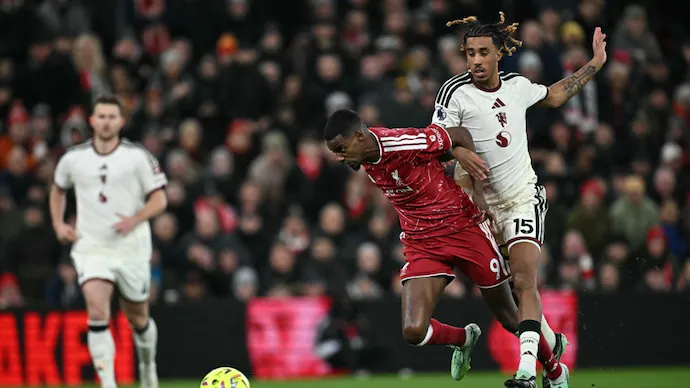
Manchester United head coach Mauricio Pochettino has questioned the competence of VAR officials after the Football Association overturned Leny Yoro’s red card following Sunday’s 4-0 defeat to Liverpool. The Argentine manager accepted that on-field referees can make mistakes but expressed frustration that video assistant referees failed to intervene during the controversial incident at Anfield.
Yoro was sent off in the eighth minute after bringing down Aleksander Isak just outside the penalty area. Manchester United believed the Liverpool forward’s heavy touch had taken the ball beyond his reach and that goalkeeper Senne Lammens would have collected it before Isak could make another attempt to reach it.
The dismissal left United facing a difficult situation early in the match. Although the FA subsequently overturned the red card, Pochettino believes the original decision should have been reviewed and corrected during the game itself. He questioned why VAR did not prevent what he considers a significant refereeing error.
Pochettino criticises VAR after Yoro’s red card
Pochettino was particularly disappointed with the way the incident was handled. He acknowledged that referee Sam Barrott could make an incorrect decision in the heat of a match, but argued that the purpose of VAR is to provide an opportunity to review important calls.
The United manager questioned why the technology was unable to produce a different outcome when Yoro was dismissed so early in the contest. He also highlighted the consequences of the decision, pointing out that his team could not simply replay the match with 11 players on each side after the mistake had been recognised.
“I am very disappointed,” the Argentine said. “This type of thing can never happen.
“We can accept the referee can make a mistake. But if we have VAR, what were they doing? What were they doing? Are we going to repeat the game? Are we going to have the possibility to play 11 by 11? No.
“We have an unbelievable car, but we need to be at the level to drive [it]. We accept that the technology is there but what are they doing?”
His comparison between VAR and an advanced car reflected his belief that having sophisticated technology is not enough on its own. In his view, officials must also be capable of using the system effectively and making the correct decisions when important incidents occur.
The manager’s frustration centres on the difference between the original on-field decision and the subsequent appeal process. While the FA eventually overturned Yoro’s dismissal, United believe the technology should have identified the issue before the match was affected.
Why Manchester United believe Yoro’s dismissal was incorrect
The incident occurred in the eighth minute at Anfield when Yoro brought down Isak just outside the penalty area. The referee judged the challenge to be worthy of a red card, leaving Manchester United to continue with 10 players for the remainder of the contest.
United’s argument focused on the position of the ball and the likelihood of Isak reaching it. The club believed the Liverpool forward had taken a heavy touch, sending the ball beyond his immediate control. They argued that Lammens was positioned to reach it before Isak could regain possession.
This detail was central to the club’s appeal to the FA. United are understood to have used data concerning Isak’s top speed and his chances of reaching the ball as part of their case. The club believes the relevant evidence could have been assembled within minutes of the incident, potentially giving VAR officials the information needed to reconsider the decision.
The FA’s decision to overturn the red card gave United support for their challenge to the original dismissal. However, it did not change the circumstances of the match or remove the consequences of playing with 10 men after the early sending-off.
For Pochettino, that is precisely why the role of VAR matters. He believes the system should help prevent major mistakes from having such a significant influence on a match, particularly when a player is sent off within the opening minutes.
Howard Webb defends the referee and VAR officials
Manchester United have also expressed dissatisfaction with the subsequent defence of the decision by referees’ chief Howard Webb. On Sky Sports’ Mic’d Up programme, Webb backed referee Sam Barrott and VAR official John Brooks, explaining why the original decision was not overturned during the game.
Webb acknowledged that there was some uncertainty about whether Isak would have reached the ball before Lammens. However, he said the referee had made his assessment based on what he saw during the incident and that VAR did not believe the decision met the threshold for intervention.
“There’s a question mark, I guess, around whether or not he would get onto that ball before Lammens. Now, in the moment, the referee looked at it and felt he would,” Webb said.
Webb explained that VAR’s responsibility was to assess whether the on-field decision was clearly and obviously incorrect, rather than simply deciding whether another interpretation of the incident was possible.
“That was the referee’s call made on the field, and then the VAR checks that to see whether that decision made on the field was clearly and obviously incorrect, and formed the opinion that it wasn’t.”
He also suggested that many observers would consider the original decision reasonable because of Isak’s movement towards the ball. While acknowledging the alternative possibility that Lammens could have arrived first, Webb argued that the situation was not clear enough to justify overturning the referee’s call at the time.
“I think, by and large, most people would see that as a correct decision, with Isak moving quickly on towards that ball.
“The alternative view is that Lammens might get there first, but I think it’s a little bit debatable. Certainly not clearly wrong.”
Webb’s explanation highlights the distinction between reviewing a decision and determining that it crosses the threshold for VAR intervention. United, however, remain unhappy with that interpretation, particularly after the FA later overturned the red card.
United plan to raise the matter with the Premier League and PGMOL
Manchester United intend to raise their concerns with both the Premier League and Professional Game Match Officials Limited (PGMOL). The club are unhappy with the handling of the incident and the defence of the decision that followed.
The club’s position is that the dismissal should have been reviewed more carefully during the match. United believe the available evidence about Isak’s movement and the position of the ball could have helped officials reach a different conclusion.
The use of data in the appeal is also an important part of the club’s argument. United are understood to have examined Isak’s top speed and the likelihood of him reaching the ball before Lammens. They believe that information could have been gathered quickly enough to assist the VAR team during the original review.
The planned discussions with the Premier League and PGMOL indicate that the club want an explanation beyond the FA’s decision to overturn the dismissal. They are seeking answers about why the original decision was allowed to stand despite the availability of video technology.
The issue has also raised questions about the consistency of VAR intervention. United’s frustration is not simply about the referee making an initial mistake; it is about why the technology did not lead to a correction before the dismissal affected the game.
Second major VAR controversy involving Manchester United this season
The Yoro incident is not the first major VAR decision involving Manchester United to attract criticism this season. Another controversial moment occurred during the Manchester derby on September 13, when Erling Haaland’s winning goal was allowed to stand despite Enzo Fernandez being in an offside position and interfering with play.
Webb later apologised over that decision. However, there has been no apology regarding Yoro’s dismissal, adding to United’s dissatisfaction with the way the two incidents have been handled.
The difference in the responses has become another point of frustration for the club. United have already experienced a major VAR controversy this season and now believe the decision involving Yoro represents another instance in which the system failed to deliver the outcome they expected.
For Pochettino, the latest incident reinforces his concerns about how VAR is being used. His criticism suggests that the technology itself is not necessarily the problem; rather, he believes the officials operating it must meet the standard required to make accurate decisions.
Pochettino also questions Liverpool’s opening goal
Pochettino’s criticism was not limited to Yoro’s dismissal. The Manchester United manager also questioned the validity of Liverpool’s opening goal, claiming Bradley Barcola was positioned too close to the United defensive wall before Dominik Szoboszlai scored from the resulting free-kick.
The manager argued that Barcola’s position should have resulted in the goal being disallowed. He was frustrated that the incident had not received the same level of attention as other decisions during the match.
“No-one talked about [the fact] that the goal wasn’t legal,” Pochettino said. “Barcola was touching our wall. It must be disallowed.
“We need to defend my players and my club, and that is to denounce it and to say, the decision wasn’t good. And now, the three points, where are the three points?”
His comments reflected his wider dissatisfaction with the officiating during the 4-0 defeat. Pochettino believes United were affected by more than one disputed decision and wants the club’s concerns to be heard by the relevant authorities.
The manager’s reference to the three points highlighted another important issue for United: subsequent explanations or corrections cannot restore the result or change what happened on the pitch. Even when a decision is overturned after a match, the team has already experienced its consequences.
VAR debate continues after the FA overturns Yoro’s red card
The controversy surrounding Yoro’s dismissal has placed renewed attention on the relationship between on-field referees, VAR officials and the appeal process. The FA’s decision to overturn the red card and Webb’s defence of the original call have created two different points of discussion.
Webb’s explanation focused on the requirement for a decision to be clearly and obviously wrong before VAR intervenes. Manchester United, meanwhile, believe the evidence surrounding Isak’s heavy touch and Lammens’ position should have prompted a different decision during the match.
Pochettino has made it clear that he accepts referees can make mistakes, but he expects VAR to help prevent those errors from having a major impact. His criticism of the officials reflects the club’s belief that the technology was not used effectively when Yoro was sent off.
United are now preparing to take their concerns to the Premier League and PGMOL. The discussions could provide an opportunity for the club to seek further clarification about the incident and the reasoning behind the decision not to intervene.
For now, the disagreement remains unresolved. The FA has overturned Yoro’s red card, but Manchester United are still unhappy with the original decision, Webb’s defence of the officials and the other disputed moments from the defeat at Anfield.
Pochettino’s central message is that technology can only improve refereeing when it is used effectively. With United seeking answers from the football authorities, the incident has become another major talking point in the ongoing debate over VAR and the consistency of officiating in the Premier League.
For breaking news and live news updates, like us on Facebook or follow us on Twitter and Instagram. Read more on Latest Football on thefoxdaily.com.





COMMENTS 0