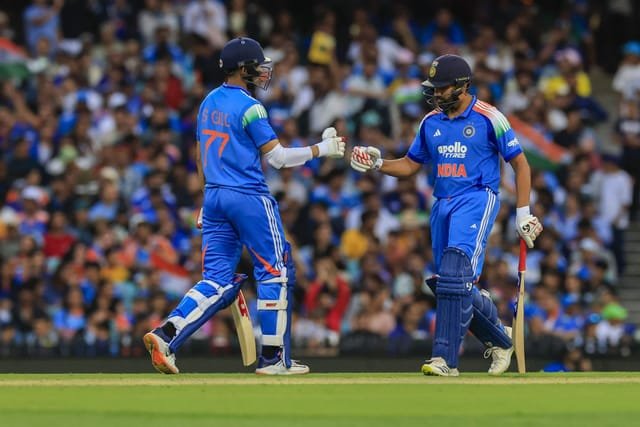
India’s comfortable victory over Afghanistan in the opening ODI of the 2026 series may have secured an early lead, but one moment from the match continues to dominate discussions. A costly mix-up between Rohit Sharma and Shubman Gill resulted in the Indian captain’s dismissal, prompting strong reactions from former cricketers and analysts.
Among those weighing in was Ravichandran Ashwin, who delivered a blunt assessment of the incident. The veteran off-spinner emphasized that the fundamentals of running between the wickets are taught at a young age and should not become an issue at the international level.
While the run-out did not affect India’s result, it exposed a recurring problem that could prove costly in high-pressure matches against stronger opposition.
How the Rohit Sharma-Shubman Gill Mix-Up Happened
The incident occurred during the sixth over of India’s chase at the HPCA Stadium in Dharamshala.
Rohit Sharma tapped the ball toward mid-on and immediately called for a quick single. However, Shubman Gill hesitated at the non-striker’s end after tracking the ball and momentarily losing sight of the bowler, Allah Ghazanfar, who was following through in the same direction.
That brief hesitation created confusion.
By the time Gill declined the run and Rohit attempted to return to his crease, it was already too late. Despite a desperate dive, the Indian skipper was comfortably run out for 16 runs off 16 deliveries.
The dismissal interrupted India’s momentum and shifted attention away from an otherwise controlled run chase.
R Ashwin Explains the Basic Rule of Running Between the Wickets
Ashwin’s criticism centered on a fundamental principle of batting partnerships: when the ball is played in front of the wicket, the striker’s call takes priority.
“When you play in front of the wicket, it is the call of the striker that the non-striker needs to uphold. These are basics they teach in childhood.”
According to Ashwin, Rohit’s decision to attempt the run was correct because, as the striker, he had the best view of the ball and the fielding setup.
The former spinner clarified that mistakes can happen during a match but stressed that such misunderstandings should be minimized at the international level.
His comments were not intended to single out one player but to highlight the importance of communication and awareness during crucial moments.
Who Was Responsible for the Run-Out?
Run-outs often involve shared responsibility, but cricket’s established conventions provide clear guidelines.
| Situation | Who Makes the Call? |
|---|---|
| Ball played in front of the wicket | Striker |
| Ball played behind the wicket | Non-striker |
| Unclear situation | Loudest and earliest call prevails |
In this case, the ball was played toward mid-on, placing responsibility for the decision primarily with the striker.
However, effective running between the wickets requires both batters to communicate clearly and respond instantly.
Gill’s hesitation, whether caused by the bowler’s movement or uncertainty about the fielder’s position, disrupted that process.
At the same time, Rohit committed fully to the run, leaving little margin for correction once the call was reversed.
A Recurring Issue for Rohit Sharma and Shubman Gill
What makes the latest incident more concerning is that it was not an isolated mistake.
Rohit Sharma and Shubman Gill have previously been involved in similar run-out mix-ups, including a memorable incident during India’s T20I match against Afghanistan in early 2024.
On that occasion, Rohit was also the striker and called for a quick single after hitting the ball toward mid-off. Gill hesitated, leading to another avoidable dismissal.
The repetition suggests that the issue may stem from differences in communication styles or split-second decision-making under pressure.
Strong opening partnerships rely heavily on trust and instinct, qualities that develop through time spent batting together.
Why Running Between the Wickets Is an Underrated Skill
Modern cricket often celebrates power hitting, innovative stroke play, and bowling variations, but running between the wickets remains one of the game’s most important fundamentals.
Elite batting pairs create scoring opportunities not only through boundaries but also through quick singles, sharp doubles, and intelligent running.
Excellent running between the wickets can:
- Disrupt a bowler’s rhythm.
- Convert pressure into scoring opportunities.
- Force fielding errors.
- Rotate strike consistently.
- Reduce reliance on boundaries.
Conversely, poor communication can cost wickets, derail momentum, and alter the outcome of close matches.
What Shubman Gill Did Right After the Run-Out
To his credit, Gill responded positively after the unfortunate mix-up.
Rather than allowing the incident to affect his concentration, the young opener played a composed and responsible innings to guide India to victory.
His unbeaten half-century demonstrated maturity and mental resilience, qualities that separate elite players from talented prospects.
Recovering quickly from mistakes is a crucial trait in international cricket, where every error is magnified by public scrutiny.
Why India Must Address These Errors Quickly
Against Afghanistan, the run-out proved inconsequential because India’s overall quality ensured a comfortable victory.
However, similar mistakes against stronger teams in major tournaments can have significant consequences.
Knockout matches are often decided by small margins, and avoidable dismissals can shift momentum dramatically.
With major ICC events on the horizon, India’s coaching staff will likely focus on refining communication between batting partners.
Simple measures such as clearer calling systems, increased awareness drills, and regular match simulations can help reduce such errors.
What This Incident Reveals About Modern Cricket
The growing intensity of international cricket leaves little room for hesitation.
Players today must process information rapidly while dealing with pressure, crowd noise, and increasingly athletic fielding units.
Even experienced cricketers can make split-second errors.
The key difference between good teams and great teams often lies in their ability to eliminate basic mistakes consistently.
Ashwin’s comments serve as a reminder that while technology, analytics, and advanced coaching continue to evolve, success still depends on mastering the fundamentals.
Looking Ahead to the Second ODI
India will face Afghanistan in the second ODI in Lucknow with an opportunity to seal the series.
While attention will naturally focus on batting performances and bowling combinations, the Rohit-Gill partnership will remain under scrutiny.
Fans and analysts will watch closely to see whether the pair can improve their communication and avoid repeating previous mistakes.
Given their talent and experience, there is little doubt they can develop into one of India’s most effective opening combinations across formats.
However, building that partnership requires trust, clarity, and flawless coordination between the wickets.
Conclusion
Ravichandran Ashwin’s criticism of the Rohit Sharma-Shubman Gill mix-up was direct but rooted in cricketing fundamentals. His message was clear: basic principles of running between the wickets should not be overlooked, regardless of a player’s experience or reputation.
Although the run-out did not affect the result against Afghanistan, it highlighted an area that India must address before facing stronger opposition.
For Rohit and Gill, the solution lies in better communication and greater awareness. For the Indian team, it is a timely reminder that even in an era dominated by power hitting and advanced analytics, mastering the basics remains essential for sustained success.
For breaking news and live news updates, like us on Facebook or follow us on Twitter and Instagram. Read more on Latest Sports on thefoxdaily.com.






COMMENTS 0