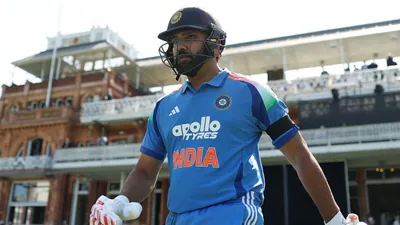
Rohit Sharma future has emerged as a major talking point in Indian Cricket as the Board of Control for Cricket in India prepares to discuss India’s long-term ODI plans. The former India captain’s position is particularly intriguing because his recent performances have complicated what appeared to be a straightforward transition toward a younger generation.
Rohit has already stepped away from Test cricket and T20Is, leaving ODI cricket as his only remaining international format. His future therefore carries significance beyond one player. It is tied to India’s plans for the next ODI World Cup cycle, the development of younger batters, leadership succession and the selectors’ vision for the 2027 tournament.
The debate intensified after Rohit produced a memorable 138 at Lord’s against England in July. The innings demonstrated that he can still influence an ODI at the highest level, but it did not automatically settle the larger question: should India build its 2027 World Cup campaign around a batter who will be in his late 30s by the tournament?
That is the central issue facing Indian cricket. A single century can change public opinion overnight, but World Cup selection is ultimately about sustained performance, fitness, team balance and what the selectors believe India will need several months down the road.
Why Rohit Sharma’s ODI Future Is So Important
Rohit’s situation is unusual because he is neither an established automatic selection nor a player whose international career has clearly reached its conclusion.
His retirement from Tests in 2025 and T20Is in 2024 reduced his international workload significantly. ODI cricket now represents his only remaining route to continue playing for India, making every series and selection decision more consequential.
At the same time, India cannot approach the 2027 World Cup simply by looking at reputation. The tournament is still ahead, meaning the selectors have to evaluate what Rohit can contribute across an extended period rather than what he achieved in one afternoon at Lord’s.
This creates two competing arguments.
- The case for Rohit: experience, proven ODI impact, big-match temperament and the ability to produce match-defining innings.
- The case against automatic selection: age, the need to develop the next generation and the importance of maintaining a long-term squad structure.
Neither argument can be dismissed. That is why the Rohit Sharma future debate has become more complicated after Lord’s rather than less complicated.
What Happened Before the Lord’s Century?
Reports surrounding Rohit’s future became particularly intense during India’s England tour. There was speculation that the ODI finale at Lord’s could represent his final appearance for the national team.
According to the report cited by Hindustan Times, Rohit had been told by a member of the selection committee, though not the chairman, that the panel had already decided to move forward without him. The same report suggested that he was asked whether he could announce his retirement after the Lord’s ODI.
Those claims created an extraordinary situation. Rohit was still an active international cricketer, yet questions about his retirement were apparently being discussed around him.
The reported response was significant because it suggested that Rohit was prepared to accept the situation despite being unhappy with it. But his performance at Lord’s immediately changed the public conversation.
Rohit Sharma’s 138 at Lord’s Changed the Argument
The importance of Rohit’s Lord’s century goes beyond the number 138.
For an experienced batter trying to remain part of a World Cup plan, an innings of that quality provides evidence that he can still perform against international opposition and handle the pressure associated with a major venue.
It also challenged the assumption that age automatically makes an experienced player less valuable.
However, the innings came in a losing cause, which provides an important reminder. Individual brilliance is only one part of selection. The selectors have to consider whether Rohit’s contribution fits the team’s broader strategy and whether his presence improves India’s chances of winning the 2027 tournament.
This is where the debate becomes more sophisticated than simply asking whether Rohit can still score runs.
Why One Century Cannot Guarantee a World Cup Place
A century can strengthen a player’s selection case, but it cannot remove every other selection consideration.
For a World Cup squad, selectors normally need to think about consistency, fitness, role clarity, fielding, team combinations and the availability of alternatives. A batter may produce one outstanding performance and still face competition from younger players who offer greater long-term value.
Rohit’s situation is therefore best understood as a selection equation rather than a simple performance contest.
If Rohit continues producing significant ODI innings, the argument for retaining him becomes stronger. If his performances become inconsistent or his availability becomes an issue, the selectors may have greater reason to accelerate the transition.
India’s Bigger Challenge: Experience Versus Transition
The Rohit Sharma future debate reflects a much bigger question facing India: how quickly should a successful team move from an established generation to its successors?
Replacing experienced players too early can create instability. Waiting too long can leave a team with insufficient preparation when a major tournament arrives.
The ideal solution is usually a gradual transition.
India can continue evaluating experienced players while simultaneously giving younger batters meaningful ODI opportunities. That approach allows selectors to judge whether the next generation is genuinely ready instead of selecting players solely because they are younger.
This could become one of the most important strategic decisions in India’s preparation for the 2027 World Cup.
Virat Kohli and Ravindra Jadeja Add Another Layer
Rohit is not the only senior player whose future is being discussed. Virat Kohli and Ravindra Jadeja are also part of the broader conversation surrounding India’s ODI planning.
However, the level of pressure on the three players is not necessarily identical.
Rohit has attracted particularly intense attention because he has already retired from two international formats and his ODI future is therefore directly connected to the final phase of his international career.
Kohli and Jadeja, meanwhile, remain important parts of the wider discussion about how India balances experience with succession.
The bigger picture is that India is not simply choosing individual players. The selectors are effectively designing the core of a World Cup squad several months before the tournament.
The BCCI Meeting Could Be Important for More Than Rohit
The reported BCCI meeting in Mumbai is significant because the discussion extends beyond Rohit’s place in the team.
According to the report, questions surrounding the selection committee and chief selector Ajit Agarkar’s position are also part of the wider discussion.
Reports have suggested that Agarkar’s continuation could be considered, while VVS Laxman has been mentioned as a possible alternative for the chief selector role.
Any change in the selection leadership could potentially influence how India approaches the ODI transition. Different selection groups can have different philosophies regarding age, experience, workload and the development of younger players.
That is why the Rohit Sharma future question cannot be separated completely from the structure of Indian cricket’s selection process.
Devajit Saikia’s Earlier Comments Added to the Uncertainty
BCCI secretary Devajit Saikia had previously indicated that Rohit remained part of India’s plans, according to the report.
That statement was important because it appeared to contradict the speculation that Rohit’s international career was nearing an immediate conclusion.
The resulting uncertainty highlights one of the biggest challenges in modern sports administration: communication.
When different messages emerge from officials, selectors and reports, speculation can quickly become larger than the original issue. For a senior player, that can create unnecessary uncertainty around what should ultimately be a cricketing decision.
What Should India Evaluate Before the 2027 World Cup?
Rather than treating the Lord’s century as either definitive proof that Rohit must play or irrelevant to the selection process, India should evaluate several measurable factors.
- Recent ODI consistency: One exceptional innings should be assessed alongside performances across multiple matches.
- Fitness and availability: Long-term tournament planning requires players who can remain available through preparation and competition.
- Opening combination: Rohit’s selection must fit with the best possible opening partnership.
- Role clarity: India needs to know exactly what role each senior batter will perform.
- Next-generation development: Younger contenders need sufficient opportunities before the World Cup squad is finalized.
- Team balance: Individual reputation cannot be allowed to override the combination required to win matches.
Rohit’s Experience Could Be Especially Valuable in a World Cup
There is one factor that statistics alone cannot completely capture: tournament experience.
Rohit has played a major role in India’s ODI setup for many years and has experienced the unique pressure surrounding World Cups. That knowledge can matter when matches become tense and margins become small.
An experienced batter can also help younger players understand tournament rhythms, preparation and pressure management.
But experience only becomes a competitive advantage when it is accompanied by current performance. A player cannot rely indefinitely on achievements from previous seasons.
That distinction is crucial to understanding Rohit’s position.
Comparison: Rohit’s Two Possible Paths
| Scenario | What It Could Mean for India | Main Advantage | Main Question |
|---|---|---|---|
| Rohit continues in ODIs | India retains a highly experienced opening option | Experience and proven big-match ability | Can he maintain consistent performance and fitness? |
| India transitions to younger openers | More preparation time for the next generation | Long-term squad continuity | Can younger players handle World Cup pressure? |
The Unique Angle: India Does Not Have to Make the Decision Immediately
One of the most important points often lost in the retirement debate is timing.
India does not necessarily need to decide the entire 2027 World Cup batting lineup based on one series. The better strategy could be to establish a clear evaluation period.
During that period, Rohit can be judged against the same criteria as every other contender. Younger players can receive opportunities, while Rohit can demonstrate whether his Lord’s performance was part of a sustained level of ODI cricket.
This approach would reduce the danger of making a major World Cup decision based either on nostalgia or on the excitement of one century.
Prediction: Rohit’s Next ODI Performances Will Matter More Than the Lord’s Knock
The most logical prediction is that Rohit’s immediate future will remain under evaluation rather than being settled permanently by the Lord’s innings.
If he continues producing impactful performances, India will face increasing pressure to retain him. If his form drops and younger alternatives establish themselves, the selectors will have a stronger case for transition.
In other words, Lord’s may have reopened the door, but Rohit still has to keep walking through it.
That is perhaps the fairest way to assess the situation. His career deserves respect, but World Cup selection must ultimately be based on what a player can contribute to the team at that particular stage.
What Rohit Sharma’s Future Means for Indian Cricket
The decision will have consequences beyond Rohit himself.
If India retains him, the team could benefit from experience while younger players continue developing around him. If India moves on, the transition could accelerate and give the next generation a longer runway before the 2027 tournament.
Either route carries risk.
Keeping a veteran too long can delay succession. Moving on too quickly can remove valuable experience before replacements are ready.
The best outcome will therefore depend less on sentiment and more on evidence.
Conclusion: Rohit Sharma’s World Cup Case Is Still Alive
Rohit Sharma future remains one of the most intriguing questions surrounding India’s ODI cricket. His 138 at Lord’s changed the mood and showed that the veteran batter can still produce a major innings on the international stage.
But the century did not automatically secure his place in India’s 2027 World Cup squad. The selectors must weigh current form, consistency, fitness, team balance and the progress of younger players.
The situation also highlights a wider transition for Indian cricket, with Rohit, Virat Kohli and Ravindra Jadeja representing an experienced generation while the selectors consider the future core of the ODI side.
For now, Rohit’s World Cup dream remains alive. The decisive evidence, however, will come from what he does next rather than what he already accomplished at Lord’s.
For breaking news and live news updates, like us on Facebook or follow us on Twitter and Instagram. Read more on Latest Cricket on thefoxdaily.com.






COMMENTS 0