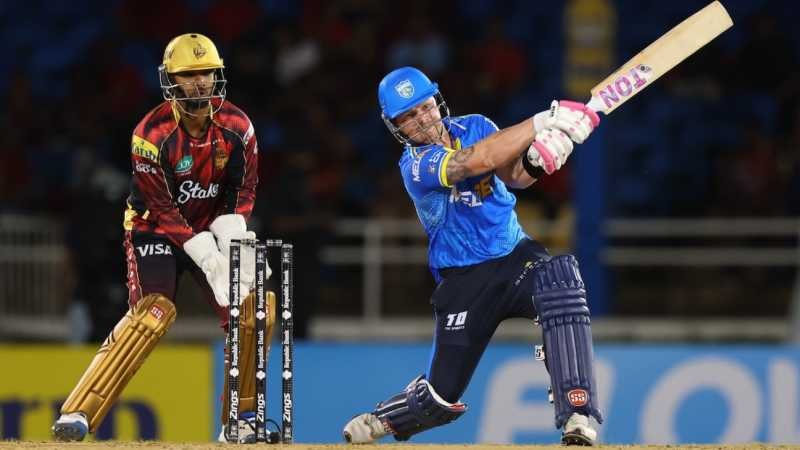
TKR vs SLK delivered one of the most decisive performances of the Caribbean Premier League 2026 season as St Lucia Kings defeated Trinbago Knight Riders by 36 runs at Port of Spain on August 26. The Kings posted 211 for 4 after being asked to bat, with Tim Seifert producing a brilliant unbeaten 105 from 61 balls.
Trinbago Knight Riders, chasing 212, made a promising start through Colin Munro and Sunil Narine but lost three crucial wickets in one over from Roston Chase. Kieron Pollard then launched a remarkable counterattack with 65 from just 26 balls, including six fours and five sixes, but his dismissal effectively ended TKR’s hopes.
The victory lifted St Lucia Kings back to the top of the CPL 2026 standings with eight points, while Trinbago Knight Riders slipped to sixth. The match also produced a striking contrast between Seifert’s controlled century and Pollard’s explosive late assault.
TKR vs SLK result: St Lucia Kings win by 36 runs
| Team | Score | Result |
|---|---|---|
| St Lucia Kings | 211/4 in 20 overs | Won |
| Trinbago Knight Riders | 175/6 in 20 overs | Lost by 36 runs |
| Top scorer | Tim Seifert – 105* | St Lucia Kings |
| Best bowler | Roston Chase – 3/24 | St Lucia Kings |
| Venue | Port of Spain | CPL 2026, 17th Match |
Tim Seifert turns the innings into a one-man show
The foundation of St Lucia Kings’ imposing total was laid by Tim Seifert, who remained unbeaten on 105 from 61 deliveries. The New Zealand batter combined power with patience and ensured that the Kings kept scoring even when the innings temporarily slowed down.
Seifert reached his century from 57 balls, completing his second CPL hundred. He struck five sixes during the innings and maintained control deep into the closing stages.
His performance was particularly important because St Lucia Kings had entered the match in a tournament where 200-plus totals had been relatively uncommon. Their 211 for 4 became only the second total above 200 in the first 17 matches of CPL 2026.
Rather than relying exclusively on a frantic finish, the Kings constructed their total through several productive partnerships. That made their innings difficult for TKR to disrupt.
St Lucia Kings make an aggressive start in the powerplay
After being asked to bat, St Lucia Kings raced to 64 for 1 during the powerplay. Seifert immediately looked comfortable, while Kamil Pooran provided valuable support at the other end.
The pair added 60 runs from only 34 balls, with Pooran contributing 25 from 17 deliveries and Seifert scoring 31 from the same number of balls.
That opening burst was significant because early momentum has been difficult to achieve consistently during this CPL season. By establishing a strong scoring rate immediately, the Kings forced TKR’s bowlers into defensive options much earlier than they would have preferred.
John Campbell helps keep the pressure on TKR
After Usman Tariq ended the partnership, Seifert continued his attack alongside John Campbell.
The pair added another 75 runs from 38 balls, giving St Lucia Kings the platform to move beyond the 200-run mark.
Campbell scored 27 from 17 deliveries before Sunil Narine dismissed him. The wicket was also a landmark moment for Narine, who claimed his 650th T20 wicket.
Only Rashid Khan had more T20 wickets at the time, underlining the remarkable longevity and consistency of Narine’s career in the shortest format.
Charith Asalanka adds another important partnership
With Seifert already well established, Charith Asalanka joined him and ensured that the Kings did not lose momentum during the middle overs.
The pair added 51 runs from 36 balls. Seifert temporarily adopted a more measured approach, scoring 15 runs at a run-a-ball during this partnership, while Asalanka attacked more aggressively.
Asalanka eventually finished with 33 from 21 balls, giving the innings another important push before his dismissal at the end of the 18th over.
That partnership also created the platform for Seifert to attack the final overs without needing to take unnecessary risks earlier in the innings.
Seifert reaches his century in the final over
After Asalanka’s dismissal, the major question was whether Seifert would have enough deliveries to reach three figures.
He answered that question in the final over.
Facing Kieron Pollard, Seifert pulled a slower bouncer for the runs he needed and completed his century from 57 balls. He remained unbeaten on 105 from 61 deliveries, ensuring that St Lucia Kings finished on a formidable 211 for 4.
The manner of the innings was just as important as the final number. Seifert did not simply rely on a late flurry; he adapted his tempo according to the situation and then accelerated when the opportunity arrived.
TKR start their chase with real promise
Trinbago Knight Riders needed 212 to win, but their chase initially looked capable of becoming competitive.
Colin Munro and Sunil Narine combined for 56 runs during the powerplay, giving TKR the kind of start required when chasing a total above 200.
At that stage, the match was far from settled. The Kings needed a breakthrough to disrupt TKR’s rhythm, and that moment arrived when Roston Chase was introduced for the eighth over.
Roston Chase destroys TKR’s momentum in one over
Chase produced the defining bowling moment of the match by taking three wickets in the same over.
Narine fell from the third delivery. Matthew Breetze was dismissed from the next ball, and Nicholas Pooran followed on the fifth delivery.
Three wickets in four balls completely changed the shape of the chase.
TKR had moved into a promising position, but the sudden cluster of dismissals exposed the lower middle order to enormous pressure. Instead of needing to maintain an aggressive scoring rate, TKR now had to rebuild while the required run rate continued to rise.
Chase finished with three wickets for 24 runs, making his over arguably the most influential passage of the entire contest.
Kieron Pollard launches a spectacular counterattack
Despite the collapse, Kieron Pollard refused to allow the chase to disappear quietly.
The veteran all-rounder produced one of the innings’ most entertaining passages, attacking the Kings’ bowlers with extraordinary power.
Pollard reached 23 from his first 10 balls after striking two fours and two sixes. He then moved to 31 from 14, 44 from 19 and eventually 50 from only 21 balls.
His innings finished at 65 from 26 deliveries, containing six fours and five sixes.
Pollard’s assault briefly created the possibility of an unlikely recovery. His ability to score boundaries at such a rapid rate meant that even a difficult chase could not be completely dismissed while he remained at the crease.
Matthew Forde provides the decisive breakthrough
Pollard’s counterattack finally ended in the 17th over when Matthew Forde dismissed him caught and bowled.
Pollard attempted another pull but top-edged the delivery, giving Forde the breakthrough that effectively sealed the result.
At the time of Pollard’s dismissal, TKR still required 65 runs from 24 balls. Even with wickets in hand, the equation had become extremely demanding.
Once Pollard departed, TKR finished at 175 for 6, falling 36 runs short of the target.
Why St Lucia Kings won the TKR vs SLK contest
The biggest difference between the two teams was not simply the final score. It was the way each side handled key phases of the match.
St Lucia Kings consistently created pressure through partnerships with the bat and timely wickets with the ball. TKR, meanwhile, allowed one poor over to turn a competitive chase into a difficult recovery mission.
There were three decisive factors:
- Seifert’s unbeaten 105: His century gave the Kings both stability and explosive finishing power.
- Chase’s three-wicket over: The collapse of Narine, Breetze and Nicholas Pooran dramatically shifted the chase.
- Pollard’s dismissal: His 65 kept TKR alive, but his departure with 65 still required from 24 balls ended the realistic comeback opportunity.
Seifert vs Pollard: Two very different approaches
One of the most interesting aspects of the match was the contrast between Seifert and Pollard.
| Statistic | Tim Seifert | Kieron Pollard |
|---|---|---|
| Runs | 105* | 65 |
| Balls | 61 | 26 |
| Sixes | 5 | 5 |
| Role | Built and finished the innings | Late chase counterattack |
Seifert’s innings was the more complete performance because it controlled the entire shape of St Lucia Kings’ batting effort. Pollard’s knock was shorter but extraordinarily explosive, giving TKR a brief opening after the middle-order collapse.
The comparison also illustrates two different ways of succeeding in T20 cricket: Seifert built his innings around sustained impact, while Pollard relied on immediate boundary pressure.
What the result means for the CPL 2026 standings
The victory was particularly valuable for St Lucia Kings because it moved them back to No. 1 in the tournament standings.
They became the second team to reach eight points after Antigua and Barbuda Falcons, strengthening their position in the race for the playoffs.
For Trinbago Knight Riders, the situation is considerably less comfortable. The defeat was their third loss in four matches and dropped them to sixth in the standings.
The result means TKR cannot afford to rely on individual brilliance alone. Pollard’s innings showed the team’s capacity to produce spectacular moments, but the collapse earlier in the chase demonstrated why a more complete batting performance is required.
The bigger tactical lesson from TKR vs SLK
The match highlighted an important principle of modern T20 cricket: a huge target does not necessarily require every batter to attack from the first ball, but it does require teams to protect themselves from sudden collapses.
TKR’s powerplay gave them a foundation. The problem came when they lost three wickets in one over.
That sequence turned a manageable chase into one that required extraordinary hitting for the remainder of the innings. Pollard almost provided that miracle, but even his 65 could not compensate for the damage.
St Lucia Kings, by contrast, spread their scoring across several partnerships. Seifert remained the central figure, but Pooran, Campbell and Asalanka all contributed meaningful runs.
That balance reduced the pressure on any single batter and ultimately proved decisive.
What St Lucia Kings can take forward
St Lucia Kings now have evidence that their batting lineup can produce a 200-plus total while their bowling unit can respond when an opponent gets off to a strong start.
The biggest positive is arguably their ability to win despite TKR’s powerplay success. Rather than allowing the early momentum to dictate the match, Chase’s spell and the subsequent bowling effort restored control.
If Seifert continues to provide innings of this quality, the Kings will have a reliable anchor around whom their aggressive batting options can operate.
What Trinbago Knight Riders need to fix
TKR’s biggest concern is their inability to convert a promising start into a sustained chase.
Scoring 56 in the powerplay against a 212-run target was encouraging, but losing three wickets in one over created a hole that was too large to escape.
The team also needs greater support for Pollard when he produces a counterattack. His 65 demonstrated that the target was not completely beyond reach, but the required run rate and remaining wickets made the task increasingly difficult.
With the Knight Riders sitting sixth, their upcoming fixtures become increasingly important. They will need more consistent contributions rather than relying on one spectacular innings to rescue difficult situations.
Conclusion
TKR vs SLK ended with a 36-run victory for St Lucia Kings, powered by Tim Seifert’s unbeaten 105 and Roston Chase’s game-changing three-wicket over.
Seifert’s 61-ball century gave the Kings the platform to post 211 for 4, while Chase ensured that TKR’s promising chase lost momentum at precisely the wrong time.
Kieron Pollard’s 26-ball 65 was an extraordinary individual effort and briefly threatened to change the contest, but his dismissal left TKR needing 65 runs from 24 balls.
Ultimately, St Lucia Kings had too much control across the major phases of the match. The win moved them to the top of the CPL 2026 standings with eight points, while Trinbago Knight Riders slipped to sixth after their third defeat in four matches.
The result also provides a clear warning to the rest of the competition: when a team combines a century-maker at the top with a bowler capable of producing a match-changing over, it becomes extremely difficult to knock them off course.
For breaking news and live news updates, like us on Facebook or follow us on Twitter and Instagram. Read more on Latest Cricket on thefoxdaily.com.



COMMENTS 0