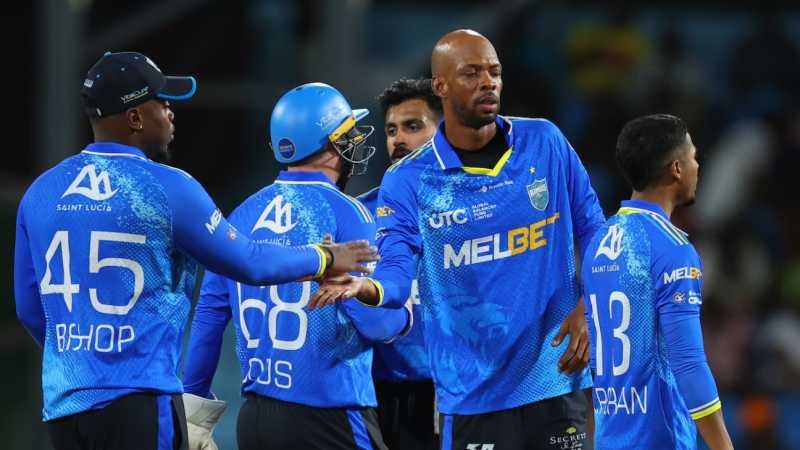
St Lucia Kings vs Antigua and Barbuda Falcons produced one of the closest finishes of CPL 2026 in Kingstown, with the Kings defending 187 despite the Falcons appearing to have control of the chase at several stages.
St Lucia Kings defeated Antigua and Barbuda Falcons by four runs in the third match of the Caribbean Premier League 2026 on August 9. After posting 187 for 8, St Lucia watched the Falcons reach 183 for 7 in response. The visitors needed 13 runs from the final over, but Matthew Forde conceded only eight to seal the result.
The match was shaped by three contrasting performances. Andries Gous provided the batting foundation with an impressive 82 from 51 balls, Evin Lewis gave Antigua and Barbuda an explosive start with 42 from 24 deliveries, and the Kings’ spinners gradually pulled the chase away from the Falcons before Forde delivered at the death.
The result also highlighted an important T20 lesson: a team can appear comfortably ahead in a chase and still lose if momentum disappears during the middle overs. That was exactly what happened to the Falcons in Kingstown.
St Lucia Kings vs Antigua and Barbuda Falcons Match Summary
| Team | Score | Result |
|---|---|---|
| St Lucia Kings | 187/8 | Won |
| Antigua and Barbuda Falcons | 183/7 | Lost by 4 runs |
| Target | 188 | Falcons fell short |
| Player of the Match | Andries Gous | 82 off 51 balls |
| Best Falcons bowler | Alzarri Joseph | 3/32 |
Andries Gous Gives St Lucia Kings the Perfect Batting Foundation
The Kings’ total of 187 for 8 was largely built around one outstanding individual contribution. Andries Gous produced the innings that allowed St Lucia to remain competitive despite regular wickets at the other end.
Gous scored 82 from 51 balls and remained at the crease until midway through the 18th over. His innings was especially valuable because St Lucia did not receive another major contribution from the top or middle order. Ackeem Auguste was the next-highest scorer with 18 from 20 balls.
That contrast underlines the importance of Gous’ innings. The Kings did not enjoy a traditional T20 batting performance in which several players contributed quick scores. Instead, Gous provided stability, absorbed pressure and continued scoring while wickets fell around him.
His presence prevented the Falcons from completely taking control of the innings. Even when Antigua and Barbuda’s bowlers picked up wickets, they could not remove the main source of St Lucia’s scoring quickly enough.
Alzarri Joseph again led the Falcons’ attack, taking 3 for 32 after also claiming three wickets in the team’s previous match. However, Gous’ ability to stay in control ensured that the Kings still reached a total that eventually proved sufficient.
Why Gous’ 82 Became the Foundation of the Victory
Gous’ contribution was important not only because of the number of runs but also because of when those runs came. He was involved from the beginning of the innings until deep into the second half, giving St Lucia a dependable batter through multiple phases.
In T20 cricket, losing wickets without losing the ability to score is often the difference between a defendable total and a below-par score. Gous effectively protected the Kings from that problem.
His innings also gave the lower order an opportunity to play around a set batter rather than having to rebuild the innings from scratch. Even though St Lucia did not produce a spectacular finish, Gous had already done enough to keep the total near the 190-run mark.
That proved crucial because the Falcons eventually fell only four runs short. Had Gous contributed significantly less, the entire final-over equation could have been different.
Falcons Begin the 188-Run Chase at Full Speed
Antigua and Barbuda Falcons started their chase in exactly the manner required against a target of 188. Rahkeem Cornwall and Evin Lewis attacked early, helping the Falcons cross 30 inside the first three overs.
Cornwall was dismissed soon afterward by Maheesh Theekshana, but Lewis continued to keep the pressure on St Lucia. The Falcons scored 65 runs during the powerplay, giving themselves an excellent foundation.
The momentum continued into the middle of the innings. Antigua and Barbuda reached 109 by the halfway stage, putting them in a strong position to complete the chase.
At that moment, the Kings needed a change in strategy. Simply defending boundaries was unlikely to be enough. They needed wickets and economical overs to force the required rate upward.
That shift eventually became the defining feature of the match.
Maheesh Theekshana Starts Turning the Momentum
Maheesh Theekshana played a significant role in disrupting the Falcons’ chase. His two wickets included Rahkeem Cornwall and another important breakthrough during the middle overs.
The value of his bowling went beyond the wickets themselves. Spin can be particularly effective in T20 middle overs when batters are looking to accelerate but cannot afford to lose wickets.
The Falcons had reached 109 by the halfway point, but their strong position depended on continuing to score quickly. Once the Kings’ spinners created pressure, the chase began to lose some of its early fluency.
Joshua Bishop and Roston Chase Put the Falcons Under Pressure
The biggest change came in the 11th over when Joshua Bishop dismissed Evin Lewis for 42 from 24 balls.
Lewis had been one of the primary reasons the chase looked comfortable. His dismissal removed a batter who had already demonstrated the ability to score quickly and placed greater responsibility on the remaining middle order.
Roston Chase then strengthened St Lucia’s position by dismissing Karima Gore and Tajinder Singh. Those wickets meant the Falcons were no longer able to rely on a settled top-order batter to control the chase.
By the end of the 16th over, Antigua and Barbuda were 145 for 5 and needed 43 runs from four overs.
That equation was still achievable in T20 cricket, but the Kings had successfully transformed the match from a comfortable chase into a pressure situation.
The 17th and 18th Overs Become the Turning Point
The 17th over was particularly damaging for the Falcons because it produced only four runs. The following over cost nine.
Across those two overs, Antigua and Barbuda added only 13 runs when they needed to maintain a high scoring rate. More importantly, they lost the momentum generated during the first half of the innings.
This was arguably the hidden turning point of the contest.
The Falcons had scored 109 in their first ten overs, but the Kings prevented them from carrying that scoring rate into the final phase. Once the middle-order scoring slowed, the burden shifted toward the final two overs.
For St Lucia, this was exactly the situation they wanted. Every dot ball and single now carried greater value because the Falcons had fewer deliveries remaining to recover the required runs.
Fabian Allen Revives the Falcons in the 19th Over
Just when the Kings appeared to have taken control, Fabian Allen produced a powerful response in the 19th over.
Allen struck a six and a four against Shadley van Schalkwyk, suddenly bringing the Falcons back into contention. The two boundaries demonstrated how quickly the dynamics of a T20 match can change.
After the 19th over, Antigua and Barbuda required 13 runs from the final six deliveries.
At that point, the match was firmly back in the balance. St Lucia had the advantage, but one or two boundaries could have turned the result around.
Matthew Forde Holds His Nerve in the Final Over
Matthew Forde was given the responsibility of defending 13 runs in the final over, and he delivered when the Kings needed him most.
Forde conceded only eight runs, ensuring that Antigua and Barbuda finished on 183 for 7 and lost by four runs.
The pressure on the bowler was enormous. Fabian Allen had already demonstrated his ability to find boundaries, while the Falcons needed only a handful of successful deliveries to complete an unlikely comeback.
Forde’s execution meant the Kings did not allow the final over to become another boundary-filled assault. His control ultimately separated the two sides.
It was a reminder that death bowling is not always about taking wickets. Sometimes the most valuable outcome is simply preventing the opposition from finding enough boundaries.
Strike Management Becomes an Overlooked Factor
Although Forde deserves credit for the final over, the Falcons’ strike management also played an important role.
Fabian Allen was on strike for only two deliveries during the decisive over. Jahmar Hamilton faced the first part of the over and had scored 10 runs from 20 balls during his innings.
That created a difficult tactical situation for Antigua and Barbuda. Their most dangerous finisher was available, but he did not face enough deliveries when the chase required maximum aggression.
This is one of the most useful lessons from the match. A T20 chase is not determined only by the required run rate. Batting teams must also consider who is facing the next ball and whether their best boundary-hitter can access the strike.
The Falcons were close enough to win, but the final over did not give Allen enough opportunity to dictate the outcome.
Alzarri Joseph Again Leads the Falcons’ Bowling Attack
Alzarri Joseph continued his strong start to the tournament with another three-wicket performance.
His figures of 3 for 32 showed that Antigua and Barbuda’s bowling attack was capable of putting pressure on the Kings. Joseph had also taken three wickets for 34 runs in the previous game, making his repeated impact one of the positive developments for the Falcons.
However, the match showed that taking wickets alone is not enough. Gous remained at the crease long enough to ensure the Kings retained their scoring foundation.
For the Falcons, the next challenge is converting individual bowling breakthroughs into sustained control over the innings.
What St Lucia Kings Got Right
- Gous provided stability: His 82 from 51 balls gave St Lucia the foundation for a competitive total.
- Spin was used effectively: Theekshana, Bishop and Chase disrupted the Falcons during the crucial middle overs.
- The Kings controlled the 17th over: Conceding only four runs at that stage created major pressure.
- They responded to Allen’s attack: After the Falcons scored quickly in the 19th over, Forde remained composed.
- They executed at the death: Forde conceded only eight when Antigua and Barbuda required 13.
What Antigua and Barbuda Falcons Need to Improve
- Maintain middle-over momentum: The chase slowed dramatically after Lewis was dismissed.
- Build stronger partnerships: The Falcons needed greater support around their key batters once the powerplay momentum disappeared.
- Manage the strike: Allen’s limited involvement in the final over reduced the team’s finishing potential.
- Avoid quiet overs: Four runs from the 17th over placed unnecessary pressure on the final phase.
- Finish strong after a good start: Reaching 109 at halfway created an excellent platform, but it was not converted into victory.
The Bigger Tactical Lesson From the Match
The most important insight from the St Lucia Kings vs Antigua and Barbuda Falcons contest is that T20 matches are often won through phases rather than dominance from start to finish.
St Lucia did not control every part of the game. The Falcons actually had a strong beginning to their chase and looked capable of reaching the target comfortably.
But the Kings changed the rhythm of the innings during the middle overs.
Their spinners created wickets, the scoring rate dropped and the Falcons were forced to depend on a late surge. Once the match reached the final two overs, St Lucia’s earlier pressure meant that the Falcons had almost no room for error.
This makes the four-run victory more significant than the final margin suggests. The Kings did not simply survive the final over. They created the conditions that made the final over so difficult for the Falcons.
Comparison: How the Two Innings Differed
| Factor | St Lucia Kings | Antigua and Barbuda Falcons |
|---|---|---|
| Top scorer | Andries Gous – 82 | Evin Lewis – 42 |
| Best bowling figure | Matthew Forde – decisive final over | Alzarri Joseph – 3/32 |
| Key strength | Middle-over pressure and death bowling | Fast powerplay and late hitting |
| Major weakness | Limited contributions beyond Gous | Middle-over slowdown |
| Final outcome | 187/8 | 183/7 |
Why This Victory Could Matter for St Lucia Kings
A four-run victory can provide significant confidence in a T20 tournament because it demonstrates that a team can win even when the contest becomes uncomfortable.
St Lucia showed that they have multiple ways to influence a match. Gous supplied the batting stability, the spinners created pressure and Forde handled the most difficult bowling assignment.
However, there is also an obvious area for improvement. The Kings relied heavily on Gous, while the next-highest scorer made only 18. Against a bowling attack that removes Gous earlier, St Lucia could find themselves under considerable pressure.
Developing stronger secondary batting contributions could therefore be just as important as celebrating the win.
Why the Falcons Can Still Take Positives From the Defeat
Antigua and Barbuda Falcons will be disappointed after coming so close, but the performance contained several encouraging signs.
They scored 65 in the powerplay, reached 109 at halfway and had the match within reach during the final two overs. Their bowling attack also produced regular wickets, with Joseph again standing out.
The main concern is therefore not a lack of ability. It is consistency across the full 20-over chase.
If the Falcons can avoid the middle-over slowdown and ensure their most aggressive batters receive enough strike at the death, they have the tools to convert close matches into wins.
Conclusion
The St Lucia Kings vs Antigua and Barbuda Falcons match was a classic example of how narrow the margins can be in CPL 2026.
Andries Gous’ 82 gave St Lucia a competitive total of 187 for 8, while Evin Lewis’ 42 helped the Falcons begin their chase brilliantly. But the Kings changed the game through disciplined middle-over bowling, with Theekshana, Bishop and Roston Chase creating the breakthroughs that slowed the chase.
Fabian Allen briefly restored the Falcons’ hopes with a six and a four in the 19th over, leaving 13 runs required from the final over. Matthew Forde then produced the decisive spell, conceding only eight runs to secure a four-run victory.
The match ultimately showed that T20 cricket is not simply about scoring quickly. Momentum, wickets, strike management and execution under pressure can be equally important. St Lucia Kings won because they controlled those details when the match reached its most important moments.
For breaking news and live news updates, like us on Facebook or follow us on Twitter and Instagram. Read more on Latest Cricket on thefoxdaily.com.






COMMENTS 0