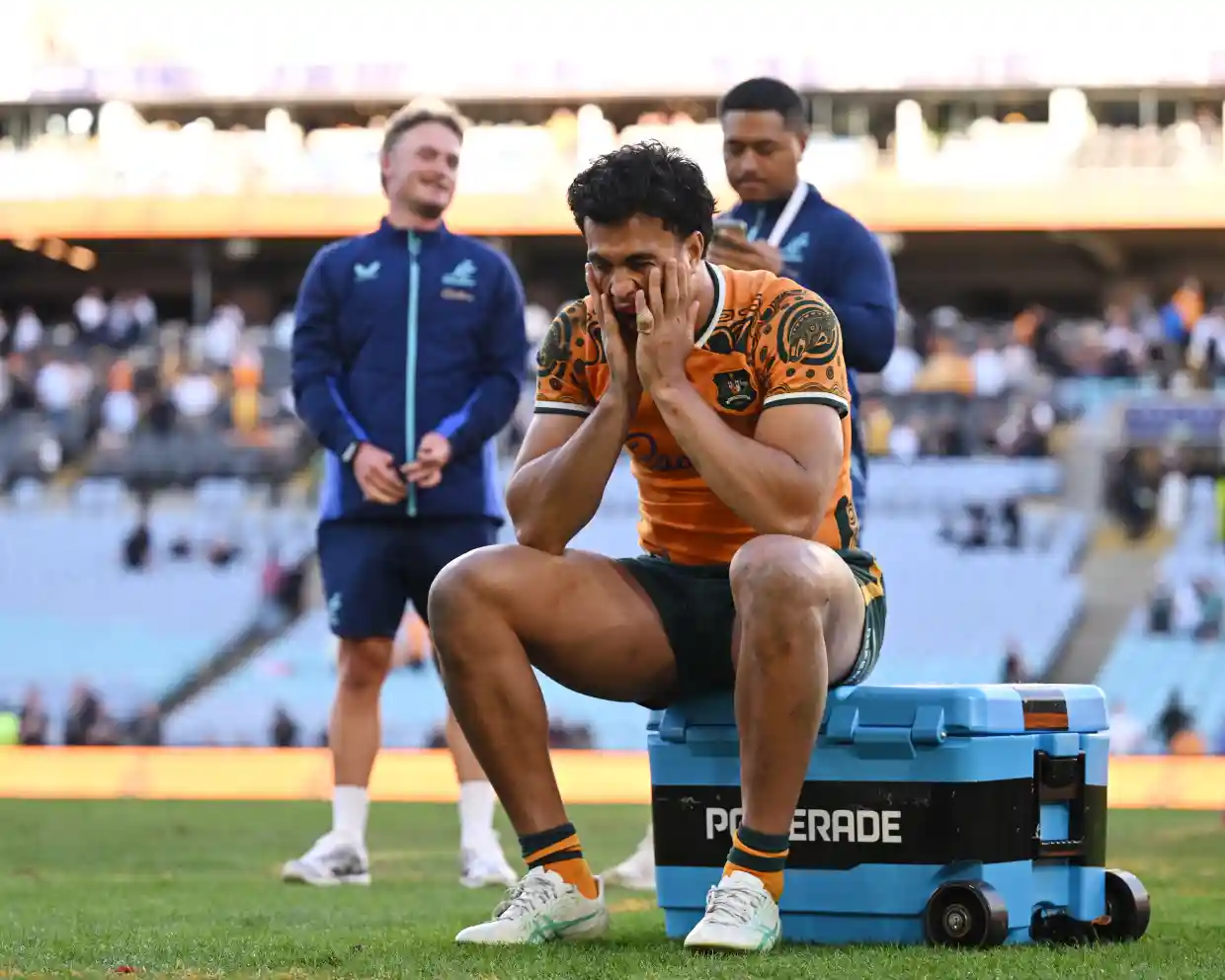
Australia’s hopes of challenging New Zealand in the Bledisloe Cup suffered another major setback as the Wallabies endured a humiliating defeat against the All Blacks. The 13th consecutive loss to their trans-Tasman rivals exposed serious weaknesses in Australia’s performance, raising fresh concerns about the team’s progress under head coach Les Kiss.
The defeat was particularly concerning because the match took place at the stadium where Australia will host a home Rugby World Cup. With the tournament approaching, the Wallabies face mounting pressure to improve if they want to remain competitive among the world’s leading rugby nations.
After an encouraging run of performances, including a victory over world No. 1 South Africa last month, expectations had risen around Kiss and his team. However, the latest Bledisloe Cup loss served as a stark reminder that Australia still has considerable work to do before it can consistently compete with the All Blacks.
Wallabies’ Bledisloe Cup Defeat Exposes Major Weaknesses
The Wallabies entered the match with renewed confidence after remaining unbeaten across six Tests and recording an impressive result against South Africa. Their performances had generated optimism among Australian rugby supporters, with the team appearing to make progress under Kiss.
However, the encounter against New Zealand quickly exposed the difference between Australia’s recent improvements and the standards required to challenge the world’s best teams. The Wallabies struggled from the opening minutes, making costly mistakes and allowing the All Blacks to take control of the contest.
Although Australia had managed to remain competitive during the first half of their previous meeting at Eden Park, they eventually conceded 26 unanswered points. The latest performance was even more alarming, with the Wallabies falling behind early and failing to contain New Zealand’s attacking threat.
The defeat also came against an understrength All Blacks side, making Australia’s inability to compete particularly difficult to overlook.
Disastrous Start Leaves Australia Facing an Uphill Battle
Australia’s problems began almost immediately as poor execution and unforced errors allowed New Zealand to establish a commanding advantage. Two kickoffs went out on the full, while the Wallabies repeatedly failed to complete promising attacking moves during the opening 10 minutes.
Rather than keeping their approach simple and building pressure, the Australians attempted overly complicated plays that ultimately broke down. Their inability to execute basic skills gave the All Blacks opportunities to attack and punish defensive mistakes.
The opening stages brought back painful memories of Australia’s previous Bledisloe Cup performance at the same venue in 2024, when the Wallabies trailed 21-0 after 15 minutes before eventually getting on the scoreboard.
This time, New Zealand had raced to a 22-0 lead in almost the same period. The situation could have been even worse if Damian McKenzie had not missed three of his four conversion attempts.
The disastrous start placed Australia under enormous pressure and left the team struggling to recover against an opponent that rarely wastes opportunities.
Les Kiss Admits Wallabies’ First-Half Performance Was Unacceptable
Head coach Les Kiss was visibly disappointed by Australia’s performance, particularly the defensive errors and attacking opportunities conceded during the first half.
Reflecting on the damage caused by the opening period, Kiss acknowledged that his team had given the All Blacks too many opportunities to take control.
“It was damage that’s for sure,” Kiss said of the first half.
He also made it clear that the team’s early performance fell well below acceptable standards.
“None of us accept 22-0. Those line breaks we offered, those missed tackles. The All Blacks are so clinical and they knock you off. A lot of young guys learned a lot but as a team there’s got to be more thinking about what it really means to turn up.”
Kiss’s comments highlighted the central problem facing Australia: the team must become more disciplined, mentally prepared and consistent if it wants to compete against elite international opposition.
While the coach recognised that younger players could learn from the experience, the scale of the defeat suggested that the necessary improvements must extend across the entire squad.
Statistics Reveal the Scale of Australia’s Defensive Collapse
The half-time statistics illustrated just how thoroughly New Zealand had dominated the contest. The All Blacks led by six tries to one and recorded 18 line breaks compared with Australia’s single line break.
The defensive numbers were equally troubling. Australia had missed 21 tackles, while New Zealand had missed only one. The Wallabies also conceded eight turnovers, compared with just two by their opponents.
These figures demonstrated that the defeat was not simply the result of a few unfortunate moments. Australia’s defensive organisation, ball security and attacking execution all fell short against a clinical New Zealand side.
The composition of the All Blacks team added another layer to the disappointment. Several prominent New Zealand players, including Ardie Savea, Ruben Love, Richie Mo’unga and Jordie Barrett, were absent from the match.
Despite those absences, New Zealand controlled the contest and exposed weaknesses that Australia must address before facing similarly strong opponents during the upcoming international season.
All Blacks Extend Their Dominance Over the Wallabies
New Zealand continued its impressive record against Australia by securing a 13th consecutive victory over the Wallabies. The result reinforced the All Blacks’ superiority in the rivalry and underlined the challenge facing Kiss as he attempts to rebuild Australia’s competitiveness.
When New Zealand scored again early in the second half, the score stood at 7-43. The margin recalled Australia’s 5-43 defeat in 2020, but the circumstances made the latest performance particularly alarming.
The earlier loss had been the final score after Australia went into half-time trailing 0-26. In this match, the Wallabies were already facing a heavy deficit with another 35 minutes remaining.
Kiss responded by emptying his bench in an attempt to change the momentum. However, although Australia showed greater fight after the break, the damage had already been done.
The Bledisloe Cup was beyond the Wallabies’ reach, and their latest defeat left serious questions about whether the team could close the gap on New Zealand in time for future major tournaments.
Wallabies Show Signs of Improvement After Half-Time
Despite the disastrous opening period, Australia showed greater energy and determination during the second half. The Wallabies improved their intensity and produced some encouraging individual moments, even though they could not recover from the early deficit.
Young fly-half Declan Meredith offered some positive signs in attack and came close to scoring two impressive tries. His willingness to take on defenders provided a glimpse of the attacking potential Australia hopes to develop.
Max Jorgensen also demonstrated creativity on the wing. Although his defensive performance included missed tackles, he continued to look for attacking opportunities and showed the ability to create something from difficult situations.
Joseph-Aukuso Suaalii ran strongly, while captain Harry Wilson attempted to inspire his teammates through his physicality and determination.
These individual contributions offered some encouragement, but they were not enough to disguise the scale of Australia’s collective failure. The Wallabies need more than isolated moments of quality to compete consistently against elite international teams.
Disappointed Fans Leave Stadium as Australia Struggles
The atmosphere at the stadium changed dramatically as the scale of Australia’s defeat became clear. Earlier in the day, supporters had enjoyed positive performances from Australia’s rugby sevens men, who drew 19-19 with Fiji, and the Wallaroos, who recorded their biggest victory against Scotland.
However, the main event failed to deliver the contest many spectators had hoped to see. As the match progressed, fans began leaving the stadium in large numbers, while a Mexican wave around the hour mark reflected the increasingly subdued atmosphere.
The scenes were particularly damaging because the venue is expected to play a central role when Australia hosts a future Rugby World Cup.
For Australian rugby, the tournament represents a major opportunity to strengthen the sport’s position in the country. But performances like this raise concerns about whether the Wallabies can develop into serious contenders before the competition arrives.
Harry Wilson Calls for Immediate Improvement
Captain Harry Wilson cut a dejected figure after the defeat and made no attempt to hide his disappointment. The Wallabies skipper acknowledged that the team had fallen well below expectations during the series.
“I’m gutted,” Wilson said. “It’s not good enough. We’ve got to be a lot better. It’s been a very disappointing series.”
Wilson also stressed the need for the squad to regroup ahead of a demanding spring tour, which will test Australia’s ability to respond to adversity.
“We’re going to have to regroup and improve a lot because we’ve got a big spring tour ahead. Not the way we wanted to finish the year.”
The captain’s comments reflected the mood within the Australian camp, where the immediate priority will be to understand what went wrong and develop a more reliable approach before the next series of international fixtures.
Wallabies Face Crucial Autumn Tour Against England, Scotland and Wales
Australia must now turn its attention to the upcoming northern tour, beginning with a Test against England at Twickenham on November 8. The Wallabies will subsequently face Scotland and Wales in a challenging run of matches.
The tour provides an opportunity for Kiss and his players to demonstrate that the Bledisloe Cup defeat can become a turning point rather than the beginning of a prolonged decline.
Australia also faces a difficult qualification challenge if it hopes to reach the Nations Championship finals on November 27. The Wallabies need to win all three upcoming matches with bonus points while also relying on favourable results involving South Africa and New Zealand.
That scenario leaves little room for further mistakes. The team must improve its defensive discipline, reduce turnovers and become more effective when converting attacking opportunities into points.
Dave Rennie’s All Blacks Set the Standard for Clinical Rugby
New Zealand coach Dave Rennie emphasised the importance of winning key moments, physical dominance at the breakdown and making effective decisions under pressure.
His team’s performance demonstrated how those elements can combine to create a decisive advantage. The All Blacks repeatedly punished Australia’s mistakes, controlled possession and capitalised on defensive gaps.
For Kiss, the challenge is to identify the missing elements in Australia’s performance and build a team capable of maintaining its composure when the pressure rises.
The Wallabies had enjoyed a confidence boost after defeating South Africa, but the latest result showed that success in one match does not automatically translate into consistent performances against other elite opponents.
The team must learn how to remain patient, execute its plans and avoid allowing early setbacks to dictate the outcome of a contest.
Can Les Kiss Revive Australia’s Rugby Campaign?
The defeat has placed renewed scrutiny on Kiss and his plans for Australian rugby. After a promising start that included six unbeaten Tests and a notable victory over South Africa, the Wallabies have now suffered a setback that raises questions about their consistency and resilience.
The coach must ensure that the team learns from the mistakes rather than becoming overwhelmed by the result. The performances of younger players such as Meredith and Jorgensen provide some encouragement, but Australia needs significant collective improvement to challenge the world’s best sides.
The upcoming tour will offer an early indication of how effectively the squad can respond. Matches against England, Scotland and Wales will test the Wallabies’ defensive organisation, attacking discipline and ability to compete for the full 80 minutes.
For a team preparing for a home World Cup, the stakes are considerable. Australia cannot afford to treat repeated heavy defeats as isolated disappointments if it hopes to restore its standing in international rugby.
Conclusion
Australia’s crushing defeat to the All Blacks has exposed significant weaknesses in the Wallabies’ defence, attacking execution and ability to handle pressure. The 13th consecutive loss in the Bledisloe Cup rivalry was particularly concerning because New Zealand managed to dominate despite missing several key players.
Les Kiss now faces the task of rebuilding confidence and addressing the problems that contributed to Australia’s disastrous start. Although individual performances from Declan Meredith, Max Jorgensen, Joseph-Aukuso Suaalii and Harry Wilson offered glimpses of potential, the team must become far more consistent.
With Tests against England, Scotland and Wales approaching, the Wallabies have an immediate opportunity to respond. Their performance on the northern tour will be crucial in determining whether they can recover from this setback and make meaningful progress towards Australia’s next major international rugby challenge.
For breaking news and live news updates, like us on Facebook or follow us on Twitter and Instagram. Read more on Latest Sports on thefoxdaily.com.

COMMENTS 0