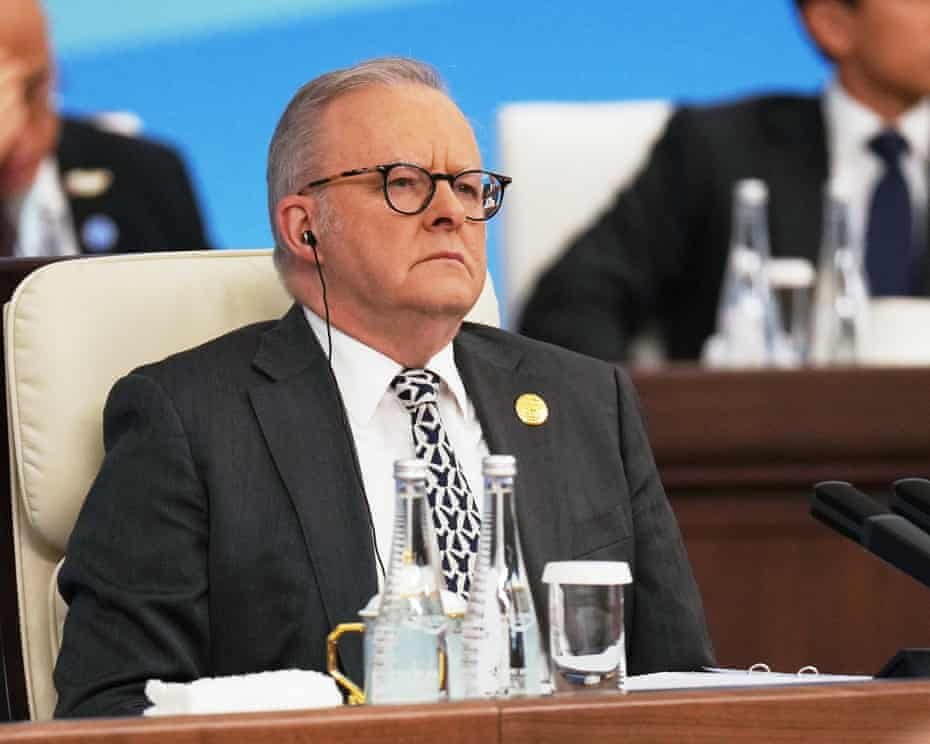
Australian Prime Minister Anthony Albanese has delivered a direct message to Russian President Vladimir Putin at the Asia-Pacific Economic Cooperation (APEC) summit in Shenzhen, China, urging him to end the war in Ukraine immediately. Addressing more than 20 world leaders, Albanese linked the conflicts in Ukraine and the Middle East to disrupted international trade, rising inflation and cost-of-living pressures.
Looking directly towards Putin during his speech, the Australian leader said: “And I say very directly to President Putin: end your war, end it now.” The remarks placed Russia’s invasion of Ukraine in the middle of discussions focused on economic cooperation and regional stability, with Chinese President Xi Jinping and US President Donald Trump also attending the summit.
Albanese’s intervention came just hours before a planned meeting between Xi, Trump and Putin on the sidelines of the gathering. The proposed trilateral discussions have attracted international attention because of the three countries’ influence over global security, trade and diplomacy, as well as concerns about whether Ukraine’s interests will be adequately represented in any discussion about the war.
Albanese Uses APEC Economic Forum to Confront Putin Over Ukraine
Albanese made his remarks during the APEC Economic Leaders’ Meeting in Shenzhen on Thursday, November 19, 2026. Although the summit’s central purpose is to promote economic cooperation among Asia-Pacific economies, the Australian prime minister used his address to highlight how armed conflicts are affecting international commerce.
He argued that the wars in Ukraine and the Middle East are among the major sources of disruption to global trade. The consequences, he said, extend beyond the countries directly involved, affecting supply chains, economic stability and the prices paid by consumers in other economies.
“Two of the biggest causes of disruption to trade are the conflicts in Ukraine and the Middle East, and we must do all we can to end them,” Albanese told the gathering.
He then specifically connected the Middle East conflict to inflation and household financial pressure, saying that the fighting was contributing to higher costs of living across economies.
His message to Putin was notably more direct than a general appeal for peace. Rather than referring only to the need for dialogue or de-escalation, Albanese addressed the Russian president personally and called on him to bring the war to an end.
Putin was present during the speech. According to observations from the event, the Russian president had his head down while Albanese delivered the remarks. The exchange created one of the summit’s most politically significant moments, bringing the Ukraine War into a forum primarily concerned with regional economic cooperation.
Trump, Xi and Putin Prepare for Unprecedented Three-Way Talks
Albanese’s comments came ahead of a planned meeting involving Putin, Trump and Xi later on Thursday. The three leaders were expected to hold trilateral discussions on the sidelines of the APEC Summit, bringing together the heads of the United States, China and Russia.
The meeting is attracting attention because of the diplomatic weight carried by the three countries. The United States remains a major actor in international efforts surrounding the Ukraine war, Russia is directly involved in the conflict, and China maintains a significant economic and diplomatic relationship with Moscow while also holding extensive ties with Washington.
Albanese publicly welcomed the planned discussions, despite his criticism of Putin’s actions in Ukraine.
“I welcome the meeting being held this afternoon between President Xi, President Trump and President Putin, and we hope for positive outcomes in the interests of the world,” he said.
His statement reflected two elements of Australia’s position: opposition to Russia’s war and support for diplomatic engagement that could help reduce international conflict.
However, the existence of high-level talks does not itself guarantee progress towards ending the war. Any meaningful settlement would involve difficult questions about Ukraine’s territory, sovereignty, security and the conditions under which fighting could stop.
The meeting’s significance also extends beyond Ukraine. Relations among Washington, Beijing and Moscow influence nuclear security, trade, technology and the wider international balance of power. Bringing the three leaders together therefore creates an opportunity for direct communication, but the different interests of their governments could limit what they are able to agree upon.
Zelenskyy Warns Against Decisions About Ukraine Without Kyiv
Ukrainian President Volodymyr Zelenskyy has warned that Thursday’s meeting must not determine the future of Ukraine without the country’s participation. His concern reflects a central issue surrounding diplomacy involving Russia: any agreement about Ukraine’s future would directly affect the country whose territory and population are at the centre of the war.
The proposed meeting has also prompted comparisons with the Yalta Conference of 1945, when the leaders of the United States, Britain and the Soviet Union discussed the post-war political order in Europe. The comparison has raised concerns among commentators and European leaders about the possibility of major powers discussing arrangements that could affect countries not represented at the negotiating table.
However, the historical circumstances are different. The Yalta meeting took place towards the end of the Second World War, when the participating Allied powers were negotiating the post-war settlement. The current discussions involve three countries with different positions on the Ukraine conflict and do not, by themselves, establish that a settlement or territorial agreement is being negotiated.
Zelenskyy’s warning nevertheless highlights the importance of Ukraine’s participation in any process that could shape the terms of peace. For Kyiv, an agreement reached without its involvement could raise fundamental questions about national sovereignty and the security of its territory.
Albanese has also maintained that a peaceful outcome must respect Ukraine’s position. His remarks at APEC reinforced Australia’s opposition to the Russian invasion while welcoming diplomatic efforts involving the major powers.
Albanese Faces Criticism Over APEC Group Photograph With Putin
Before delivering his speech, Albanese had faced criticism from members of the Ukrainian Australian community over his participation in a group photograph featuring APEC leaders, including Putin.
The photograph placed the Australian prime minister alongside the Russian president at an international gathering, prompting questions about whether appearing in the same official image could be interpreted as normalising Putin’s participation in global diplomacy despite the ongoing war.
Albanese, however, indicated that he would not allow the presence of the Russian leader to prevent him from communicating Australia’s position directly. His speech provided an opportunity to make that position clear in front of the other leaders attending the summit.
The distinction is important for Australia’s diplomatic approach. Participating in a multilateral event alongside a leader does not necessarily indicate support for that leader’s policies. Governments routinely attend international forums where countries with conflicting interests are represented, using those settings to communicate disagreements as well as pursue cooperation.
By addressing Putin publicly, Albanese sought to make clear that Australia’s participation in the summit did not mean abandoning its criticism of Russia’s actions in Ukraine.
China’s Economic Importance Complicates Australia’s Diplomatic Balancing Act
Albanese’s appearance at the Shenzhen summit also reflects the complex relationship between Australia and China. China is Australia’s largest trading partner, accounting for more than 25 per cent of Australian exports, according to the prime minister’s address.
That economic relationship gives the meetings between Albanese and Chinese officials considerable importance for Australian businesses, exporters and the wider economy. China is a major destination for Australian products, making stable trade relations an important consideration for Canberra.
At the same time, Australia has been strengthening its security cooperation with the United States and other regional partners. This creates a diplomatic balancing act: maintaining access to China’s large market while deepening defence and strategic relationships with countries concerned about China’s growing influence in the Indo-Pacific.
Albanese acknowledged the uncertainty facing economies around the world, saying that governments were dealing with inflationary pressures and an increasingly complicated international economic environment.
His comments also placed the Ukraine and Middle East conflicts within a broader economic argument. For Australia and other export-dependent economies, disruptions to international shipping, energy markets and supply chains can affect businesses and consumers even when the fighting takes place far from their borders.
Xi Jinping Calls for Cooperation Among APEC Economies
Chinese President Xi Jinping used his address to promote economic development and cooperation among APEC members. As host of the summit, Xi presented regional collaboration as essential for navigating economic uncertainty and maintaining prosperity across the Pacific.
“Members of APEC are like passengers riding the same ship. To navigate the waves of the Pacific, we must unite as one and look out for each other,” Xi said.
His remarks reflected China’s emphasis on trade, investment and cooperation as major themes of the gathering. The summit brings together economies with different political systems and strategic interests but substantial commercial links.
For Beijing, hosting the leaders provides an opportunity to present China as an important participant in regional economic governance. The presence of Trump and Putin alongside leaders from other APEC economies also gives the summit a wider diplomatic dimension.
However, economic cooperation does not remove disagreements over security and technology. China’s relationship with Australia continues to involve both commercial interdependence and strategic differences, particularly over regional security arrangements.
Quad Security Cooperation Could Feature in Albanese-Xi Meeting
Albanese is scheduled to meet Xi directly on Friday, November 20, with the wars in Ukraine and Iran among the international issues that could be discussed. The meeting will also take place against the background of Australia’s expanding security cooperation with the United States, India and Japan.
China is expected to raise concerns about Australia’s efforts to strengthen security ties with Washington and its participation in the Quad, a diplomatic and strategic grouping involving Australia, India, Japan and the United States.
The Quad has become an important platform for cooperation among the four countries across the Indo-Pacific. Its activities include maritime security, regional coordination and initiatives intended to strengthen cooperation in areas of shared strategic interest.
Earlier in the week, Quad leaders meeting in Manila announced plans for new joint military exercises and a business leaders’ forum expected to begin in 2027. Australia’s contribution to the military exercises will include P-8A Poseidon and P-3C Orion maritime patrol aircraft.
These aircraft are used for maritime surveillance and patrol operations, capabilities that are particularly relevant in a region where governments are increasingly focused on maritime security and freedom of navigation.
China’s concerns about the Quad reflect wider disagreements over the regional security architecture. Beijing has frequently criticised arrangements involving the United States and its partners, while the participating countries describe their cooperation as supporting a stable and open Indo-Pacific.
For Albanese, the challenge will be to maintain Australia’s security partnerships without undermining the economic relationship with China. The two priorities are closely connected to Australia’s long-term regional interests, but they do not always align comfortably.
Albanese to Continue China Visit With Talks in Beijing
Following his meeting with Xi in Shenzhen, Albanese is scheduled to travel to Beijing for further discussions with Chinese Premier Li Qiang and Zhao Leji, China’s third-ranking official.
The meetings will provide an opportunity to discuss the broader Australia-China relationship, including economic cooperation and regional developments. The prime minister’s visit comes at a time when governments across the Indo-Pacific are attempting to manage economic uncertainty alongside growing strategic competition.
China’s importance to Australian exports means that maintaining regular political communication remains a priority for Canberra. At the same time, Australia’s participation in the Quad and its military cooperation with the United States demonstrate that its foreign policy is not limited to trade considerations.
Why Albanese’s Message Matters Beyond the APEC Summit
Albanese’s direct appeal to Putin illustrates how the consequences of the Ukraine war have become part of wider international economic and diplomatic discussions. Although the conflict is taking place in Europe, its effects reach far beyond the region through energy markets, trade routes, inflation and geopolitical uncertainty.
For Australia, the issue is also connected to its stated support for Ukraine’s sovereignty and its relationships with international partners. Speaking directly to Putin at a gathering attended by major world leaders gave Albanese a platform to communicate that position without relying solely on diplomatic statements issued from Canberra.
The planned meeting between Trump, Xi and Putin will be closely watched for any indication of progress on international conflicts and security questions. Yet the most important test will be whether high-level engagement produces practical steps towards reducing violence and addressing the concerns of countries directly affected.
For Ukraine, that means ensuring its sovereignty and future are not decided without its participation. For Australia and other APEC economies, it means limiting the economic damage caused by prolonged conflict and protecting the stability of international trade.
Albanese has made Australia’s message unmistakable: the war in Ukraine must end. Whether the diplomatic discussions in Shenzhen can translate that appeal into meaningful progress remains an open question.
For breaking news and live news updates, like us on Facebook or follow us on Twitter and Instagram. Read more on Latest World on thefoxdaily.com.




COMMENTS 0