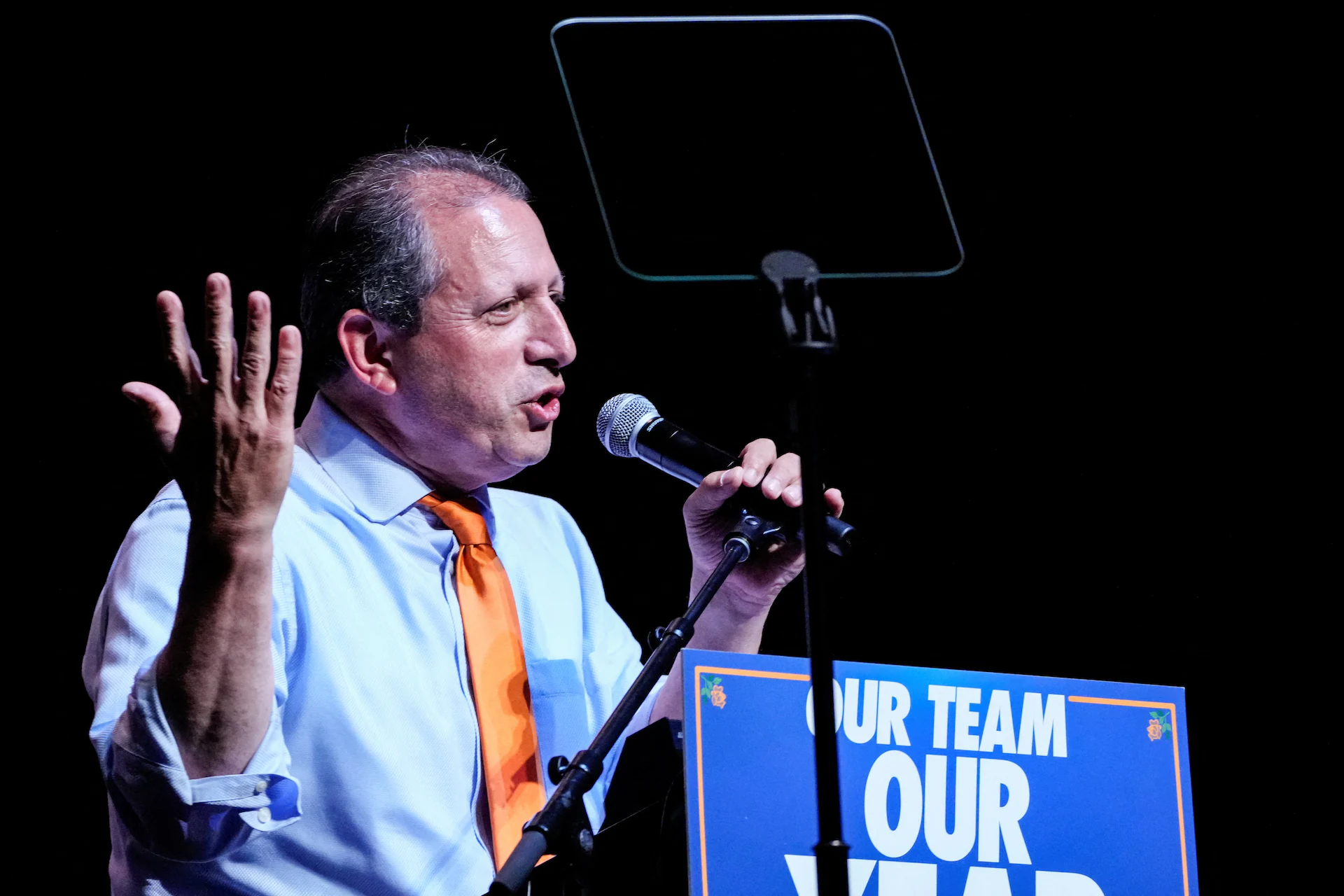
Brad Lander, a US Democratic Party candidate for Congress and former New York City comptroller, was detained by Israeli authorities on Wednesday, October 21, while participating in an olive harvest alongside Palestinian farmers and international volunteers in the occupied West Bank. He was later released, according to human rights organisations monitoring the incident.
The detention took place in Nahalin, a village south of Bethlehem, where Palestinian farmers were gathering olives with approximately 80 volunteers, according to Israeli organisation Rabbis for Human Rights and the North American Jewish organisation T’ruah. More than 30 US citizens, along with British and Canadian nationals, were reportedly among those detained.
Israeli police said the group had been harvesting olives near the fence of an Israeli settlement in an area where the activity was prohibited. The Israeli military, meanwhile, said harvesting in the location required prior coordination that had not taken place. Rights groups disputed the suggestion that the gathering had disrupted public order, saying the volunteers had been participating in a peaceful solidarity activity.
The incident comes amid heightened tensions surrounding Palestinian access to agricultural land and reports of increasing settler violence in the West Bank during the annual olive harvest. It has also drawn attention because of Lander’s political profile and his criticism of Israel’s conduct during the war in Gaza.
Who Is Brad Lander, and Why Was He Detained?
Brad Lander is a Jewish American politician, former New York City comptroller and former mayoral candidate who is running for New York’s 10th Congressional District in the US House of Representatives. The election is scheduled for November 3, 2026.
Lander is also an ally of New York City Mayor Zohran Mamdani and has been publicly critical of Israel’s conduct in the war in Gaza. His detention during a solidarity visit with Palestinian olive harvesters has brought additional attention to the incident involving American citizens in the occupied West Bank.
According to Rabbis for Human Rights and T’ruah, Lander was among the volunteers and local farmers detained by Israeli forces in Nahalin. He later confirmed his detention in a post on X, explaining that he had been gathering olives with a group of rabbis and volunteers.
In his statement, Lander wrote: “We were simply harvesting olives in a grove near Nahalin in the West Bank. The occupation is a crime under international law. Harvesting olives isn’t a crime under any law I know.”
His remarks linked the detention to broader concerns about the restrictions Palestinians face when accessing agricultural land in the West Bank. Lander characterised the activity as ordinary olive harvesting rather than conduct that warranted detention.
Rabbis for Human Rights and T’ruah subsequently confirmed that Lander had been released. Israeli police also said one foreign national was released after authorities learned that the individual was a congressional candidate.
Lander was not immediately available for further comment following the incident, according to the report.
What Israeli Police and the Military Said About the Detentions
Israeli police said Palestinian olive harvesters and dozens of Israeli and foreign activists had gathered near the fence of an Israeli settlement in an area where harvesting was prohibited. Police said those present had been detained.
The police account also stated that one foreign national was later released after officials became aware that the person was running for Congress in the United States. The statement did not identify the individual by name, but the circumstances corresponded with Lander’s reported release.
The Israeli military offered a different explanation for the restrictions. It said olive harvesting in the area required prior coordination, which had not taken place, and that the people present had consequently been detained.
The military did not say in its statement that harvesting itself was prohibited in the area. This distinction is important because the police and military explanations referred to different aspects of the incident: police described the activity as prohibited near the settlement fence, while the military cited the absence of required coordination.
The human rights organisations involved said Israeli military and police personnel arrived approximately two hours after the harvest began. According to their account, officials informed the farmers and volunteers that the location had been designated a closed military zone and that those present would be detained.
The available accounts therefore differ in how they describe the basis for the intervention. Israeli authorities referred to restrictions on the location or a lack of coordination, while the organisations supporting the harvesters said the gathering had been peaceful and that the participants had been willing to comply with the order to leave.
Rights Groups Say Volunteers Were Willing to Leave
Anton Goodman, acting director of Rabbis for Human Rights, said the participants had not known that the area had been designated a closed military zone. According to Goodman, the designation had been issued that morning.
Goodman said the group informed Israeli forces that they would respect the order and leave the area. However, he alleged that authorities then prevented them from departing, telling the participants they had been disturbing public order.
Speaking by phone from a police station in the Israeli settlement of Betar Illit, Goodman challenged that explanation.
He said the harvest had been quiet and peaceful and that the volunteers had not harmed public order. His account contradicted the suggestion that the group had engaged in conduct that justified their continued detention.
The distinction between the participants’ willingness to leave and their subsequent detention is central to the dispute. The rights groups maintained that the gathering was a peaceful activity conducted in solidarity with Palestinian farmers, while Israeli authorities cited restrictions applicable to the location.
The available information does not establish an independent resolution of the conflicting accounts. The circumstances surrounding the designation of the area, the instructions given to the group and the reasons for the detention remain important elements of the incident.
More Than 30 Americans Reportedly Among Those Detained
Rabbi Jill Jacobs, chief executive of T’ruah, said the group included more than 30 US citizens, as well as British and Canadian nationals. Jacobs was herself among those detained, according to the report.
Jacobs told Reuters that the volunteers had not engaged in violence and were simply picking olives alongside Palestinian farmers. She said the group had apparently been regarded as disturbing public order because of its participation in the harvest.
Rabbis for Human Rights said Lander was the only person released at that stage and that the others were expected to be interrogated. The status of the remaining detainees was not fully established in the available account.
The involvement of so many foreign nationals raised concerns about the treatment of international volunteers participating in agricultural solidarity activities. Such volunteers accompany Palestinian farmers in areas where the farmers may face threats or intimidation while trying to access their land.
The presence of international observers can draw attention to incidents affecting local residents, but it does not necessarily prevent confrontations or guarantee that participants will be permitted to remain in a particular area. The rules imposed by Israeli authorities, including restrictions on access and coordination requirements, can directly affect whether such activities proceed.
The reported detention of dozens of foreign citizens also made the response of their respective governments relevant. The US Embassy in Jerusalem confirmed that it was aware of reports involving detained American citizens and was monitoring the situation.
US Embassy Monitoring the Situation
A spokesperson for the US Embassy in Jerusalem said the embassy was aware of reports that US citizens had been detained by Israeli authorities and was monitoring developments. The spokesperson declined to provide further details, citing privacy and other considerations.
The spokesperson also said that the Trump administration had no higher priority than the safety and security of Americans.
The embassy’s statement confirmed awareness of the reported detentions but did not provide details about any direct diplomatic intervention, the legal status of the detained citizens or the steps being taken on behalf of individual participants.
For American citizens detained overseas, consular officials may monitor developments and provide appropriate assistance within the limits of their responsibilities. However, the precise support available in a particular case depends on the circumstances, and the embassy’s statement did not outline any specific actions beyond monitoring the situation.
Lander’s release reduced the immediate uncertainty surrounding his own detention, but questions remained about the other volunteers and the circumstances under which they were being held.
Why Palestinian Olive Harvesting Is So Important
The annual olive harvest is a major agricultural activity for Palestinian communities in the West Bank. Olive trees provide income for farming households and contribute to a wider agricultural sector that supports employment and local economic activity.
According to figures cited from the Palestinian Authority’s agriculture ministry, agriculture accounts for approximately 8% of Palestinian gross domestic product and supports more than 60,000 jobs. Olive cultivation is an important part of this agricultural landscape.
For many families, olive harvesting is more than a seasonal task. The crop can be a significant source of household income, and the ability to reach and work on agricultural land is essential to maintaining livelihoods.
Restrictions on access to farmland, delays in harvesting and security threats can affect a farmer’s ability to collect the crop. Because olive harvesting is seasonal, losing access at the relevant time can have economic consequences that are difficult to reverse once the harvest period has passed.
These challenges are especially significant in areas where Palestinian farms are close to Israeli settlements or roads and locations subject to security restrictions. Farmers may face uncertainty about whether they can reach their land safely and whether they will be permitted to continue working once they arrive.
International volunteers sometimes accompany farmers as part of what human rights groups describe as a protective presence. Their participation is intended to provide solidarity and visibility during the harvest, particularly in areas where farmers report threats or violence.
The incident in Nahalin illustrates how these activities can become entangled in disputes over access, security restrictions and the rights of Palestinian residents to work their agricultural land.
Rising Concerns Over Settler Violence in the West Bank
Lander’s detention took place against a backdrop of reports of increasing violence by Israeli settlers against Palestinians and other civilians in the occupied West Bank. The annual olive harvest has repeatedly drawn attention to tensions surrounding access to agricultural land.
According to the report, attacks over the preceding weekend prompted US Secretary of State Marco Rubio to call on Israeli Prime Minister Benjamin Netanyahu’s government to crack down on settler violence.
Two other incidents were cited in connection with the concerns. An American photojournalist working for The Washington Post was reportedly beaten by Israeli settlers while covering a Palestinian olive harvest on Friday. On Saturday, European diplomats and a French mayor were reportedly attacked by settlers during another harvest-related visit. Palestinians were also attacked in both incidents.
Israeli police announced on Monday that they had made 10 arrests in connection with the weekend violence.
These incidents have intensified attention on the safety of Palestinian farmers, international observers and other visitors in areas where access to agricultural land is disputed. They have also raised questions about the enforcement of laws and the protection of civilians during the olive harvest.
Rubio’s reported call for action placed the issue on the agenda of US-Israeli relations, particularly as American citizens and other foreign nationals were also involved in the latest detention incident.
However, the reported arrests relating to the weekend attacks and the detentions in Nahalin are separate developments. The available information does not establish that the cases are directly connected beyond their broader context of tensions and security concerns in the West Bank.
What Is a Protective Presence During the Olive Harvest?
The volunteers accompanying the farmers in Nahalin were participating in an activity commonly described by the organisations involved as a protective presence. In this context, volunteers accompany local residents as they carry out agricultural work in locations where they may face threats or confrontations.
The approach is based on the idea that the presence of additional witnesses can increase visibility and help document incidents. Participants may include human rights advocates, religious leaders, international visitors and local supporters.
Rabbis for Human Rights and T’ruah, the organisations cited in the incident, have been involved in solidarity activities connected to Palestinian communities and concerns about access to agricultural land.
Such activities can nevertheless bring volunteers into areas governed by military orders, access restrictions or other security measures. Participants may face detention if authorities determine that they have violated an applicable restriction, as Israeli officials said had happened in Nahalin.
The disagreement in this case centred on the character of the gathering and the basis for the detention. The organisations said the harvest was peaceful and that participants had agreed to leave when informed of the closed military zone. Israeli authorities cited restrictions and the absence of prior coordination.
The episode highlights the challenges facing both Palestinian farmers seeking to harvest their crops and international volunteers who accompany them in contested areas.
What Happens Next for Lander and the Other Detainees?
As of the latest account in the report, Lander had been released, while the other detained volunteers were expected to be interrogated, according to Rabbis for Human Rights. The report did not establish when the remaining detainees would be released or whether any formal charges would follow.
The US Embassy in Jerusalem said it was monitoring the situation involving American citizens but did not disclose details of any individual cases. The position of the British and Canadian nationals was not fully detailed in the available information.
Lander’s immediate political plans following the incident were also unclear. He is running for New York’s 10th Congressional District in the November 3 midterm elections, and the detention occurred less than two weeks before the scheduled vote.
His release and public statement brought the incident to wider attention, but the underlying dispute over access to the harvest area remains part of broader concerns about restrictions on Palestinian agricultural activity and reports of violence in the West Bank.
The incident also leaves unresolved questions about how authorities determine when harvesting requires coordination, how closed military zones are communicated to farmers and volunteers, and how people who agree to comply with an order to leave are treated.
Key Takeaways From the West Bank Detention Incident
- Brad Lander was detained and released: The Democratic congressional candidate and former New York City comptroller was detained while participating in an olive harvest in Nahalin, south of Bethlehem, before being released.
- The gathering involved Palestinian farmers and international volunteers: Rights groups said approximately 80 volunteers accompanied local farmers during the harvest.
- Dozens of foreign nationals were reportedly detained: More than 30 US citizens, along with British and Canadian nationals, were among those held, according to T’ruah’s chief executive.
- Israeli authorities cited restrictions: Police said the harvesting was prohibited near a settlement fence, while the military said prior coordination had not taken place.
- Rights groups disputed the public-order justification: Organisers said the participants were peaceful and had agreed to leave when informed of the closed military zone.
- The US Embassy was monitoring the situation: The embassy confirmed awareness of reports involving American citizens but declined to provide further details.
- The incident occurred amid wider tensions: Reports of settler attacks during the olive harvest had prompted calls for action from US Secretary of State Marco Rubio.
The detention of Brad Lander and other olive harvest volunteers underscores the tensions surrounding Palestinian access to agricultural land in the occupied West Bank. While Israeli authorities cited restrictions on harvesting in the area, rights organisations said the volunteers had been participating in a peaceful solidarity activity. Lander’s release resolved his immediate detention, but the status of the other participants and the broader concerns about farmers’ safety and access to their land remained unresolved in the latest account.
For breaking news and live news updates, like us on Facebook or follow us on Twitter and Instagram. Read more on Latest World on thefoxdaily.com.

COMMENTS 0