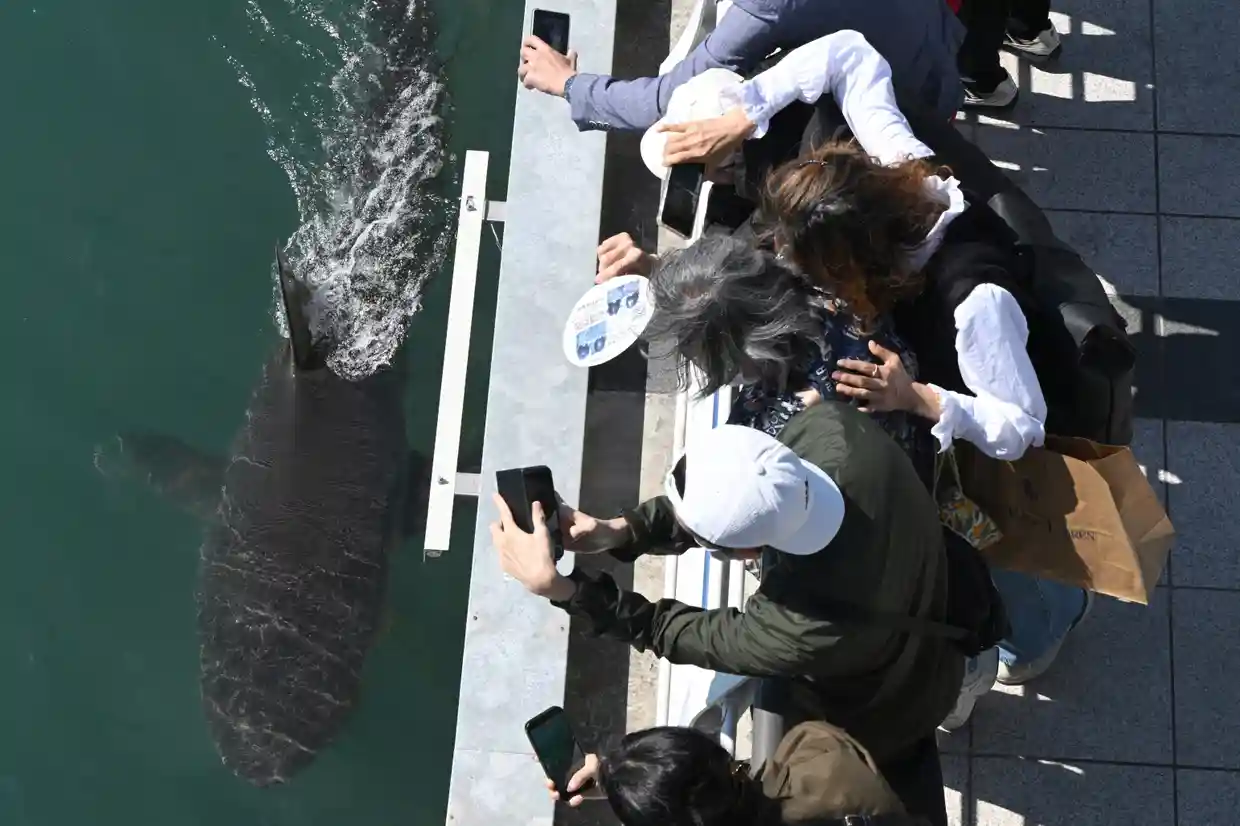
For more than a month, a stranded shark in South Korea’s Busan city became the focus of an extraordinary public effort, bringing together livestreamers, curious visitors and concerned residents. As the animal remained trapped in a canal, a group of YouTubers took on an unusual role: patrolling the waterfront at night to protect the shark from bright lights, food waste and other disturbances.
Affectionately named Bukang-i, the approximately three-metre-long female dusky shark attracted more than 1.6 million visitors, transforming a quiet waterfront park into a national attraction. While authorities made repeated attempts to guide her back to the sea, online creators and local supporters began monitoring the waterway, urging visitors to leave the animal undisturbed.
The vigil came to an end on Wednesday, when officials successfully guided the shark out of the canal on their third attempt, South Korea’s oceans ministry said. After weeks of public attention and concern about the animal’s welfare, her departure marked the conclusion of an unusual episode that combined Wildlife Conservation, livestreaming culture and grassroots activism.
Who Were the YouTubers Protecting Bukang-i?
In South Korea, the term jagyeongdan describes a group resembling a neighbourhood watch or a self-appointed vigilante patrol. During Bukang-i’s time in the canal, this informal idea took on a wildlife-protection dimension as livestreamers and local residents gathered after dark to watch over the stranded shark.
Wearing high-visibility vests and carrying selfie sticks, the volunteers took turns patrolling the waterfront. Many were YouTubers who had started broadcasting the shark’s presence online. As the story gained national attention, they began using their livestreams not only to document the animal but also to discourage behaviour that could disturb her.
Their work often involved confronting visitors who shone torches, camping lamps or other bright lights into the canal. Some of these visitors were described by Korean internet users as “lantern villains”, a label reflecting the frustration of those who believed the lights were upsetting the shark.
Choi Won-jin, one of the volunteer guardians, said he would arrive after the canal lights went out and wait for people attempting to illuminate the water. Choi has operated a YouTube channel for about a decade, covering trending issues in South Korea. His involvement in Bukang-i’s story grew from online observation into a regular nighttime presence at the canal.
“We’re ordinary members of the public,” Choi said, explaining that the group had to rely on persuasion rather than formal authority. The volunteers tried to explain why the shark should be left alone, hoping visitors would understand the risks instead of turning every confrontation into an argument.
Another livestreamer, who lived nearby and used the name Na Tae-soo, repeatedly asked visitors not to switch on their torches. He said most people complied when approached, although some continued to disturb the animal.
Why Were Bright Lights a Concern for the Stranded Shark?
The volunteers’ concerns were not simply about keeping the canal quiet. Footage recorded during the vigil showed Bukang-i reacting sharply to a beam of light in the early hours of the morning. At around 2am, the shark twisted away from the light and struck the side of the canal.
South Korea’s National Institute of Fisheries Science later confirmed that the shark had an abrasion on her snout. The institute said a visitor’s torch was likely to have startled the animal and contributed to the injury.
The incident highlighted how seemingly harmless actions can pose risks to wildlife, particularly when an animal is confined to a restricted environment and unable to move away from repeated disturbances. A torch or camping lamp may appear insignificant to a visitor, but the consequences can be more serious when large crowds repeatedly direct lights towards an animal.
The shark’s situation also created a difficult balance between public curiosity and animal welfare. People wanted to see an unusual marine visitor at close range, while those monitoring her argued that the attention itself could become a source of stress.
The YouTubers’ livestreams served two purposes. They allowed viewers who could not visit Busan to follow the story, but they also recorded behaviour that the volunteers believed was harmful. In doing so, the creators became informal monitors of activity around the canal, documenting both the shark’s movements and the challenges of protecting her.
More Than a Month Trapped in the Canal
Bukang-i had been stranded in the canal since September 18. Her name was derived from Bukhang, the Korean name for Busan’s North Port, linking the animal to the waterfront where she was found.
The female dusky shark belongs to a species classified as endangered worldwide. Her presence in the canal therefore attracted interest beyond the novelty of finding a large shark in an urban waterway. The animal’s condition, the circumstances that had left her there and the possibility of safely returning her to open water became central concerns.
Authorities attempted twice to guide Bukang-i out to sea, but both efforts failed. Further attempts were paused because applying additional force risked causing the shark more distress. Officials and experts faced the challenge of helping her leave without making an already difficult situation worse.
The canal became an unusual temporary habitat, drawing large crowds during the day while leaving a much quieter scene after midnight. A park that reportedly attracted around 2,000 people on a busy Saturday saw visitor numbers rise dramatically, with the city estimating that more than 1.6 million people came to see the shark during her time there.
For the YouTubers, the end of the daily crowds did not mean the end of the work. They continued visiting the waterfront after dark, checking the area and asking people to avoid disturbing the water. Their routines included walking along the canal, sharing snacks and discussing incidents they had witnessed while livestreaming.
Dispute Over Who Was Watching the Shark at Night
South Korean media reported that 105 officials from seven agencies were involved in monitoring Bukang-i, with a response team reportedly ready to reach the water within three minutes. Choi, however, challenged the impression that the official presence was sufficient during the night.
According to Choi, much of the nighttime monitoring fell to him and the other volunteer guardians. His account pointed to a difference between the formal arrangements reported by the media and the experience of people who spent long hours at the waterfront.
The canal’s public access was restricted from midnight until 5am. The volunteers nevertheless argued that enforcing the restriction across a large park was difficult, especially when visitors could approach the water from different points.
During one livestream, Choi recorded a man pouring food waste into the canal. The incident raised further concerns about how people were interacting with the waterway and whether their behaviour could affect the shark’s environment.
There was also uncertainty about whether Bukang-i was feeding while trapped. The volunteers said nobody had seen her eat, but experts noted that feeding could occur in a brief moment and that a shark of her size would not necessarily need to eat frequently.
These details illustrated the limits of what could be established through observation alone. Livestreamers could record visible behaviour and draw attention to potential problems, but they could not necessarily determine the shark’s health, feeding patterns or wider physiological condition without scientific assessment.
Why Experts Were Watching Water Temperature
As the weeks passed, water temperature became an important factor in discussions about Bukang-i’s prospects. Dusky sharks prefer water temperatures between 18C and 26C, according to the fisheries institute.
Experts estimated that the shark’s physiological functions could begin to decline below 15C, while temperatures around 11C could make survival precarious. Busan officials expected the canal’s water temperature to reach that lower level after the middle of November.
The approaching cold weather added urgency to the question of how long the shark could safely remain in the canal. Yet it did not provide a simple answer. Although cooler conditions were expected to encourage her to move on, the authorities also had to consider the risks associated with another intervention.
Attempts to guide a large marine animal out of a confined waterway can be challenging, especially when the animal is distressed or does not respond as expected. The previous unsuccessful efforts reinforced the need to avoid unnecessary pressure while considering the consequences of leaving her in place.
The decision to pause further attempts reflected this tension between intervention and restraint. The challenge was to protect the shark without exposing her to additional stress, while also recognising that the canal might become increasingly unsuitable as temperatures fell.
Bukang-i’s eventual departure, confirmed by the oceans ministry on Wednesday, followed two unsuccessful attempts. Officials said she had been successfully guided out of the canal and were expecting her to move into open water.
Warmer Seas and More Shark Sightings Off South Korea
Bukang-i’s appearance in Busan also drew attention to wider changes in the marine environment around South Korea. The National Institute of Fisheries Science recorded 46 large sharks off the country’s east coast during the first half of the year, nearly four times the number reported over the same period a year earlier.
The institute attributed the increase to warmer seas and a greater abundance of fish that sharks feed on. These factors can influence where marine animals travel and the conditions in which they find food, although the figures alone do not establish why a particular shark entered a canal.
Rising sea temperatures can affect marine ecosystems by changing the distribution of species and altering the availability of prey. When conditions shift, some marine animals may appear in places where sightings were previously less common. However, individual encounters require careful interpretation, and Bukang-i’s presence in the canal should not automatically be treated as proof of a specific climate-related cause.
The increase in reported shark sightings nevertheless gave the episode a broader environmental context. It raised questions about how coastal communities, fisheries experts and local authorities can respond when large marine animals enter busy public areas.
For officials, such encounters can require a combination of monitoring, public communication and decisions about when intervention is appropriate. For residents and visitors, they can provide a reminder that wildlife protection is not limited to remote marine habitats. It can also become an immediate concern in a city where people live, work and gather beside the water.
How Bukang-i Became a National Celebrity
The stranded shark’s story quickly expanded beyond wildlife monitoring. As crowds arrived and livestreams attracted large audiences, Bukang-i became a recognisable figure in South Korean popular culture.
The attention generated a range of commercial and promotional activities. A commemorative soju was introduced, a baseball mascot appeared wearing a shark cape, and Bukang-i received an honorary city ambassadorship. Nearby shops also reported increased sales as visitors came to see the animal.
South Korean President Lee Jae Myung visited the canal in mid-October, underlining the national attention surrounding the episode. The visit came as the public continued to follow the shark’s condition and authorities considered how to resolve her prolonged stay in the waterway.
The surge in visitors demonstrated how an unusual wildlife encounter can quickly become a major public event in the age of social media. Livestreams allowed audiences to follow the shark in near real time, while short clips of her movements and interactions with the environment could be shared widely.
For local businesses, the crowds created an unexpected commercial opportunity. For the city, the attention offered visibility but also brought practical responsibilities, including managing visitors and limiting activities that could disturb the animal.
The popularity of Bukang-i also created a contradiction. Public attention helped keep her welfare in the spotlight, but the large crowds that made her famous could themselves become a source of disturbance. The challenge was to encourage interest in the animal without allowing curiosity to compromise her safety.
Why Some Guardians Opposed Forcing the Shark Out
Despite the urgency surrounding the shark’s condition, not all of her volunteer guardians believed that authorities should keep trying to move her by force. Some argued that she should be allowed to remain in the canal until she chose to leave, provided her environment remained safe enough.
Choi said the city should protect Bukang-i where she was rather than pressuring her to move before she was ready. His position reflected the concern that repeated interventions could create additional stress for an animal already confined to an unfamiliar environment.
Kim Jong-hwan, a small-business owner who also kept watch during the day, livestreamed Bukang-i on most days. He initially visited the canal to pass information to his followers, but his regular observations gradually changed how he viewed the efforts to guide the shark away.
Kim said that watching the water pumps being activated and nets being used made him increasingly uncomfortable with the methods employed during the attempts to move her. He said the experience led him and others to support the shark rather than simply observe her as a spectacle.
“She’s just an animal, and she came in by her own choice,” Kim said.
He argued that the shark should be left to respond to the conditions around her. If the water became too cold, food became scarce or the environment no longer suited her, he believed she would leave when she was ready.
That view was not necessarily the same as a scientific assessment of the shark’s ability to survive in the canal. Experts were monitoring temperature thresholds and officials were responsible for evaluating the risks of different interventions. Nevertheless, the volunteers’ position highlighted an ethical question that often arises in wildlife management: when does helping an animal become another source of stress?
The Role of Livestreaming in Wildlife Protection
Bukang-i’s story showed how online creators can become involved in events that extend beyond entertainment. The YouTubers arrived as observers, but their broadcasts helped document the shark’s movements, public reactions and potential disturbances around the canal.
Unlike trained wildlife professionals, the guardians did not have formal authority to control access to the water or decide how the shark should be handled. Their influence came from their presence, their ability to communicate directly with visitors and the audiences following their livestreams.
That informal role had both advantages and limitations. Continuous observation could help bring incidents to public attention, while live broadcasts could encourage visitors to behave more carefully. At the same time, the number of people drawn to the spectacle showed how online attention can increase pressure on a vulnerable animal.
The episode also demonstrated the importance of clear communication between authorities and the public. Official monitoring, scientific expertise and community participation can serve different purposes, but they are most effective when the public understands what is being done and why certain restrictions are necessary.
As the shark’s story spread, the volunteers became an unexpected part of the response. Their nighttime patrols were not a substitute for professional wildlife management, but they helped focus attention on everyday actions that could make the animal’s situation worse.
What Bukang-i’s Story Leaves Behind
Bukang-i’s successful departure from the canal brought an end to more than a month of uncertainty, public fascination and nighttime vigilance. The oceans ministry confirmed that she had been guided out on the third attempt, with officials expecting her to move into open water.
Her journey through the canal attracted millions of visitors, brought new business to the surrounding area and turned a group of YouTubers into informal guardians of a stranded marine animal. Their efforts centred on a simple request: do not shine lights at the shark, throw waste into the water or otherwise disturb her while she remained trapped.
The episode also raised larger questions about wildlife encounters in urban environments, the impact of changing marine conditions and the responsibilities that accompany viral attention. A rare animal can become a source of public excitement almost overnight, but its welfare depends on more than the number of people watching.
For Choi, Kim and the other volunteers, the experience was about more than filming an unusual sight. They wanted the shark to be treated as a living animal rather than a tourist attraction. Their views differed in emphasis from the authorities’ efforts to guide her back to sea, but both sides were confronted with the same difficult task: finding a way to protect an animal whose presence had captured the public imagination.
As Bukang-i left the canal, the livestreams and late-night patrols became part of an unusual chapter in Busan’s recent history. The shark’s story offered a reminder that wildlife protection can begin with small, practical acts of restraint, even when the animal at the centre of the attention has become a national celebrity.
For breaking news and live news updates, like us on Facebook or follow us on Twitter and Instagram. Read more on Latest World on thefoxdaily.com.


COMMENTS 0