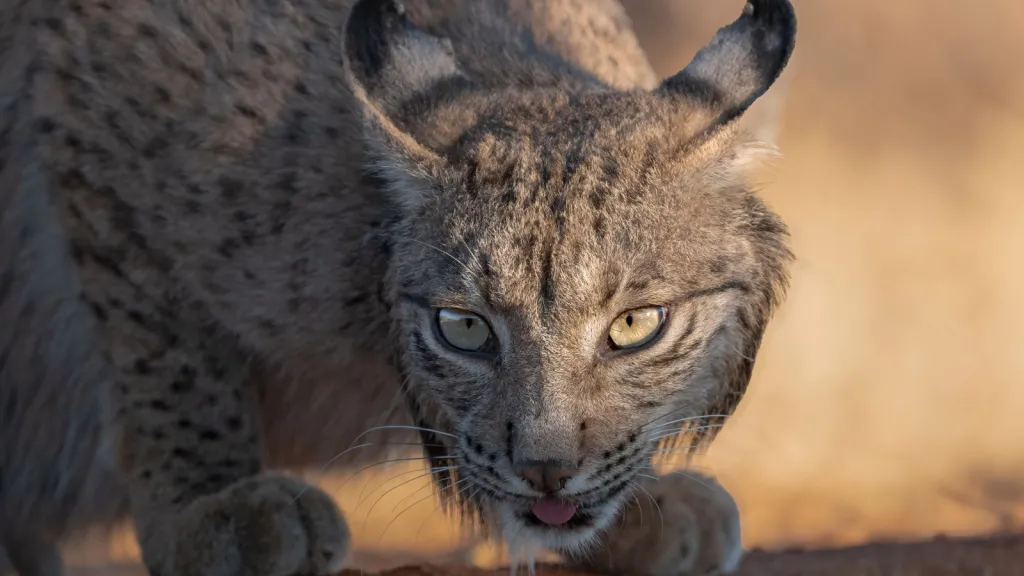
In the wild, predators usually kill their prey and carry it away to eat or feed their young. But researchers studying the Iberian lynx in Spain have documented an unusual step in this process: some female lynxes are dipping freshly killed rabbits into water before taking them away. The behaviour, recorded through camera traps, has left scientists investigating why these wild cats are soaking their food.
The observations were made at the El Castañar estate in Spain’s Montes de Toledo region. Between 2020 and 2025, researchers documented eight incidents involving five female Iberian lynxes and five water troughs. In four of these cases, camera footage directly showed the animals immersing their prey in water.
One particularly clear recording, dated August 20, 2023, showed a female lynx named Naia holding a rabbit underwater for at least 60 seconds. She then carried away the visibly soaked carcass. Researchers did not record the lynxes eating the rabbits after soaking them, leaving the purpose of the action uncertain.
The findings offer a rare glimpse into an unusual behaviour among wild carnivores. Although food-washing and soaking have been observed in several animal species, deliberately immersing freshly killed prey before carrying it away appears to be a much less familiar activity. Scientists have proposed several explanations, but none has yet been confirmed.
What makes the Iberian lynx’s prey-soaking behaviour unusual?
The Iberian lynx is a specialised predator whose diet depends heavily on European rabbits. Hunting and transporting rabbits are therefore important parts of its daily survival and, for females with young, their role as mothers.
What makes the recent observations particularly interesting is that the lynxes did not simply drink from the water troughs or accidentally wet their prey. Camera recordings showed females deliberately immersing freshly killed rabbits before carrying them away.
The repeated incidents suggest that the behaviour may serve a purpose rather than being an isolated accident. However, researchers still need more observations to establish whether it is a learned habit, a practical response to environmental conditions or an activity linked to raising cubs.
The August 2023 recording of Naia is especially useful because it clearly shows the sequence of events. The female held the rabbit underwater for at least a minute before leaving with it. Yet the footage does not reveal what happened after she carried the prey away or whether her cubs consumed it.
Why would female Iberian lynxes soak freshly killed rabbits?
Researchers have considered several possible explanations for the behaviour. The leading ideas relate to water transportation, feeding young cubs and social learning. Each offers a possible reason for the repeated observations, but the available evidence is not sufficient to identify one as the definitive explanation.
1. Could lynxes be carrying water to their cubs?
One possibility is that female lynxes use soaked rabbits to transport water to their young. This theory is particularly interesting because the behaviour was recorded during a period that included warmer and drier summer months.
Water availability can become an important concern for animals living in hot environments. Female lynxes raising cubs must also meet the needs of their offspring while hunting and moving around their territories. If the cubs are not able to access sufficient water independently, their mothers may need to find ways to provide it.
By immersing a rabbit in a water trough, a female lynx could potentially carry some of that water back to her young. The soaked carcass might retain moisture during transport, allowing the mother to bring both food and a small amount of water in a single journey.
This explanation is supported by the researchers’ exploratory experiment, which found that rabbit carcasses could retain measurable amounts of water after immersion. However, the researchers did not directly observe cubs obtaining water from soaked prey. The idea therefore remains a hypothesis rather than an established explanation.
2. Could soaking make rabbits easier for cubs to eat?
Another possibility is that the behaviour is connected to the development of young lynxes. Like other mammals, Iberian lynx cubs initially depend on their mother’s milk. As they grow, they gradually begin consuming solid food, making the transition from milk to meat an important stage of development.
Researchers have suggested that soaking a rabbit could make the prey easier for cubs to consume during this weaning period. The added moisture might change the texture of parts of the carcass or make it more suitable for young animals that are still adapting to solid food.
However, there is no direct evidence that soaked rabbits are easier for lynx cubs to eat. The camera traps recorded the mothers immersing their prey, but researchers did not document the cubs feeding on the carcasses afterwards.
The theory is therefore a possible explanation for why the behaviour might be useful to mothers, particularly when they are raising young. Further observations of feeding interactions would be needed to determine whether it plays a role in the weaning process.
3. Could the behaviour spread through social learning?
The researchers also considered whether prey-soaking might be a behaviour that spreads between individual lynxes through social learning. In some animal species, individuals acquire new behaviours by observing others, particularly members of their family or social group.
The recorded incidents involved females living in neighbouring territories or animals that were related. This raised the possibility that the behaviour could have been passed between individuals through contact or observation.
However, the researchers found no direct evidence that one lynx learned to soak prey by watching another. The fact that related or neighbouring females displayed similar behaviour is interesting, but it does not establish how the habit originated or spread.
It is also possible that different females independently developed the same behaviour in response to similar environmental or maternal needs. Distinguishing between individual innovation and social learning will require more detailed observations.
What did the rabbit-soaking experiment reveal?
To investigate whether soaking could help cool prey or allow it to retain water, the research team conducted exploratory trials using four rabbit carcasses. The experiment examined how immersion affected the carcasses under different conditions.
The results suggested that immersing a rabbit in water slightly accelerated its cooling. The effect was more noticeable when the carcass was kept in the shade, indicating that the combination of soaking and reduced exposure to sunlight could influence how quickly the prey cooled.
The researchers also measured how much water the carcasses retained after immersion. A rabbit soaked for 30 seconds and then kept in the shade retained water equivalent to 5.14 per cent of its body weight. Even after 40 minutes, it still retained approximately 3.7 per cent.
These observations are relevant to the water-transport theory. If a female lynx carries a soaked rabbit back to her cubs, some moisture could remain in the carcass during the journey. The mother might therefore be transporting water along with food.
Why the experiment cannot confirm the behaviour’s purpose
Although the results provide an interesting starting point, the researchers have cautioned against treating them as proof of why lynxes soak their prey. The experiment involved only four rabbit carcasses and was exploratory, non-replicated and illustrative in nature.
A small experiment can help identify a possible mechanism, but it cannot establish how frequently that mechanism matters in the natural environment. The results show that rabbit carcasses can retain water after immersion; they do not demonstrate that female lynxes deliberately soak prey to provide drinking water to their cubs.
Similarly, the cooling effect does not establish that temperature regulation is the reason behind the behaviour. More extensive experiments and direct observations of mothers and cubs would be needed to test these explanations.
The research therefore provides possible clues rather than a final answer. The difference is important because unusual animal behaviours can have several potential functions, and the most convincing explanation must be supported by evidence from the animals themselves.
Do other animals wash or soak their food?
Food-washing and soaking are not entirely unknown in the animal kingdom. Similar behaviours have been documented in primates, raccoons, wild boars and birds, although many observations have involved animals living in captivity.
In captive environments, animals may have regular access to water sources and food in ways that differ from their natural habitats. This can make it difficult to determine whether a behaviour reflects an instinctive activity, a learned habit or a response to conditions created by captivity.
In the wild, food-washing has also been reported in long-tailed macaques. These observations demonstrate that animals can interact with water and food in ways that go beyond drinking or bathing.
However, the Iberian lynx observations are particularly notable because researchers describe them as the first documented example of deliberate prey-soaking in wild carnivores. Unlike animals that wash food before eating it, the recorded lynxes soaked freshly killed rabbits and then carried them away.
This distinction makes the behaviour especially interesting. The lynxes may not be trying to clean their food at all. Instead, the action could be connected to transporting resources, preparing food for their young or another purpose that scientists have not yet identified.
Why the Iberian lynx matters for wildlife conservation
The Iberian lynx is native to Spain and Portugal and is recognised for its distinctive appearance, including tufted ears, facial ruffs and a short tail with a dark tip. It is also a specialised hunter whose survival is closely linked to the availability of European rabbits.
The species has a remarkable conservation history. It was once on the brink of extinction, with declining populations and habitat-related pressures placing its future at serious risk. Conservation programmes, habitat protection and reintroduction efforts have helped the population recover.
The recovery of the Iberian lynx is an important example of how sustained conservation work can improve the prospects of a threatened species. However, population recovery does not mean that every aspect of an animal’s behaviour or ecological needs is fully understood.
Studying how lynxes hunt, feed their young and use resources such as water can provide valuable information about their lives in the wild. Such observations may also help researchers understand how animals respond to changing environmental conditions.
Why studying unusual animal behaviour is important
Wildlife research often focuses on population numbers, habitat use, reproduction and diet. But unusual behaviours can reveal additional details about how animals adapt to their surroundings and meet the needs of their offspring.
In the case of the Iberian lynx, the discovery began with camera-trap footage rather than a controlled experiment. Repeated recordings over several years allowed researchers to identify a pattern that might otherwise have gone unnoticed.
Camera traps are particularly useful for studying elusive animals because they can record activity without requiring researchers to remain physically present. They can capture interactions around water sources, feeding sites and animal pathways, helping scientists build a picture of behaviour over time.
Nevertheless, camera footage has limitations. It may show what an animal does without revealing why it does it. Researchers often need additional observations, experiments and comparisons before they can explain the purpose of an unfamiliar action.
A mystery that scientists are still trying to solve
The female Iberian lynxes recorded in Spain have given researchers an unusual scientific puzzle. Their deliberate decision to dip freshly killed rabbits into water before carrying them away raises questions about maternal care, food preparation and how wild animals use available resources.
The possibility that mothers are transporting water to their cubs is particularly intriguing, while the idea that soaking helps young lynxes transition to solid food offers another potential explanation. Social learning may also play a role, although no direct evidence currently supports that theory.
The exploratory experiment adds another piece to the puzzle by showing that soaked rabbit carcasses can retain water and cool slightly faster under certain conditions. But the small sample size means the findings cannot establish the actual purpose of the behaviour.
For now, scientists know that female Iberian lynxes have repeatedly soaked their prey, but they do not yet know why. Further observations of mothers, cubs and feeding behaviour may eventually reveal whether the unusual practice is a way of carrying water, preparing meals or serving another purpose entirely.
Until then, the camera-trap recordings remain a fascinating reminder that even well-studied predators can surprise researchers. The natural world still holds behaviours that science has yet to fully explain.
For breaking news and live news updates, like us on Facebook or follow us on Twitter and Instagram. Read more on Latest Lifestyle on thefoxdaily.com.






COMMENTS 0