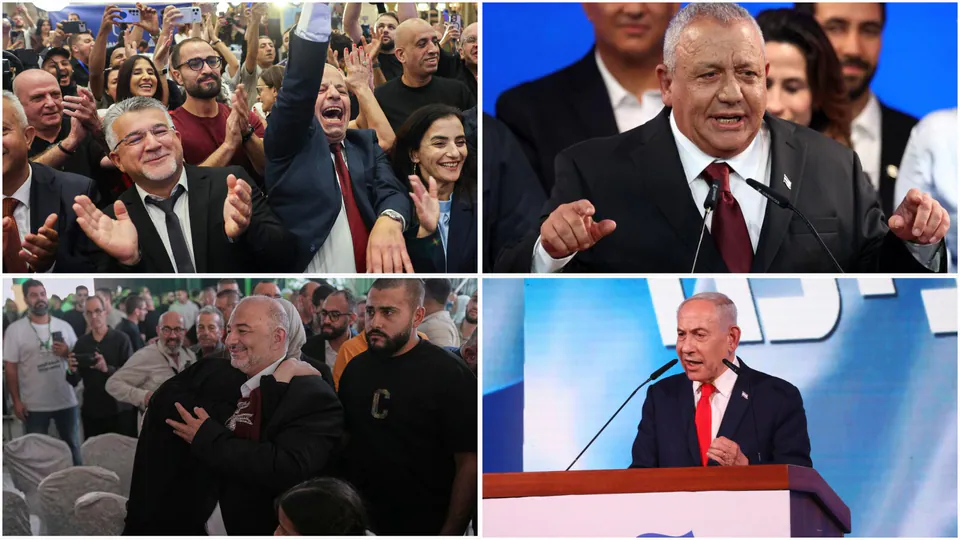
Israel’s Arab political parties have emerged as potential kingmakers in a closely contested election, with the Joint List alliance and Ra’am potentially holding the balance of power between rival political blocs. Their parliamentary strength could determine whether opposition leader Gadi Eisenkot or incumbent Prime Minister Benjamin netanyahu can assemble a government.
With approximately 90% of the votes counted by 9 pm local time, the election had yet to produce a clear winner. Interim figures from Israel’s Central Elections Committee indicated that Netanyahu’s Likud-led coalition was on course to secure 53 seats in the 120-member Knesset, while the opposition bloc led by Eisenkot was projected to win 48 seats.
The remaining seats could prove crucial in determining which side reaches the 61-seat threshold required for a parliamentary majority. According to the figures cited in the election coverage, Arab parties could secure as many as 19 seats, potentially giving them considerable influence over coalition negotiations.
However, their position is complicated by the reluctance of some Jewish-led parties to enter government with Arab-led factions. The two parties also differ in their political approaches, priorities and willingness to cooperate with rival blocs.
The election has therefore placed renewed attention on the Joint List and Ra’am, their political histories, their agendas for Arab citizens of Israel and the conditions under which they might support a new government.
Why the Joint List and Ra’am Matter in the Election
Israel’s parliamentary system makes coalition-building essential when no party or political bloc wins enough seats to govern independently. In a closely divided Knesset, smaller parties can gain significant negotiating power because their support may determine whether a potential government can command a majority.
The Joint List and Ra’am represent different approaches to Arab political participation in Israel. Both have sought to address issues affecting Arab citizens, but they have differed over political alliances, ideological priorities and the methods used to influence government policy.
The Joint List has traditionally brought together Arab-majority political parties around shared concerns, including civil equality, workers’ rights, housing, public services and crime in Arab communities. Ra’am, formally known as the United Arab List, has placed particular emphasis on participating directly in parliamentary and governing institutions to secure practical improvements for Arab citizens.
Their possible influence in the new Knesset does not necessarily mean that they will join the same coalition or support the same candidate for prime minister. Their decisions will depend on political negotiations, policy commitments and the positions adopted by the larger blocs.
What Is the Joint List?
The Joint List is an alliance of Arab-majority political parties in Israel that was established in 2015. Its original formation brought together several parties to strengthen Arab representation in the Knesset and provide a common political platform.
The alliance has included Hadash, Balad and Ta’al, while Ra’am was also part of the grouping until 2021. Although it operates as an alliance, the Joint List has frequently contested elections as a combined electoral force rather than functioning as a single conventional political party.
The Joint List’s Electoral History
The alliance made an immediate impact when it entered the political arena in 2015, winning 13 seats and approximately 10.6% of the vote. That result made it the third-largest political force in the Knesset at the time.
In the 2019 election, the Joint List again emerged as a significant parliamentary force, winning 15 seats. The alliance retained 15 seats in the 2020 election after Israel failed to resolve its political deadlock and returned to the polls.
However, the alliance’s unity weakened in subsequent years. Ra’am separated from the grouping ahead of the 2021 election, while disagreements and further departures involving other constituent parties reduced its strength. The Joint List contested the 2021 election without Ra’am and won six seats, a substantial decline from its earlier results.
As Ta’al, Balad and other components moved away from the alliance, the original grouping eventually disbanded.
For the 2026 election, the Joint List re-emerged with Hadash, Ta’al and Balad, while Ra’am contested independently. The renewed alliance came against the backdrop of the war in Gaza and continuing disputes over Israel’s security policies, Palestinian rights and the position of Arab citizens within Israeli society.
The Joint List’s Political Priorities
Led by Yousef Jabareen, the Joint List has sought to combine its positions on the wider Israeli-Palestinian conflict with domestic issues affecting Arab communities.
The alliance has called for a shift in political priorities away from war and towards investment in people’s lives. Its agenda includes improving housing, increasing wages, expanding access to free education, strengthening workers’ rights and addressing inequalities affecting Arab citizens of Israel.
Another major concern is organised crime in Arab communities. The alliance has advocated for a comprehensive plan to tackle criminal networks, improve public safety and strengthen the institutions responsible for enforcing the law.
Its stated priorities also include greater support for Arab local authorities, economic development and stronger cooperation between the state and Arab society.
The alliance has framed these goals as part of a broader demand for genuine civil equality. Its approach seeks to connect improvements in everyday living conditions with changes to the relationship between Arab communities and state institutions.
These priorities could influence any negotiations involving the Joint List. Even if the alliance is prepared to support a government led by an opposition figure, its leaders may seek commitments on civil rights, public investment, crime prevention and the government’s approach to the Palestinian territories.
What Is Ra’am, Israel’s United Arab List?
Ra’am, also known as the United Arab List, is a conservative Arab political party with Islamist roots. It was established before Israel’s 1996 election and has contested parliamentary elections since then.
The party initially developed from the southern faction of the Islamic Movement in Israel. Over time, it pursued a strategy that placed increasing emphasis on participation in parliamentary politics and negotiations with Jewish-led parties.
Ra’am’s electoral support grew gradually, culminating in its participation in Israel’s governing coalition in 2021. That move marked a significant moment for Arab political representation, as an independent Arab party entered a governing coalition for the first time in decades.
The decision reflected a different approach from political factions that were more reluctant to cooperate with governments led by Jewish-majority parties. Ra’am argued that participation within the political system could create opportunities to secure practical benefits for Arab citizens.
Ra’am’s Role in Government and Opposition
Under the leadership of Mansour Abbas, Ra’am became associated with a pragmatic approach to coalition politics. Rather than treating participation in a government as incompatible with its political identity, the party sought to use its parliamentary position to influence decisions affecting Arab communities.
In 2021, Ra’am joined a coalition government, making it an important participant in Israel’s political system. Its involvement demonstrated that an Arab party could become part of a governing arrangement despite longstanding political and ideological barriers.
The party returned to the opposition in 2022. Abbas subsequently indicated that Ra’am was open to working with political forces opposed to Netanyahu, suggesting that future cooperation would depend on the circumstances and the opportunities available to advance its priorities.
In 2025, the party announced its separation from the Islamic Movement and presented itself as a civic party. This development formed part of its broader emphasis on direct political participation and practical policy outcomes.
Ra’am’s Agenda for Arab Citizens
Ra’am focuses on improving the quality of life for Arab citizens of Israel through political engagement, public investment and efforts to address social and economic problems.
The party’s priorities include improving services and living conditions in Arab communities and ensuring that Arab citizens have a stronger voice in national decision-making.
Its electorate includes nationalist Israeli Arabs, with particular support among parts of the Bedouin community, according to the supplied election background.
Ra’am also supports a two-state solution to the Israeli-Palestinian conflict. However, its political manifestos have not placed the same emphasis on ending the Israeli occupation of Palestinian territories that some other Arab political factions demand.
This distinction helps explain why Ra’am’s political strategy can differ from that of the Joint List. Although the two share concerns about equality and the position of Arab citizens, their approaches to coalition-building and wider national issues are not identical.
Can the Arab Parties Become Kingmakers?
The possibility of Arab parties holding the balance of power arises from the difference between the projected seat totals of the rival blocs and the 61 seats needed for a parliamentary majority.
With Netanyahu’s bloc projected to win 53 seats and the opposition bloc led by Eisenkot on 48 in the interim figures, neither side appeared positioned to govern independently. The potential 19 seats available to Arab parties could therefore become decisive, depending on the final results and the willingness of other parties to negotiate.
If the opposition seeks to replace Netanyahu, cooperation with Arab parties could provide a route towards the required majority. However, securing support would involve political negotiations and agreement on at least some key policy priorities.
For Netanyahu, an agreement with an Arab-led party could also theoretically strengthen his parliamentary position. Yet he has publicly rejected the prospect of forming a coalition with Arab parties, describing such an arrangement as “a shame and disgrace.”
These opposing positions demonstrate why parliamentary arithmetic alone cannot determine the outcome. Even when a smaller party has enough seats to make a majority possible, ideological objections and political commitments can prevent an agreement.
The Anti-Arab Veto and Its Impact on Coalition Talks
One of the main obstacles facing the Joint List and Ra’am is the informal veto against including Arab-led parties in a coalition. The term describes the reluctance of some Jewish-led political parties to form a government with Arab factions, limiting the coalition options available to Arab representatives.
The issue has shaped Israeli coalition politics for years. Arab parties can win substantial representation in the Knesset without necessarily gaining access to the governing coalition, leaving them with less influence over executive decisions than their seat totals might suggest.
The election campaign also included an attempt by the Netanyahu-led bloc to prevent Arab parties, including the Joint List and Ra’am, from contesting the election. The move was subsequently struck down by Israel’s Supreme Court, allowing the parties to participate.
The episode highlighted the continuing political contest over the legitimacy and role of Arab parties in national politics.
The anti-Arab veto could become particularly important if neither major bloc can reach 61 seats without their support. In that situation, party leaders would have to decide whether the need to form a government outweighs their objections to cooperation with Arab factions.
Even indirect support could become relevant. Depending on the parliamentary arrangements and the positions taken by other parties, Arab factions might influence the formation of a government without necessarily becoming full coalition partners.
Why Working With Eisenkot Could Be Difficult for the Joint List
Although the Joint List has expressed an interest in removing Netanyahu from power, cooperation with the opposition is not guaranteed.
Jabareen has said that a central objective for the alliance is to change Israel’s political situation and end Netanyahu’s tenure as prime minister. However, the opposition bloc’s position on the war in Gaza and the occupation of southern Lebanon could create serious disagreements.
The Joint List has criticised the emphasis on military action and called for greater investment in civilian life and economic development. If the opposition maintains policies that the alliance considers unacceptable, negotiations could become difficult even when both sides have an interest in changing the government.
This tension illustrates the limits of treating Arab parties as a single political bloc. Their decisions are shaped not only by their opposition to Netanyahu but also by their own positions on security, civil equality and the Israeli-Palestinian conflict.
For Eisenkot, the challenge would be to determine whether a workable parliamentary arrangement could be reached without abandoning the positions held by his wider political bloc. For the Joint List, any agreement would raise questions about whether cooperation could deliver meaningful policy changes.
Ra’am Signals Openness to a Government of Change
Ra’am has indicated a greater willingness to consider participation in a new coalition, consistent with the strategy it pursued when it joined the government in 2021.
Abbas has argued that working from within the political system offers an opportunity to achieve concrete improvements rather than relying solely on opposition. Following the release of the first exit polls, he told Ynet that joining a government of change could produce substantial results rather than empty promises.
The statement suggests that Ra’am may be prepared to negotiate with a potential coalition if it believes the arrangement can advance its priorities.
However, willingness to negotiate does not guarantee an agreement. The party would still need to assess the proposed government’s policies, the commitments offered to Arab communities and the extent to which its participation would influence national decisions.
Other parties would also have to accept the arrangement. Even if Ra’am agrees to support a coalition, objections from potential partners could prevent the deal from moving forward.
The party’s approach therefore offers one possible route towards a parliamentary majority, but its success would depend on negotiations involving multiple political actors.
How the Gaza War Shapes Arab Political Choices
The war in Gaza has added another layer of complexity to coalition negotiations. Arab parties face pressure to address the conflict and the treatment of Palestinians while also responding to domestic concerns among Arab citizens of Israel.
The Joint List has emphasised the need to redirect political priorities towards civilian welfare and economic development. Its concerns about the military campaign in Gaza and the occupation of southern Lebanon could make cooperation with parties supporting those policies difficult.
Ra’am’s approach has placed greater emphasis on political participation and practical changes through parliamentary institutions. Nevertheless, the party must also consider how its decisions are viewed by voters who are concerned about the conflict and its consequences.
The October 7, 2023, Hamas attacks and the subsequent war have also intensified political sensitivities surrounding cooperation between Jewish-led and Arab-led parties.
For some Jewish-led parties, entering a coalition with Arab factions may carry significant political costs. For Arab parties, joining a government without securing meaningful policy commitments could expose them to criticism from their own supporters.
These competing pressures mean that the formation of a government could depend on more than the number of seats available. The parties would also need to assess whether a coalition could function amid disagreements over security, Palestinian rights and the future direction of Israeli policy.
What Happens if Neither Bloc Reaches a Deal?
If neither Netanyahu’s bloc nor the opposition can secure a workable majority, Israel could face another election.
Repeated elections have previously followed periods of political deadlock, reflecting the difficulty of building stable coalitions in a fragmented parliamentary system. A new vote would provide another opportunity for parties to seek a different distribution of seats, but it would not automatically resolve the underlying disagreements.
If coalition negotiations fail, Netanyahu could remain in office as caretaker prime minister while the political process continues, as described in the supplied election coverage.
Such an outcome would prolong uncertainty over the government’s composition and the direction of national policy. It could also leave the Arab parties with continued parliamentary influence but without the direct role in government that their seat totals might otherwise make possible.
Whether the parties choose to negotiate, support a government from outside the coalition or reject both major blocs will therefore be central to the next stage of Israeli politics.
Conclusion: Arab Representation Could Shape Israel’s Next Government
The Joint List and Ra’am have become central to the coalition calculations surrounding Israel’s closely contested election. Their potential parliamentary strength could help determine whether Netanyahu remains in power or whether Eisenkot can assemble an alternative government.
However, the two parties follow different political strategies, and neither is guaranteed to support a particular bloc. The Joint List’s opposition to the war and its emphasis on civil equality could complicate cooperation with an opposition leadership that supports Israel’s military campaign. Ra’am’s willingness to participate in government could create an opening for negotiations, but any agreement would depend on policy commitments and acceptance by potential coalition partners.
The informal veto against coalitions involving Arab parties remains a major obstacle. Even if the election arithmetic gives Arab representatives a potentially decisive role, political objections could prevent them from converting that position into direct participation in government.
The final outcome will depend on the confirmed seat distribution, negotiations between the major blocs and the willingness of party leaders to compromise. The election has placed Arab political representation at the centre of Israel’s coalition debate, but whether that influence produces a new government or another period of political deadlock remains unresolved.
For breaking news and live news updates, like us on Facebook or follow us on Twitter and Instagram. Read more on Latest World on thefoxdaily.com.


COMMENTS 0