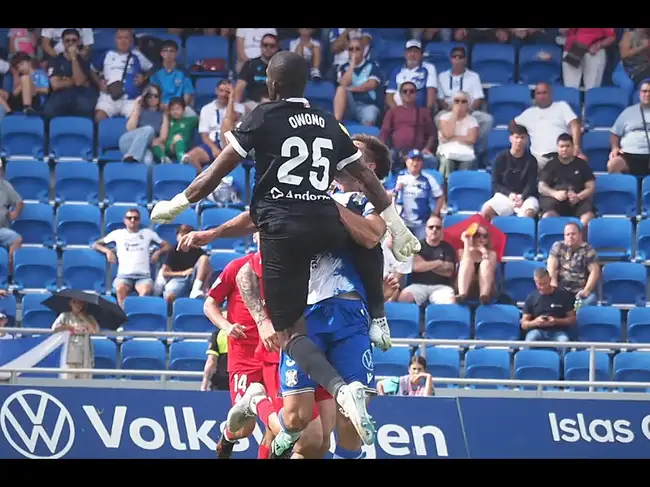
The death of CD Tenerife forward Jesus de Miguel has sent shockwaves through Spanish Football after an on-field collision with goalkeeper Jesus Owono during a match. The incident occurred when Owono rushed out of his goal to challenge the striker for a long ball. During the challenge, the goalkeeper’s raised leg struck de Miguel.
De Miguel suffered a cardiac arrest following the collision and received emergency medical attention on the pitch. He was subsequently taken to hospital, where he was initially described as being in a stable condition. However, the situation took a tragic turn when Tenerife confirmed his death on Tuesday morning, November 3, 2026.
The circumstances have raised difficult questions about the consequences for Owono. Supporters may wonder whether the goalkeeper could receive a lengthy suspension, be banned from professional football or face legal proceedings over the incident.
However, a fatal outcome does not automatically establish that a player committed a foul or deliberately injured an opponent. Any disciplinary or legal action would depend on the circumstances of the challenge, the available evidence and the findings of the relevant authorities.
What happened between Jesus Owono and Jesus de Miguel?
The incident took place during a challenge for a long ball. Owono left his goal to contest possession with de Miguel, who was attempting to reach the ball. During the aerial challenge, the goalkeeper’s raised leg made contact with the Tenerife forward.
The collision was followed by a medical emergency. De Miguel suffered a cardiac arrest and medical staff rushed to provide assistance on the pitch. He was then transported to hospital for further treatment.
Initial information indicated that the forward was in a stable condition. Nevertheless, Tenerife later announced that he had died at 8:00 am on Tuesday, November 3, 2026.
The sequence of events has made the incident particularly distressing for players, supporters and the wider football community. At the same time, the precise medical cause of death and the extent to which the collision contributed to the fatal outcome would need to be established through medical and investigative findings.
CD Tenerife confirms the death of Jesus de Miguel
CD Tenerife announced the forward’s death in an emotional statement, expressing its grief and offering support to his family, loved ones and supporters.
Rotos de dolor, con un nudo en la garganta y sin poder creer que esto sea verdad, desde el CD Tenerife comunicamos el trágico fallecimiento, este martes, día 3 de noviembre de 2026, a las 8:00 horas, de Jesús de Miguel Alameda.
No hay palabras de consuelo; no hay absolutamente nada que mitigue este sentimiento repleto de tristeza. Estamos junto a su desolada familia, junto a sus seres queridos, junto a todo el tinerfeñismo que hoy llora por este cruel desenlace.
La familia de Jesús de Miguel agradece todas y cada una de las muestras de apoyo recibidas, e igualmente solicita, de corazón, máximo respeto a su privacidad, en estos terribles momentos.
The club’s message reflected the immense sadness surrounding the loss. Tenerife also asked supporters and the public to respect the family’s privacy during this difficult period.
What punishment could Jesus Owono face?
Whether Owono faces punishment will depend on how football authorities assess the challenge. A collision during a match is not automatically a disciplinary offence, even when it results in a serious injury or death. Football’s disciplinary framework generally considers the nature of the challenge, the player’s actions, the level of force involved and whether the conduct was reckless or violent.
If the match officials or disciplinary authorities determine that Owono committed a serious foul, he could face a suspension under the applicable competition regulations. The length of any ban would depend on the specific offence and the evidence available.
1. No suspension if the challenge is considered accidental
If the available footage and other evidence show that Owono was making a legitimate attempt to reach the ball and that the contact was accidental, he may not receive a footballing suspension.
Goalkeepers regularly leave their penalty areas or rush forward to challenge attackers. These situations can involve physical contact, particularly when both players attempt to reach the same ball. The fact that a collision has tragic consequences does not, by itself, prove that the challenge was illegal.
In such circumstances, the incident could be treated as an unfortunate sporting accident rather than misconduct. Any final assessment would still depend on the match footage, referee’s report and disciplinary review.
2. Suspension for a reckless or dangerous challenge
If authorities conclude that Owono acted recklessly or used excessive force, he could face a suspension. Football disciplinary rules allow sanctions for challenges that endanger an opponent’s safety, even when a player does not intend to cause serious harm.
The goalkeeper’s raised leg will likely be an important part of the review. Investigators and disciplinary officials would need to examine the speed of the challenge, the position of both players, the goalkeeper’s movement and whether the contact could reasonably have been avoided.
A finding of serious foul play could result in a multi-match suspension, depending on the applicable competition rules and the severity of the offence.
3. A longer ban if serious misconduct is established
A more severe disciplinary sanction could be considered if the evidence establishes particularly dangerous conduct or a serious breach of football regulations. However, a lifetime ban or permanent exclusion from professional football would be an exceptional outcome and cannot be assumed from the fatal result alone.
Any decision would need to follow the relevant disciplinary procedures. The authorities would also have to distinguish between an accidental collision, a reckless challenge and deliberate violent conduct. These are different categories and can carry different consequences.
Will Jesus Owono face a criminal investigation?
A criminal investigation is a separate matter from a football disciplinary hearing. While football authorities can examine whether a player breached the rules of the game, police and prosecutors would consider whether the available evidence supports a criminal offence under the relevant law.
The fact that a player was involved in a collision followed by an opponent’s death does not automatically mean that the player will be prosecuted. Investigators would need to establish what happened, whether the conduct went beyond the risks normally associated with competitive football and whether there is sufficient evidence of criminal responsibility.
Could the authorities examine the challenge?
If a formal investigation is opened, authorities could review match footage, witness accounts, medical records and reports from the officials who attended the incident. They may also examine the medical findings to establish the cause of de Miguel’s cardiac arrest and death.
An important question would be whether the collision directly caused or contributed to the medical emergency. That determination would require medical evidence rather than assumptions based solely on the sequence of events.
Could Owono be charged with an offence?
Criminal liability would depend on the evidence and the applicable law. Investigators would have to consider whether Owono’s actions amounted to negligence or another legally recognised form of wrongdoing.
In assessing the incident, they could examine whether the goalkeeper acted within the ordinary expectations of a competitive football challenge or whether his conduct was sufficiently dangerous to cross the threshold for criminal responsibility.
If the evidence does not establish criminal wrongdoing, the investigation may not result in charges. If authorities identify evidence supporting an offence, prosecutors would determine whether formal proceedings are justified.
Why the medical findings will be important
One of the central questions is the relationship between the collision and de Miguel’s death. The forward reportedly suffered a cardiac arrest after the challenge, but the precise medical explanation has not been established in the information available.
A cardiac arrest occurs when the heart suddenly stops pumping blood effectively. It is a medical emergency that requires immediate intervention. It can have different underlying causes, and establishing what happened in an individual case requires medical examination.
For that reason, the timing of the cardiac arrest alone cannot establish the exact cause of death or determine legal responsibility. Medical findings would be important in understanding whether the impact caused a fatal injury, triggered an existing medical condition or contributed to the emergency in another way.
Could Jesus Owono return to football?
Owono’s future in football will depend on the outcome of any disciplinary or legal proceedings. If the incident is classified as an accidental collision and no separate misconduct is established, there may be no basis for a footballing ban.
If a disciplinary offence is proven, he could be suspended for a period determined by the relevant authorities. A criminal investigation, if one takes place, would follow a separate process and would not automatically establish guilt.
Until the circumstances are fully examined, it would be premature to conclude that Owono will be banned from football or face criminal punishment. The goalkeeper’s actions, the medical findings and the official investigation will be central to determining what happens next.
What happens next?
The immediate priority following de Miguel’s death is respect for his family and loved ones. The footballing consequences, if any, will depend on the evidence gathered and the decisions of the relevant authorities.
For now, there is no confirmed basis in the supplied information to say that Owono has been charged with an offence, handed a suspension or banned from professional football. The tragic outcome has raised serious questions, but responsibility cannot be determined solely from the fact that the goalkeeper was involved in the collision.
Any final decision must distinguish between an accident, a breach of football rules and conduct that could attract criminal liability. Until those questions are answered, the circumstances surrounding Jesus de Miguel’s death remain central to understanding the incident.
For breaking news and live news updates, like us on Facebook or follow us on Twitter and Instagram. Read more on Latest World on thefoxdaily.com.






COMMENTS 0