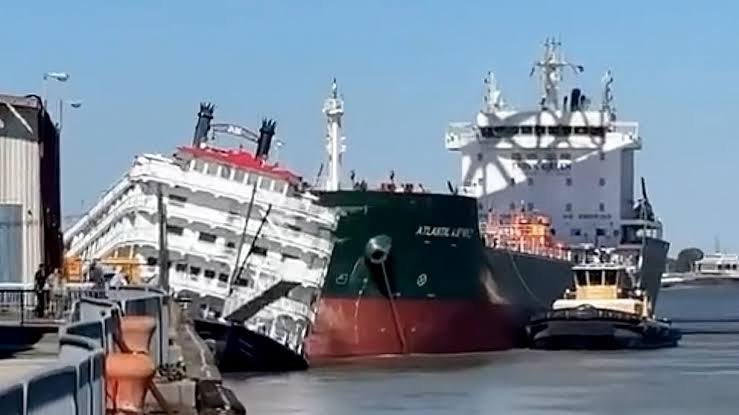
A major maritime emergency unfolded on the Mississippi River in New Orleans on Friday, November 13, after a large tanker struck an American Cruise Lines passenger vessel, causing the riverboat to overturn and partially sink. The incident prompted an extensive search-and-rescue operation involving the US Coast Guard, local police, firefighters and emergency medical personnel.
The vessel, identified as the American Heritage, was docked near the Port of New Orleans when the much larger tanker Atlantic Asphalt struck it at approximately 12:30 p.m. local time. About 129 passengers, along with crew members, were aboard the riverboat when the incident occurred, according to Port of New Orleans officials.
Images and videos from the scene showed the passenger vessel listing heavily in the water, with people wearing life jackets in the Mississippi River and others attempting to remain near the boat’s railings. The impact caused the riverboat to capsize, creating an immediate emergency for those aboard.
American Cruise Lines confirmed that passengers and crew members were evacuated and said it was coordinating with the US Coast Guard and local authorities. Meanwhile, emergency responders continued rescue and recovery operations as officials worked to establish the number of people injured and determine what caused the tanker to strike the docked vessel.
Later reports indicated that at least eight people had been taken to hospitals. Louisiana Lieutenant Governor Billy Nungesser also received information suggesting that everyone aboard had been accounted for, although the statement was initially qualified and required confirmation from emergency authorities.
What Happened Between Atlantic Asphalt and American Heritage?
The collision occurred near the Port of New Orleans, close to the Crescent City Connection bridges, an important crossing over the Mississippi River.
According to information released by the port, the American Heritage had arrived approximately two hours before the incident. The vessel was docked outside 1350 Port of New Orleans Place and was preparing to disembark passengers when the Atlantic Asphalt tanker struck it.
The timing of the incident is particularly significant. The passenger vessel was not simply travelling alongside the tanker in open water. It was docked when the larger ship made contact with it.
Initial reports described the impact as a broadside strike. The much larger tanker hit the passenger vessel from the side, causing it to lose stability and eventually turn over in the water.
The incident rapidly developed into a rescue emergency because people were still aboard the riverboat when it began capsizing.
Timeline of the New Orleans Riverboat Accident
- Approximately 10:30 a.m.: The American Heritage had arrived and docked at the Port of New Orleans, according to the port’s account that it had been there for about two hours before the collision.
- 12:30 p.m.: The Atlantic Asphalt tanker struck the docked passenger vessel on the Mississippi River.
- Shortly after the collision: The American Heritage began listing and capsized, prompting emergency calls and rescue operations.
- Early afternoon: The US Coast Guard, New Orleans Fire Department, police and emergency medical personnel responded to the scene.
- During the rescue operation: Multiple people were pulled from the water, while passengers were taken to the Port of New Orleans Administration Building for assistance.
- Later updates: Local media reported that at least eight people had been hospitalized and that officials believed everyone aboard had been accounted for.
The timeline reflects the information available from initial official statements and local reporting. The precise sequence of events leading to the tanker striking the riverboat remained under investigation.
Rescue Operation Underway as Passengers Are Pulled From the Mississippi River
The collision triggered a large emergency response involving several agencies responsible for maritime safety, firefighting, law enforcement and medical assistance.
The New Orleans Fire Department, New Orleans Police Department, Port NOLA Harbor Police and US Coast Guard were among the agencies responding to the incident.
Emergency medical personnel also arrived to assess passengers and coordinate transportation for people requiring hospital treatment.
Some individuals were seen in the water wearing life jackets as the riverboat overturned. Other passengers and crew members were evacuated from the vessel and brought to safety.
According to local reporting by WWL-TV, the Creole Queen, another New Orleans riverboat, helped rescue 14 people from the water. The assistance highlighted the importance of nearby vessels during emergencies on busy waterways.
At Least Eight People Reportedly Taken to Hospitals
As rescue operations continued, reports indicated that at least eight people had been transported to hospitals.
The exact nature and severity of their injuries were not immediately established in the initial updates. Authorities also had not released a complete medical assessment of everyone involved.
Louisiana Lieutenant Governor Billy Nungesser reportedly received a message indicating that everyone was believed to be accounted for. However, the wording of that update was cautious, and it should not be confused with a fully confirmed final casualty assessment.
The distinction is important in a maritime emergency involving a capsized passenger vessel. Rescue teams must establish that every passenger and crew member has been located, not simply that most people have been brought ashore.
American Cruise Lines separately confirmed that guests and crew members had been evacuated and expressed concern for everyone involved.
What Is the American Heritage Riverboat?
The American Heritage is a passenger riverboat operated by American Cruise Lines, a company specialising in domestic river and coastal cruising in the United States.
Unlike large ocean-going cruise ships designed for international voyages across open seas, river cruise vessels operate on inland waterways and are generally built to navigate rivers and other comparatively confined routes.
The American Heritage is a five-deck vessel built in 2015. According to reporting by The Associated Press, it can accommodate up to 150 passengers.
Its design reflects the traditional American riverboat experience, combining passenger accommodation with sightseeing and organised itineraries along major waterways.
The Vessel Was Operating a Louisiana and Mississippi Cruise
The American Heritage was completing an eight-day Louisiana and Mississippi cruise when the collision occurred, according to AP reporting.
Such journeys allow passengers to experience communities and destinations connected by the Mississippi River and its surrounding waterways.
New Orleans is an important destination for river cruises because of its location along the Lower Mississippi River and its historic relationship with commercial shipping, trade and passenger transportation.
The incident therefore affected a vessel operating within an established passenger travel route rather than an isolated recreational boating area.
The ship’s passenger capacity also helps explain the scale of the emergency. With approximately 129 passengers reported aboard, in addition to crew members, responders had to account for a substantial number of people during a rapidly developing situation.
Atlantic Asphalt: What Is Known About the Tanker?
The vessel that struck the American Heritage was identified as Atlantic Asphalt, a tanker substantially larger than the passenger riverboat.
The Associated Press reported that the tanker measured approximately 520 feet in length. Its size difference compared with the passenger vessel is an important factor in understanding the severity of the impact.
Atlantic Asphalt is associated with the transportation of asphalt and bitumen, materials used in road construction and other industrial applications.
Unlike conventional crude oil tankers, asphalt carriers are designed to transport heavy petroleum-based materials that can require temperature management to maintain suitable handling conditions.
However, it was not immediately established whether the tanker was carrying asphalt or another cargo when the collision happened.
This distinction matters because the environmental and safety implications of a tanker accident depend partly on the material being transported, the quantity involved and whether any cargo or fuel escapes into the surrounding water.
Why the Tanker’s Cargo Matters
A collision involving a tanker can raise questions beyond the immediate safety of the vessels and their occupants.
Authorities may also need to assess whether the tanker sustained structural damage, whether any fuel or cargo leaked and whether additional measures are necessary to protect the surrounding waterway.
Asphalt and bitumen are not identical to lighter petroleum products in their physical characteristics. Their behaviour in water can depend on temperature, composition and the conditions in which they are transported.
Nevertheless, the possibility of an environmental impact should not be confused with evidence that a spill actually occurred.
At the time of the initial reports, there was no confirmed public finding establishing that the collision had caused an oil or cargo spill.
Why Was the Mississippi River Closed After the Collision?
The US Coast Guard temporarily closed a three-mile section of the Mississippi River following the accident.
The restricted area extended between river mile markers 93 and 96, according to officials.
The closure was necessary to allow emergency responders to concentrate on rescue operations without interference from commercial vessels and other river traffic.
The Mississippi is one of the most important commercial waterways in the United States. It supports the movement of agricultural products, industrial materials, petroleum-related cargo and other goods between inland locations and international shipping connections.
New Orleans occupies a particularly important position within this transportation network because vessels travelling along the river connect inland commercial centres with Gulf Coast shipping routes.
How a River Closure Can Affect Commercial Shipping
Closing a section of a major commercial waterway can affect more than the vessels directly involved in an accident.
Commercial ships, tankers, barges and towing vessels may need to wait until authorities allow traffic to resume.
Depending on the duration of the restriction, vessel operators may also need to adjust arrival schedules, docking arrangements and cargo transportation plans.
However, the immediate priority during the New Orleans incident was the safety of passengers, crew members and emergency personnel.
Allowing normal commercial traffic to continue through an active rescue area could create additional hazards, particularly when emergency boats and other response vessels are operating in restricted waters.
The Coast Guard’s temporary closure was therefore an operational safety measure while responders assessed the situation.
How Could Investigators Determine What Caused the Collision?
The precise cause of the collision remained unknown in the initial reports. Investigators will need to establish why the Atlantic Asphalt struck a passenger vessel that was already docked.
Determining the cause of a maritime accident generally requires examining the vessels’ movements, navigational records, operating conditions and the actions of the people responsible for controlling them.
Several areas could become relevant to the investigation, although none should be treated as an established explanation for this particular accident.
1. Navigation and Vessel Movement
Investigators may examine the tanker’s route, speed, direction and manoeuvres before the impact.
Understanding how the vessel approached the dock could help establish whether its movement was consistent with the intended navigation plan.
2. Steering and Propulsion Systems
Large commercial vessels depend on propulsion and steering equipment to maintain direction and manoeuvre safely.
Investigators may inspect these systems to determine whether mechanical or operational problems contributed to the collision.
However, there was no confirmed evidence in the initial announcements establishing a steering failure, engine problem or loss of power.
3. Communication and Navigation Records
Communication between the vessel’s bridge team, port authorities and other relevant maritime personnel could also be important.
Investigators may review available radio communications, navigation records and other operational information to reconstruct the events leading to the impact.
4. Crew Procedures and Safety Compliance
Commercial vessels operate under maritime safety requirements governing navigation, crew responsibilities and operational procedures.
An investigation may examine whether the applicable procedures were followed and whether any operational decisions contributed to the incident.
These questions require evidence rather than assumptions based on videos or the apparent direction of the vessels.
Why New Orleans Is Particularly Important to Mississippi River Shipping
The location of the collision adds another dimension to the incident.
New Orleans is a major port city situated along the Lower Mississippi River. Its position connects inland waterways with international maritime trade routes through the Gulf of Mexico.
The port handles a wide range of commercial activity, including agricultural exports, industrial materials and other cargo transported by ships and barges.
This commercial activity takes place alongside passenger transportation, recreational boating and river tourism.
That combination makes navigation management particularly important. Different categories of vessels operate on the same waterway, but their sizes, speeds, manoeuvrability and operational requirements can vary considerably.
A large tanker has different handling characteristics from a passenger riverboat. Commercial vessels may require substantial distances and careful coordination to change direction or reduce speed.
At the same time, passenger vessels operating near docks must be protected from the movements of larger ships using the same navigable channel.
The accident illustrates why coordination between vessel operators, port authorities and maritime traffic management systems is essential.
What Does the Accident Mean for American Cruise Lines?
The collision is a serious operational incident for American Cruise Lines because one of its passenger vessels was involved in a major accident while carrying guests.
The company’s immediate responsibility is to coordinate with authorities, provide assistance to affected passengers and crew members, and communicate relevant information as it becomes available.
The incident could also create practical challenges for future cruise operations involving the American Heritage.
Because the vessel capsized and became partially submerged, its structural condition and the extent of the damage will need to be assessed before any decision about its future operation can be made.
Depending on the findings, the vessel could require extensive recovery, inspection and repair work. The precise extent of the damage had not been established in the initial reports.
Passengers booked on future departures may also need information about schedule changes or alternative arrangements if the vessel remains unavailable.
For the wider river cruise industry, the accident is a reminder that passenger safety depends not only on the condition of cruise vessels but also on the safe movement of other ships operating along shared waterways.
What Happens Next in the New Orleans Tanker Collision Investigation?
The immediate focus remains on confirming the condition and whereabouts of everyone aboard the American Heritage, supporting injured passengers and crew members, and securing the accident scene.
Once the emergency response is complete, authorities will be able to concentrate more fully on the technical investigation and assessment of the damaged vessels.
Several developments will be particularly important in the coming hours and days.
- Final passenger and crew accounting: Authorities need to establish that every person aboard the American Heritage has been located and accounted for.
- Medical updates: Further information may clarify the number of injured people and the severity of their conditions.
- Vessel inspections: The condition of the American Heritage and Atlantic Asphalt will need to be assessed.
- Environmental assessment: Authorities may examine whether fuel, cargo or other materials entered the Mississippi River.
- Navigation investigation: Investigators will work to establish why the tanker struck the docked passenger vessel.
- River traffic restrictions: The Coast Guard will determine when the affected section of the Mississippi River can safely reopen.
The investigation may take time because maritime accidents involving large commercial vessels can require detailed technical examinations and analysis of operational records.
New Orleans Riverboat Accident: What Is Confirmed So Far?
The following details summarize the information available from the Port of New Orleans, emergency response updates and initial reporting:
- Location: Mississippi River near the Port of New Orleans, Louisiana.
- Date: Friday, November 13, 2026.
- Time: Approximately 12:30 p.m. local time.
- Passenger vessel: American Heritage, operated by American Cruise Lines.
- Other vessel: Atlantic Asphalt tanker.
- Passengers aboard: Approximately 129, in addition to crew members.
- Condition of passenger vessel: Capsized and partially submerged following the impact.
- Rescue response: US Coast Guard, New Orleans Fire Department, police, harbor police and emergency medical personnel.
- Hospitalisations: At least eight people were reported to have been taken to hospitals in early local media updates.
- Passenger accounting: Officials received an indication that everyone was believed to have been accounted for, pending confirmation.
- River restrictions: A three-mile section between mile markers 93 and 96 was closed to vessel traffic during the response.
- Cause: Not immediately established.
The collision between Atlantic Asphalt and American Heritage has become a major maritime emergency on one of America’s busiest commercial waterways. Although early updates offered encouraging indications about the rescue operation, the full medical, environmental and operational consequences remained uncertain.
The priority is ensuring the safety of everyone involved. Investigators must then establish how a large tanker struck a docked passenger riverboat and whether mechanical, navigational or other operational factors contributed to the accident. Their findings will be important not only for determining what happened in New Orleans but also for understanding how similar incidents can be prevented on busy commercial waterways.
For breaking news and live news updates, like us on Facebook or follow us on Twitter and Instagram. Read more on Latest World on thefoxdaily.com.

COMMENTS 0