Pakistan has deployed troops to Saudi Arabia under an existing Defence Cooperation framework, with the stated aim of strengthening the kingdom’s defensive capabilities amid emerging security concerns. According to the Pakistani military, the personnel will operate within Saudi territory in line with agreed commitments between the two countries.
The announcement highlights the longstanding security relationship between Islamabad and Riyadh, which includes military cooperation, training arrangements and defence coordination. The deployment comes at a time when regional security concerns are placing renewed attention on the protection of Saudi territory and critical infrastructure.
Deployment Follows Pakistan-Saudi-Türkiye Defence Talks
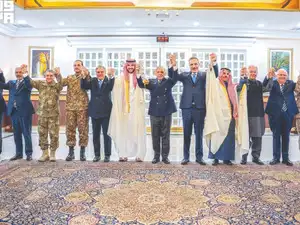
The troop movement follows a high-level meeting of the Strategic Political and Defence Committee of the Mecca Alliance for Defence, held in Islamabad on Friday. Senior civilian and military officials from Pakistan, Saudi Arabia and Türkiye attended the meeting, which focused on regional security and cooperation under the trilateral defence arrangement.
The three countries reaffirmed their commitment to protecting Saudi Arabia’s sovereignty and territorial integrity. They also backed diplomatic efforts to reduce regional tensions as security threats continue to affect the wider Middle East.
A send-off ceremony for the Pakistani troops took place on Saturday, November 28. Pakistan’s Defence Minister Khawaja Asif attended the event, along with Saudi Ambassador to Pakistan Rajeh Tami Albugamy and senior Pakistani military officers, including Chief of General Staff Lieutenant General Omer Ahmed Bokhari and Lahore Corps Commander Lieutenant General Muhammad Umer Bashir.
The ceremony provided the first public confirmation from Pakistan’s military of this deployment. However, the authorities did not disclose the size of the contingent, its precise operational responsibilities, its deployment locations or how long the soldiers would remain in the kingdom.
What Is the Mecca Joint Defence Agreement?
The deployment comes against the backdrop of the Mecca Joint Defence Agreement, signed by Pakistan, Saudi Arabia and Türkiye on August 7, 2026. The arrangement establishes a framework for collective defence and deterrence among the three countries.
One of its central provisions states that an armed attack against any member would be treated as an attack against all three. This creates a shared security commitment and provides a basis for closer military coordination when one of the participating countries faces an external threat.
The agreement also builds on Pakistan and Saudi Arabia’s longstanding bilateral defence relationship. The two countries have maintained military cooperation for decades, including training, advisory support and security coordination.
Pakistan has historically played a role in supporting Saudi military capabilities through the presence of military personnel and defence cooperation arrangements. The latest deployment adds another element to that relationship, now within the wider trilateral framework involving Türkiye.
Despite the collective-defence language, the alliance’s detailed military arrangements remain unclear. Its members have not publicly explained the full command structure, the composition of forces, the procedures for responding to an attack or the precise conditions under which collective military action would be initiated.
Houthi Attacks Add to Saudi Arabia’s Security Concerns
The deployment comes amid continued security concerns surrounding attacks attributed to Yemen’s Houthi movement. Saudi Arabia has faced missile and drone threats linked to the wider regional conflict, increasing the importance of air defence, border protection and the security of strategic infrastructure.
The Houthis, an Iran-aligned armed movement that controls significant parts of Yemen, have been involved in a prolonged conflict with Saudi-backed forces. Their military capabilities include missiles and drones, which have been used in attacks against targets in the region.
Such threats create challenges for Saudi Arabia because defending a large territory requires more than conventional ground forces. Air-defence systems, surveillance capabilities, intelligence coordination and the ability to respond quickly to incoming threats are all important components of national security.
The Pakistani military has described its deployment as an effort to strengthen Saudi Arabia’s defensive capabilities. The announcement does not, however, specify whether the troops will focus on training, operational support, infrastructure protection, border security or other responsibilities.
The distinction matters because a deployment inside Saudi Arabia does not automatically mean Pakistani forces will participate in combat operations outside the kingdom. Pakistan has previously characterised the trilateral defence arrangement as defensive in nature, rather than an agreement aimed at conducting offensive military operations against another country.
Pakistan Says Its Troops Will Remain Within Saudi Territory
Islamabad has sought to clarify the geographical limits of its military commitments under the Mecca defence framework. Pakistani officials have said that troops stationed in Saudi Arabia under the arrangement will not cross into neighbouring Yemen.
This position is significant given the history of Saudi Arabia’s involvement in Yemen’s conflict and the continuing tensions between the Saudi-led coalition and the Houthis. Pakistan’s stated approach indicates that its current deployment is intended to support Saudi security within the kingdom rather than expand its military role into Yemen.
Pakistan also has to consider its broader regional relationships, particularly its ties with neighbouring Iran. Islamabad has maintained that the trilateral defence arrangement is not directed against any specific country, including Iran.
The deployment therefore places Pakistan in a position where it must balance its security commitments to Saudi Arabia with its wider diplomatic and regional interests. The precise scope of its military responsibilities will be important in determining how that balance is maintained.
Longstanding Military Partnership Between Islamabad and Riyadh
Pakistan and Saudi Arabia have maintained close military and political relations for several decades. Their cooperation has included defence training, military exchanges and arrangements intended to support Saudi security.
The relationship is also shaped by religious, economic and diplomatic connections. Saudi Arabia hosts Islam’s two holiest sites, Mecca and Medina, and Pakistan’s military statement specifically reaffirmed Islamabad’s commitment to protecting the kingdom’s security and the sanctity of the holy sites.
Defence cooperation has become particularly important as regional tensions have increased. Saudi Arabia faces security challenges involving Yemen, the wider Gulf region and the consequences of escalating tensions between major regional and international powers.
Pakistan, meanwhile, has sought to maintain its role as a regional diplomatic actor while preserving its strategic relationship with Riyadh. The defence agreements provide a formal structure for cooperation, although their practical implications will depend on how the participating governments implement them.
What Remains Unclear About the Troop Deployment?
Although Pakistan’s military has confirmed that troops are being deployed, several important details remain undisclosed. These gaps make it difficult to assess the full operational significance of the move.
- Number of troops: Pakistan has not announced how many soldiers are included in the latest deployment.
- Operational responsibilities: The military has not identified the specific tasks assigned to the personnel.
- Deployment locations: The authorities have not disclosed where within Saudi Arabia the troops will be stationed.
- Duration: No timetable has been announced for how long the contingent will remain in the kingdom.
- Command arrangements: The public statement does not explain how Pakistani personnel will coordinate with Saudi forces or how operational decisions will be made.
These details are important because the size, location and mission of a military contingent determine what it can realistically contribute to a country’s defence. Without that information, the deployment’s precise military impact cannot be independently assessed.
What the Deployment Means for Regional Security
Pakistan’s decision to send troops to Saudi Arabia underscores the growing importance of regional defence partnerships as security threats become more complex. The use of missiles and drones, the vulnerability of energy infrastructure and the possibility of attacks across national borders have encouraged Gulf countries and their partners to strengthen military coordination.
For Saudi Arabia, Pakistani personnel could provide additional military support under the existing cooperation framework. For Pakistan, the deployment demonstrates its willingness to maintain its defence commitments to a longstanding strategic partner.
The involvement of Türkiye in the trilateral agreement also gives the arrangement a wider regional dimension. However, the alliance’s effectiveness will depend on whether its members can translate political commitments into clearly defined military procedures, coordinated capabilities and agreed responses to potential threats.
The latest deployment does not, by itself, establish that Pakistan is preparing to enter a wider regional conflict. The military has described the mission as operating within Saudi territory and under existing defence commitments. Its actual scope will become clearer as further details emerge from Islamabad and Riyadh.
Pakistan’s Saudi Deployment Marks a New Phase in Defence Cooperation
Pakistan’s troop deployment represents a significant public development in its military relationship with Saudi Arabia and the wider Mecca defence arrangement involving Türkiye. The move follows high-level security discussions and comes as the kingdom faces continuing concerns over missile and drone threats.
For now, Islamabad has confirmed the deployment but kept important operational details confidential. The number of soldiers, their assignments and the duration of their mission remain unknown. Pakistan has also emphasised that its troops will operate within Saudi territory under agreed commitments.
The development will be closely watched as the three countries work to put their collective-defence agreement into practice. Whether the arrangement develops into a more integrated regional security framework will depend on future military coordination, the nature of emerging threats and the commitments its members are prepared to fulfil.
For breaking news and live news updates, like us on Facebook or follow us on Twitter and Instagram. Read more on Latest World on thefoxdaily.com.





COMMENTS 0