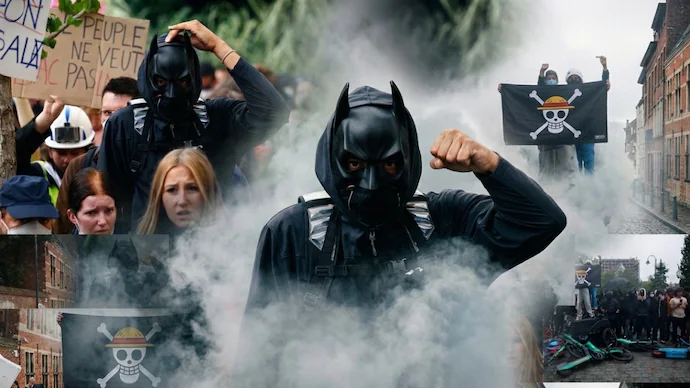
From Batman masks at demonstrations in India to Spider-Man costumes in France and the Straw Hat flag from the Japanese anime series One Piece appearing at protests abroad, fictional characters are increasingly becoming part of the visual language of street dissent. Once associated mainly with comic books, films, television and gaming, these familiar figures are now being used to communicate ideas about justice, freedom, resistance and collective identity.
A protest rally is traditionally recognised by its placards, banners, slogans and political flags. However, crowds across several countries are introducing a different kind of imagery. Batman, Spider-Man, Captain America, Iron Man and the Hulk have appeared among demonstrators, turning familiar fictional characters into unexpected symbols of real-world grievances.
These appearances are not scenes from comic-book conventions or promotional events. They are increasingly visible at demonstrations, where costumes and masks can attract attention, communicate solidarity and give protesters a recognisable identity.
In India, students and other demonstrators have appeared in superhero costumes during protests in cities including Delhi, Nagpur, Mumbai and Indore. Similar imagery has surfaced in France, while the Straw Hat flag associated with Monkey D. Luffy, the protagonist of One Piece, has appeared at demonstrations in countries including Nepal and Madagascar.
The trend raises an interesting question: why are characters created for imaginary worlds becoming part of political demonstrations thousands of kilometres away from their original stories?
Superheroes Enter India’s Protest Culture
In July 2026, photographs from student-led demonstrations in several Indian cities showed protesters wearing costumes and masks associated with popular fictional characters. Batman, Superman, the Hulk and Iron Man were among the figures spotted at rallies, while Spider-Man appeared particularly frequently across different demonstration sites.
The costumes brought an unusual visual element to protests that would otherwise have been dominated by conventional banners and slogans. For many participants, these characters offered a familiar way to attract attention while expressing solidarity with a shared cause.
The imagery returned to national attention in October, when Batman masks appeared during an INDIA bloc demonstration in New Delhi demanding the resignation of Chief Election Commissioner Gyanesh Kumar.
Youth Congress workers distributed the masks during the march, while Congress social media messaging drew a comparison between Rahul Gandhi and the fictional caped crusader. Congress president Mallikarjun Kharge was also photographed wearing a Batman mask during the anti-CEC protest.
The episode illustrated how popular fictional imagery can move beyond youth-led demonstrations and become part of political communication involving established parties and political leaders.
However, the use of superhero masks does not necessarily mean that every participant supports the same political organisation. The same character can be adopted by different groups for different reasons, depending on the protest’s objectives and the message organisers want to convey.
Fictional Characters Become Symbols of Collective Identity
Popular fictional characters often carry associations that audiences recognise without requiring lengthy explanations. Batman is widely associated with justice and confronting corruption, while Spider-Man represents an ordinary young person dealing with extraordinary responsibilities.
Iron Man is associated with technology, individual ability and heroism, while Captain America is often linked to courage and resistance. Characters such as Darth Vader, on the other hand, are frequently used as visual representations of authoritarian power.
These associations can make fictional characters useful in demonstrations, where protesters have limited time and space to communicate their demands.
Dr Murchana Kaushik, who holds a PhD in Sociology and founded Sociology Speaks, describes the use of identical masks and characters as an expression of collective identity.
“Many together, wearing the same mask, is a reflection of their belief, the same kind of principles, values or ideologies they share. That they are fighting for the same cause or they are raising the same issue together.”
She explains that the shared appearance communicates the feeling that participants are standing together in support of a common concern. In her words, it conveys the belief that “We are all together in this”.
Such imagery can help protesters establish a collective identity even when they come from different backgrounds or do not belong to the same political organisation.
Kaushik also cautions against automatically interpreting the use of these characters as an endorsement of a political party. She says students and members of Generation Z may share concerns with opposition groups without necessarily being politically aligned with those parties.
This distinction is important because the presence of a fictional character at a demonstration does not, by itself, reveal the political beliefs of everyone wearing the costume.
Why Superheroes Make Compelling Protest Symbols
Superhero stories frequently revolve around conflicts between powerful institutions and individuals who challenge injustice. Their central themes often include accountability, courage, freedom, responsibility and the struggle against forces that appear difficult to defeat.
These themes can connect with people participating in demonstrations against governments, institutions or policies they believe are unfair.
Batman, for example, is a fictional character who operates outside conventional institutions while attempting to confront crime and corruption. Spider-Man’s story centres on a young person balancing ordinary responsibilities with the decision to help others. Such narratives can provide protesters with familiar symbols through which to communicate their own frustrations.
Research into protest art and popular culture has also examined how fictional references can acquire political meanings when used in public demonstrations.
A 2018 study titled Marketing, Art and Voices of Dissent, by Georgios Patsiaouras, Anastasia Veneti and William Green, examined protest art during Hong Kong’s 2014 Umbrella Movement. It discussed how familiar cultural figures, including superheroes, were incorporated into protest displays to attract attention and communicate political concerns.
The Umbrella Movement itself became widely associated with the use of umbrellas, which protesters used as protection against police pepper spray and other crowd-control measures. The everyday object eventually became a recognisable symbol of the demonstrations.
A separate 2021 study by Delia Dumitrica, titled ‘Chuck Norris, Please Help!’: Transnational Cultural Flows in the 2017 Anti-Corruption Protests in Romania, examined 58 protest signs. It explored how popular-culture references could make political messages more recognisable while acquiring new meanings within a local political context.
These studies highlight how cultural references can become part of protest communication. A fictional character does not need to have been created for political purposes to become useful in a demonstration.
How Fan Communities Influence Protest Imagery
The emotional connection audiences develop with fictional characters also plays an important role in their adoption as protest symbols.
Shefali Johnson, CEO of Comic Con India, explains that people may recognise aspects of themselves in fictional characters or admire the qualities they represent. Over time, these figures become familiar cultural references that audiences can use to communicate ideas.
Their appeal comes from several factors, including storytelling, character design, the values associated with a particular character and the communities that develop around a franchise.
For some people, a superhero costume represents years of emotional attachment to a character. For others, it may communicate courage, resistance or solidarity. When such imagery appears at a protest, its meaning can extend beyond entertainment.
The popularity of superhero films, anime, comics and gaming has also created international fan communities. Characters that originated in one country can become recognisable to audiences across continents, making them useful visual references at demonstrations far removed from their fictional origins.
One example of this wider cultural influence is the Guy Fawkes mask associated with the fictional character V from V for Vendetta. The mask became internationally recognised through the Anonymous movement and was adopted by protesters and activists in different countries.
Its use demonstrates how an image originally popularised through entertainment can eventually acquire associations with anonymity, resistance and opposition to authority.
The One Piece Connection: How Anime Flags Enter Global Protests
The growing use of anime imagery at demonstrations has become particularly visible through the Straw Hat flag from One Piece, the globally popular Japanese manga and anime series created by Eiichiro Oda.
The story follows Monkey D. Luffy and his crew as they travel across the seas in search of the legendary treasure known as One Piece. Their adventures are shaped by friendship, loyalty, freedom and repeated confrontations with powerful authorities.
The Straw Hat flag, featuring a skull wearing Luffy’s distinctive straw hat, is one of the series’ most recognisable symbols. It has travelled beyond the anime’s fan community and appeared at demonstrations in countries including Nepal and Madagascar.
Reporting in October 2026 also documented the flag’s appearance at demonstrations in France, India and other locations. References to popular anime series such as Naruto and Dragon Ball have also become part of protest imagery.
The popularity of the Straw Hat flag reflects the way fictional stories can provide symbols that travel across geographical and cultural boundaries.
Why Luffy’s Story Resonates With Protesters
One Piece repeatedly explores conflicts involving powerful authorities, unequal systems and individuals who challenge restrictions on their freedom. Luffy’s character is driven by a desire for freedom and loyalty to his friends, while his crew regularly confronts powerful opponents.
These themes can resonate with people who feel that their voices are being ignored or that institutions are restricting their rights.
Johnson points to the universal themes running through One Piece, particularly friendship, freedom, loyalty and overcoming challenges. She explains that audiences from different age groups and cultural backgrounds can understand these ideas even without knowing the complete story.
For some protesters, carrying the Straw Hat flag is an intentional reference to resistance and opposition to oppressive authority. For others, it may simply reflect their connection to a popular series or their participation in an international fan culture.
The meaning of the flag therefore depends on the context in which it appears. Its presence at a demonstration does not automatically establish that every person carrying it shares the same political objective.
From France to India: Fictional Characters Cross Borders
The use of superhero and anime imagery is not limited to Indian demonstrations. France has also witnessed protesters appearing in costumes associated with popular fictional characters.
During demonstrations against pension reforms in Paris in 2023, a protester dressed as the Hulk attracted attention. In October 2026, Spider-Man was again spotted among demonstrators in the French capital.
Other characters, including Captain America, Batman and Iron Man, have appeared in protest imagery associated with demonstrations in different countries.
At the No Kings rally in Chicago in June 2025, a participant dressed as Captain America was photographed among demonstrators. Such appearances show how superhero costumes can become part of the visual identity of large public gatherings.
In Serbia, protesters demanding political accountability have also used their own slogans and visual references to communicate their grievances. The broader trend demonstrates how demonstrations increasingly combine conventional political messaging with elements of popular culture.
These examples do not indicate that protesters across countries are part of one coordinated movement. Rather, they show how similar cultural references can be independently adopted by groups seeking to make their demands visible.
Social Media Is Helping Protest Symbols Travel Worldwide
Social media has accelerated the spread of fictional characters as protest symbols. A photograph of someone wearing a superhero mask at a demonstration can circulate internationally within hours, reaching audiences who may have little knowledge of the original protest.
Once an image becomes popular online, other groups may adopt the same character or flag at their own demonstrations. The symbol can then acquire a different meaning depending on the political environment, local grievances and intentions of the people using it.
Familiar characters also make protest imagery more memorable and shareable. A photograph of a demonstrator dressed as Spider-Man or carrying a One Piece flag can attract attention more quickly than a conventional photograph of a crowd holding placards.
Humour and creativity can also play a role. Costumes can make demonstrations appear less formal, particularly when young protesters want to distinguish their movement from traditional political rallies.
However, the popularity of an image on social media should not be confused with a universal political message. A person may wear a costume because they are a fan, because they want to attract attention or because they deliberately identify with the character’s values.
These motivations can overlap, but they are not necessarily identical.
When Political Organisations Adopt Pop-Culture Imagery
The appearance of fictional characters at protests can also create opportunities for political organisations to connect their messaging with popular culture.
The Batman masks distributed during the October 2026 INDIA bloc demonstration in New Delhi provide an example. By associating the fictional superhero with Rahul Gandhi, Congress used a widely recognised character to communicate a political comparison.
This is different from a group of students independently choosing superhero costumes to express solidarity with a protest movement. In the first case, the imagery is part of a deliberate political communication strategy. In the second, it may emerge from shared interests, personal creativity or collective identity.
The distinction matters because the same symbol can be used by different participants for different purposes. A character may represent a political leader in one setting, a shared social concern in another and simple fandom elsewhere.
Consequently, the meaning of protest imagery cannot be understood by looking at the costume or flag alone. The identity of the people using it, the demands being raised and the circumstances of the demonstration all help explain its significance.
What Fictional Rebels Tell Us About Modern Protests
The growing presence of superheroes and anime characters at demonstrations reflects changes in the way people, particularly younger generations, communicate their concerns in public spaces.
Traditional protest symbols such as party flags, union banners and political slogans remain important. However, fictional characters offer another visual language through which people can express ideas about injustice, freedom, responsibility and resistance.
For some participants, the choice of a character is deeply personal. Years of following a story can create an emotional connection that makes its themes meaningful beyond entertainment. For others, a familiar mask or flag can help communicate solidarity with people facing similar problems.
The trend also demonstrates how popular culture can move between entertainment and politics without losing all of its original meaning. A superhero remains a fictional creation, but the values audiences associate with that character can become relevant in real-world situations.
The Message Behind the Mask
Batman, Spider-Man, Captain America and Luffy were created for fictional universes, but their stories often explore recognisable human struggles. Their narratives involve injustice, exclusion, loyalty, responsibility and the challenge of confronting powerful forces.
These themes help explain why such characters can become useful symbols at demonstrations. A familiar image can communicate a complicated emotion quickly, attract attention and give people a shared visual reference.
Yet there is no single political meaning behind every superhero costume or anime flag. A mask may represent fandom, humour, solidarity or deliberate dissent. Its significance depends on who is using it and what the demonstration is trying to communicate.
The character may belong to a fictional universe, but the emotions and political meanings attached to it come from the real world. As popular culture continues to shape how younger generations communicate, fictional rebels are likely to remain visible in the evolving visual language of street protests.
For breaking news and live news updates, like us on Facebook or follow us on Twitter and Instagram. Read more on Latest World on thefoxdaily.com.

COMMENTS 0