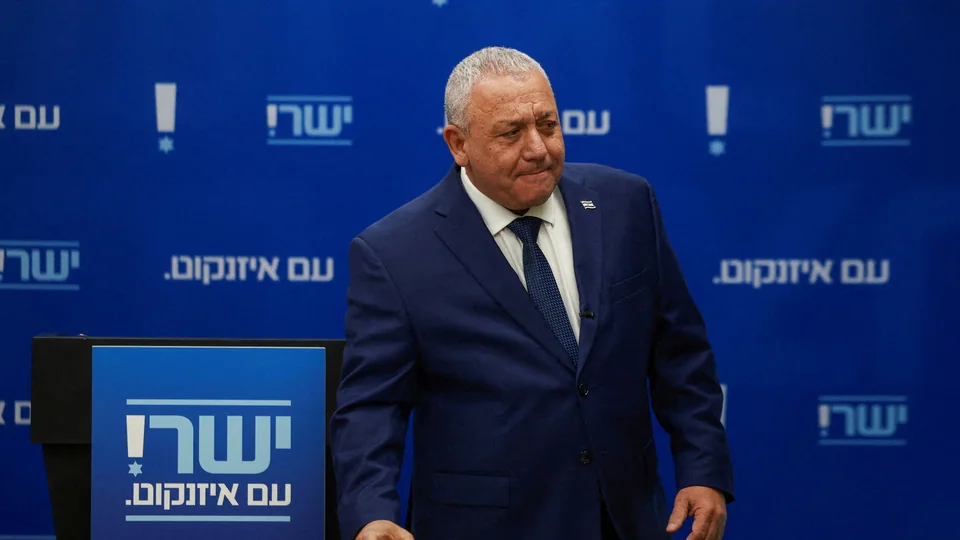
According to a source cited by Israel’s Channel 12, the bloc wants to complete the process quickly rather than use the full waiting period allowed between announcing a government and holding its swearing-in ceremony. The source said the final possible day for the ceremony would be Wednesday and indicated that the process could be completed within 24 hours once the necessary agreements are in place.
The reported timetable comes as Eisenkot faces pressure to bring together parties with different political priorities. His Yashar party has already signed a coalition agreement with Avigdor Liberman’s Yisrael Beytenu, but negotiations with other potential partners remain unsettled.
Liberman Expresses Confidence in Eisenkot’s Coalition Effort
Yisrael Beytenu leader Avigdor Liberman has expressed confidence that Eisenkot can present a coalition government with what he described as a “clear Jewish majority” by the end of next week.
His comments followed the announcement that Yashar and Yisrael Beytenu had signed a coalition agreement, marking the first formal coalition deal between parties since Eisenkot received the mandate to form a government. Liberman said the agreement’s details would be released after a legal review.
Liberman also indicated that discussions with the ultra-Orthodox United Torah Judaism (UTJ) party were progressing positively. According to reports cited by The Times of Israel, he described the negotiations as moving “very nicely”.
Bringing UTJ into the proposed government could help Eisenkot address the opposition bloc’s difficulty in securing enough parliamentary support. However, negotiations with the party involve sensitive questions about military service exemptions for ultra-Orthodox men, an issue that has been central to Israeli coalition politics.
UTJ representatives have been consulting their religious leadership before formally advancing negotiations. Reports indicate that discussions have included a possible framework that would preserve broad exemptions for ultra-Orthodox men studying in religious institutions. The party has not publicly confirmed that a final agreement has been reached.
Yashar and Yisrael Beytenu Sign Coalition Agreement
The agreement between Eisenkot’s Yashar party and Liberman’s Yisrael Beytenu represents an important step in the effort to assemble an alternative government to Prime Minister Benjamin Netanyahu‘s Likud-led administration.
According to Reuters, Yashar won 21 seats in the October 27 election, while Yisrael Beytenu secured seven. Together, the two parties account for 28 seats in the 120-member Knesset.
However, an agreement between two parties does not provide enough support to form a government. A coalition normally needs the backing of at least 61 members of the Knesset to command a parliamentary majority.
Eisenkot’s broader centre-right opposition bloc has 48 seats, leaving it short of the number required for a straightforward majority. The bloc therefore needs additional coalition partners or a political arrangement that allows it to secure sufficient support in a confidence vote.
The negotiations are taking place under a tight political timetable. President Isaac Herzog tasked Eisenkot with forming a government after the inconclusive October election, giving him until December 6 to complete the process, with a possible 14-day extension.
Democrats Suspend Coalition Talks With Eisenkot
One of the biggest obstacles to Eisenkot’s plan emerged when the Democrats party, led by Yair Golan, announced that it was suspending coalition negotiations with Yashar.
The party cited Eisenkot’s continued discussions with Netanyahu’s Likud and what it described as a stalemate in efforts to establish an alternative government. It also expressed concern about reports of progress towards a possible unity arrangement involving Likud.
The suspension highlights divisions within the opposition over the most practical route to replacing Netanyahu. Some leaders are willing to explore cooperation with parties outside their immediate political bloc, while others believe the opposition should focus on forming a government that excludes the current Prime Minister’s Likud party.
Golan has argued that the opposition should move quickly and avoid allowing disagreements to delay the formation of a new administration. Despite suspending formal negotiations, he renewed his appeal for opposition leaders to demonstrate flexibility.
In a series of posts on X, Golan wrote: “Netanyahu can be replaced as early as tomorrow.” He also argued that the Prime Minister had “no mandate to keep running the country”.
Golan urged opposition politicians to abandon ultimatums and focus on reaching an agreement. “Get off the rooftops. This is not the time for ultimatums. This is the time for leadership. Bold, swift action will save Israel,” he wrote.
He also described the kind of government he wanted to see, listing Eisenkot, Naftali Bennett, Liberman and other opposition figures as potential members of an alternative administration. His message was intended to encourage the parties to set aside their differences and agree on a governing arrangement.
Three Major Coalition Options Face Eisenkot
Eisenkot’s challenge is not simply to negotiate agreements with individual parties. He must find a combination of political partners that can work together despite disagreements over military service, relations with Arab-led parties, judicial reform and the possibility of cooperation with Netanyahu.
1. Bringing United Torah Judaism Into the Coalition
One possible route involves reaching an agreement with United Torah Judaism, an ultra-Orthodox political alliance. Liberman has expressed confidence in the negotiations and has supported efforts to bring the party into an alternative government.
However, military conscription remains a major point of disagreement. Several opposition parties have campaigned for broader military service obligations, while ultra-Orthodox parties have sought to preserve exemptions for religious students.
Any agreement would therefore require difficult negotiations over how military service rules would operate under a new government. A compromise could help Eisenkot secure additional parliamentary support, but it could also create tensions with partners who have promised to change the existing exemption system.
2. Seeking Support From Arab-Led Parties
Another possibility involves securing support from Israel’s Arab-led political parties, including Ra’am and the Joint List. Their parliamentary strength could help the opposition overcome its numerical shortfall without bringing all of them directly into the governing coalition.
However, this approach has faced resistance within Eisenkot’s own bloc. Liberman has opposed relying on Arab parties to establish a government, while other opposition figures have expressed reservations about such an arrangement.
Golan has been more open to cooperation with Arab-led parties, arguing that political flexibility is necessary to replace Netanyahu. The disagreement has contributed to tensions between the Democrats and other members of the opposition alliance.
A minority government supported by Arab parties from outside the coalition is also among the arrangements discussed in Israeli political reporting. Such a government would need to secure enough votes to survive parliamentary confidence proceedings and subsequent political challenges.
3. Exploring a Unity Government With Likud
A third option involves negotiations with Netanyahu’s Likud party over a possible unity government. Such an arrangement could bring together parties that currently occupy opposing political camps, potentially reducing the need to rely on Arab-led parties or secure support from every smaller faction.
However, the talks have encountered significant disagreements. The two sides have discussed major political issues, including judicial reform and the structure of a possible power-sharing arrangement. Questions about who would lead the government and which parties would participate remain unresolved.
The discussions have also caused friction within Eisenkot’s bloc. The Democrats have objected to the continued engagement with Likud, while Bennett’s B’Yachad party has reportedly been more receptive to exploring a unity arrangement.
These competing approaches have made it difficult for Eisenkot to present a single coalition strategy that satisfies all opposition partners.
Why the Opposition Is Divided Over Netanyahu’s Replacement
The opposition parties share an interest in replacing Netanyahu’s government, but they do not agree on the political structure that should follow it. Their differences reflect competing priorities rather than a simple disagreement over whether a change of government is desirable.
For Liberman, a coalition involving ultra-Orthodox parties is a potential route to securing a Jewish parliamentary majority without depending on Arab-led factions. Golan, by contrast, has called for broader cooperation and argued that the opposition should not rule out support from Arab parties.
Bennett’s position has also become important to the negotiations. His party has been linked to discussions about a unity government, although Bennett has publicly rejected joining a Netanyahu-led administration and said he remains committed to an alternative government headed by Eisenkot.
The Democrats’ decision to suspend talks adds another complication. Without agreement among the main opposition parties, Eisenkot could struggle to assemble a coalition that has both sufficient parliamentary backing and internal political support.
The debate also involves questions about the future direction of Israel’s domestic policies, particularly military service obligations and the judicial system. These issues are likely to influence the coalition agreement regardless of which parties eventually join the government.
What Happens if Eisenkot Cannot Form a Government?
Israel’s coalition negotiations are governed by a formal process in which the President assigns a political leader the responsibility of trying to assemble a government. Eisenkot received that mandate after the October 27 election, which did not produce a clear parliamentary majority for either the opposition or Netanyahu’s bloc.
He has until December 6 to complete the task, although the President can grant an additional 14 days. The reported aim of completing the process by the end of next week would therefore represent an effort to reach an agreement well before the formal deadline.
If Eisenkot cannot form a government within the permitted period, the mandate could be returned to the President, who would have to consider the next constitutional and political steps. Netanyahu could receive another opportunity, or the country could eventually face another election if no candidate is able to establish a government.
The possibility of another election adds urgency to the negotiations, but it does not remove the disagreements among the parties. A government formed without a stable parliamentary arrangement could also face difficulties surviving confidence votes and legislative battles.
Can Eisenkot Complete the Coalition Deal by Next Wednesday?
The reported target of swearing in a new government by next Wednesday depends on whether Eisenkot can resolve the disagreements over coalition partners and secure enough parliamentary support. The agreement with Yisrael Beytenu provides a formal starting point, while the reported progress with UTJ offers another possible route.
However, the Democrats’ suspension of negotiations and the unresolved discussions with Likud show that the opposition remains divided over how to proceed. The question of whether to rely on ultra-Orthodox parties, Arab-led factions or a unity arrangement continues to shape the negotiations.
Liberman’s confidence and the source’s reported determination indicate that the bloc wants to move quickly. But no final government should be treated as secured until the coalition agreements are completed and the necessary parliamentary steps are taken.
For now, Eisenkot faces the task of turning a collection of parties with a shared interest in replacing Netanyahu into a functioning political alliance. Whether he can meet the reported timetable will depend less on the announcement of an agreement between individual parties and more on resolving the disagreements that still divide his potential partners.
For breaking news and live news updates, like us on Facebook or follow us on Twitter and Instagram. Read more on Latest World on thefoxdaily.com.





COMMENTS 0