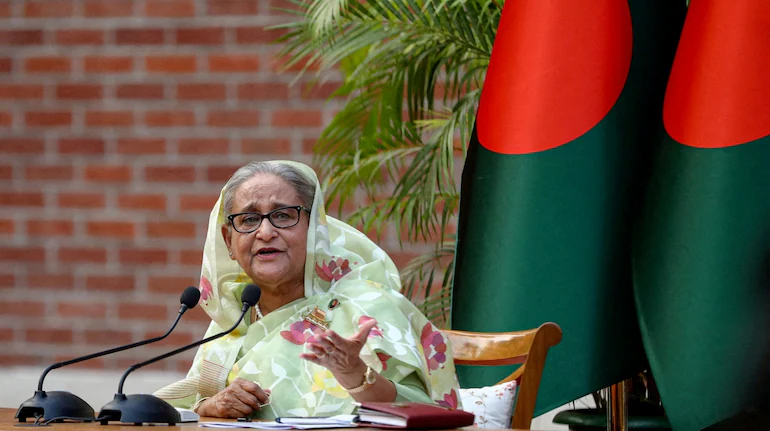
Hasina’s proposed return is not simply a question of whether she wants to board a plane. It involves two governments, a bilateral extradition treaty, India’s domestic extradition law, the validity of her travel documents and the consequences she could face immediately after reaching Bangladesh.
The central distinction is between voluntary travel and formal extradition. Hasina may be willing to return, but that willingness does not automatically settle whether India can allow her to leave independently, whether Bangladesh will admit her through an ordinary travel arrangement or whether the pending extradition request must be addressed first.
Why Bangladesh insists on extradition despite Hasina’s willingness to return
Bangladesh’s position is that Hasina is not returning as an ordinary citizen or commercial passenger. She is a former head of government who fled the country on August 5, 2024, after a student-led uprising ended her 15-year rule. She is now wanted by Bangladeshi authorities and has been sentenced to death in absentia by the country’s International Crimes Tribunal.
Dhaka says it wants her brought back under the India-Bangladesh Extradition Treaty rather than through a flight arranged at her request. State Minister for Foreign Affairs Humaiun Kobir reiterated this position on November 24, rejecting the proposed December 16 journey and saying she could return only through extradition, in custody or under strict surveillance.
Another state minister, Shama Obaed Islam, has also said the government has not arranged an aircraft or other transport for Hasina. Bangladesh’s position is that discussions about her handover must take place with India, not through a separate travel arrangement negotiated with Hasina or her representatives.
For Dhaka, extradition would place the transfer under an established legal and diplomatic framework. It would also ensure that Hasina is handed over to the authorities responsible for enforcing the court’s judgment and dealing with the cases against her.
Hasina’s spokesperson, Syed Mozammel Ali, has argued that the government should facilitate her return because she was flown to India on a Bangladeshi aircraft in August 2024. Her side has described December 16, Bangladesh’s Victory Day, as the proposed date for her homecoming.
What does the India-Bangladesh extradition treaty say?
India and Bangladesh signed their extradition treaty on January 28, 2013. It entered into force in October that year and was amended in 2016 to simplify certain procedures.
Under Article 1, the two countries agree to extradite people found in the territory of one country who have been charged with, prosecuted for, convicted of or are wanted to serve a judicially imposed sentence for an extraditable offence in the other country.
Article 2 generally defines an extraditable offence as conduct punishable under the laws of both countries by imprisonment for at least one year. The treaty therefore focuses on the nature of the alleged conduct and its treatment under the legal systems of both states, rather than requiring identical offence names in each country.
Article 10 sets out the procedure for submitting an extradition request. The request must be made through diplomatic channels and include identifying information about the person, a statement of the alleged offence and the relevant legal provisions. If the individual has already been convicted and sentenced, the requesting country must also provide the required conviction and sentencing documents.
Article 16 addresses the actual surrender. If extradition is granted, the requested country must send the person to a convenient departure point indicated by the requesting country. Bangladesh must then arrange to remove the person within the period specified by the treaty.
These provisions explain why Dhaka is insisting on a formal handover. Extradition is a government-to-government process, not simply a matter of an individual purchasing a ticket and arriving in the requesting country.
Does Hasina’s consent allow India to skip extradition?
Not automatically. Hasina’s willingness to return could change the practical circumstances of the case, but the treaty does not establish a separate, automatic voluntary-return procedure that simply cancels the formal extradition framework.
Her consent may reduce the practical difficulty of transferring her if India and Bangladesh agree on the arrangements. It does not, by itself, amount to India’s approval of the pending request or resolve the legal questions surrounding her departure.
There are two different situations to consider. In the first, India formally surrenders Hasina to Bangladesh in response to its extradition request. That would be an extradition under the bilateral treaty and would involve the relevant Indian legal and administrative procedures.
In the second, India permits her to leave independently using valid travel documents, and Bangladesh agrees to admit her. Such a journey could be legally different from a formal extradition. However, it would depend on whether Hasina is legally free to depart India, whether she can obtain acceptable travel documents and whether Bangladesh is prepared to receive her outside the extradition process.
There is no basis to assume that her consent alone resolves all these issues. Indian authorities would need to consider the status of the extradition request and any applicable legal restrictions before deciding how her departure could take place.
Can Hasina simply board a commercial flight from Delhi to Dhaka?
That is the second major obstacle. Even if Hasina is willing to return without waiting for a formal extradition decision, she would still need a legally acceptable way to travel and enter Bangladesh.
Her Bangladeshi diplomatic passport was revoked after she fled the country in August 2024. Earlier this month, her legal representatives approached the Bangladesh High Commission in New Delhi seeking a new passport and national identity card to facilitate her return. Dhaka has rejected the passport route and reiterated that it wants her brought back under the extradition treaty.
India’s Ministry of External Affairs has also highlighted the importance of travel documentation. On November 10, spokesperson Randhir Jaiswal said that international travel requires a valid travel document and described the extradition issue as a legal matter that would be handled through the appropriate process.
This does not mean a passport is necessarily the only document that could facilitate a formal extradition. Extradition is a legal handover between governments, and the treaty contains procedures for surrendering a person after approval. But if Hasina wants to travel independently as a passenger, the absence of valid travel documents becomes a practical and legal obstacle.
There is another complication: Bangladesh has made clear that it does not want to receive her through an ordinary travel arrangement. Its government says she would be arrested immediately if she returned, regardless of how she arrived.
What happens if Hasina reaches Bangladesh?
Hasina would face arrest and detention upon returning under the position publicly stated by Bangladesh’s government. The authorities have made clear that she would not receive special treatment because she was once the country’s prime minister.
Her legal difficulties stem primarily from the verdict delivered by Bangladesh’s International Crimes Tribunal in November 2025. The tribunal sentenced her to death in absentia for crimes against humanity linked to the security forces’ crackdown during the July-August 2024 uprising.
Hasina has denied wrongdoing and rejected the legitimacy of the proceedings. Her position is that the case against her is politically motivated, while Bangladeshi authorities maintain that the prosecution concerns serious criminal offences.
The United Nations estimated that as many as 1,400 people were killed during the unrest that led to her removal from power. The scale of the violence and the allegations surrounding the government’s response have made the case a major political and human-rights issue in Bangladesh.
Her return would therefore not simply mark the end of her time in India. It would place her directly within the Bangladeshi criminal justice system, where she faces the consequences of the existing judgment and any further proceedings permitted under domestic law.
Does the death sentence make extradition more difficult for India?
The death sentence is one of the most sensitive aspects of the extradition question. India would have to consider the legal basis of Bangladesh’s request as well as the circumstances in which Hasina could be detained, tried or punished after surrender.
Article 8 of the India-Bangladesh treaty provides grounds on which extradition may be refused. These include circumstances in which surrender would be unjust or oppressive because of the trivial nature of the offence, the passage of time or an accusation that was not made in good faith and in the interests of justice.
The treaty does not make every foreign conviction automatically enforceable in India. The requesting country must provide the necessary documents, and the requested country must assess the request under the treaty and its own applicable law.
The prospect of a death sentence could therefore become an important consideration in India’s assessment, particularly in relation to whether surrender would be unjust or oppressive in the circumstances. However, the treaty provisions should not be interpreted as creating an automatic refusal simply because the person sought has received a death sentence.
Reports have also raised questions about possible assurances concerning Hasina’s safety, access to legal remedies and the treatment she would receive after surrender. Any such assurances would need to be considered by the competent Indian authorities as part of the broader legal and diplomatic assessment.
Can Hasina argue that the case against her is politically motivated?
Yes. The treaty contains a political-offence exception, but it is not an unlimited protection against extradition.
Article 6 allows a country to refuse extradition when the offence for which surrender is requested is political in character. However, the same article lists several serious offences that cannot be treated as political offences for the purpose of the treaty.
These exclusions include murder, manslaughter, culpable homicide, certain forms of assault, kidnapping, unlawful detention and specified terrorism-related offences. Attempts or conspiracies involving several of these crimes are also covered by the exclusions.
This distinction matters because Hasina has described the proceedings against her as politically motivated. But her characterisation of the case does not determine how Indian authorities must classify the offences in the extradition request.
They would need to examine the actual charges, the conduct alleged, the applicable legal provisions and the evidence and documents supplied by Bangladesh. The fact that a prosecution involves a former political leader does not automatically make every offence in the case a political offence under the treaty.
Article 8 provides a separate safeguard where the person sought can establish that extradition would be unjust or oppressive because the accusation was not made in good faith or in the interests of justice. This could be relevant to arguments concerning the fairness and circumstances of the proceedings, but it would require an assessment of the specific facts rather than acceptance of a political-motivation claim alone.
What role does India’s Extradition Act, 1962 play?
The bilateral treaty is not the only legal instrument involved. India’s Extradition Act, 1962, provides the domestic framework for handling requests to surrender fugitive criminals to foreign countries.
Sections 4 to 8 of the Act set out procedures relating to requisitions, possible magisterial inquiries, arrest warrants, proceedings before a magistrate and the surrender of a fugitive criminal. The Act allows the Central Government to refer a case for a magisterial inquiry where it considers that appropriate.
During an inquiry, the magistrate can examine evidence presented by the requesting country and material submitted on behalf of the person whose extradition is sought. This can include arguments that the alleged offence is political in character or does not qualify as an extradition offence.
The applicable provisions must be read alongside the treaty and the specific arrangements governing extradition with Bangladesh. It would therefore be inaccurate to assume that every stage of a contested extradition proceeding must necessarily occur in precisely the same way in every case.
The Central Government retains an important role in deciding whether the legal requirements for surrender have been met. The existence of a treaty creates a framework for cooperation, but it does not mean that a foreign government’s request automatically results in the transfer of the individual.
Why India is being cautious about the extradition request
India’s handling of Hasina’s case has consequences beyond the legal question of whether she should be surrendered. Her presence in India has become a sensitive issue in relations between New Delhi and Dhaka.
Bangladesh’s government has repeatedly called for her return, while India has avoided announcing a final decision. The Indian Ministry of External Affairs has consistently described the matter as a legal issue that will be dealt with according to the applicable process.
In a written response recorded in a Lok Sabha committee report in February 2026, the Indian government said the extradition request was being examined by the competent authorities in accordance with applicable law and established procedures.
New Delhi must also consider the implications of its decision for bilateral relations, regional cooperation and the treatment of a former head of government facing a serious criminal judgment in another country.
India and Bangladesh share a long border and maintain important connections involving trade, transport, water resources, security and people-to-people movement. Disagreements over Hasina’s future can complicate cooperation across these areas, particularly when political tensions are already high.
At the same time, India’s decision cannot be reduced to a diplomatic calculation alone. The extradition treaty and domestic law establish legal considerations that must be addressed before any formal surrender takes place.
What are the possible ways Hasina could return?
There are several possible scenarios, although none has been confirmed as the arrangement for her proposed December 16 return.
- Formal extradition: India could approve Bangladesh’s request after examining the treaty requirements and applicable legal safeguards, then arrange her surrender through the prescribed process.
- Voluntary departure with valid documents: India could potentially permit independent travel if Hasina is legally free to leave, possesses acceptable travel documentation and Bangladesh agrees to receive her outside a formal extradition handover.
- A mutually agreed transfer arrangement: New Delhi and Dhaka could discuss practical arrangements for her return while addressing the legal requirements and custody arrangements involved.
- Continued stay in India: If the extradition request remains under examination and no independent departure arrangement is approved, Hasina could remain in India while the governments continue addressing the matter.
These possibilities are not interchangeable. A formal extradition would involve a government-authorised surrender, whereas independent travel would depend on separate decisions about her legal status, travel documents and admission into Bangladesh.
Why December 16 matters for Hasina’s proposed return
December 16 is Victory Day in Bangladesh, marking the country’s victory in the 1971 Liberation War and the end of Pakistani rule. It is one of the most significant dates in the country’s national calendar.
Hasina’s decision to identify Victory Day as her proposed return date gives the announcement political and historical significance. Her spokesperson has argued that the Bangladeshi government should arrange her journey because she originally travelled to India aboard a Bangladeshi aircraft in August 2024.
However, the date itself does not create a legal entitlement to return through a particular arrangement. Nor does it require India to approve an extradition request or compel Bangladesh to issue a passport.
Dhaka’s response has made the disagreement clear: Hasina wants the government to facilitate her journey, while the government insists that her return must take place through extradition and under custody or strict surveillance.
Can Sheikh Hasina return to Bangladesh without extradition?
It may be legally possible in principle for Hasina to travel independently, but her willingness to return is not enough to make that happen. She would need to be legally permitted to depart India, obtain a valid travel document or other acceptable travel authorisation, and secure Bangladesh’s willingness to admit her through that route.
Bangladesh has so far rejected the ordinary travel option and continues to demand a formal handover. India, meanwhile, has said the extradition request is being handled under the applicable legal process without announcing a final decision.
The most important unresolved issue is therefore not whether Hasina wants to return, but whether New Delhi and Dhaka can agree on a lawful mechanism for her transfer. Until that happens, December 16 remains her stated target rather than a confirmed return date.
For breaking news and live news updates, like us on Facebook or follow us on Twitter and Instagram. Read more on Latest World on thefoxdaily.com.






COMMENTS 0