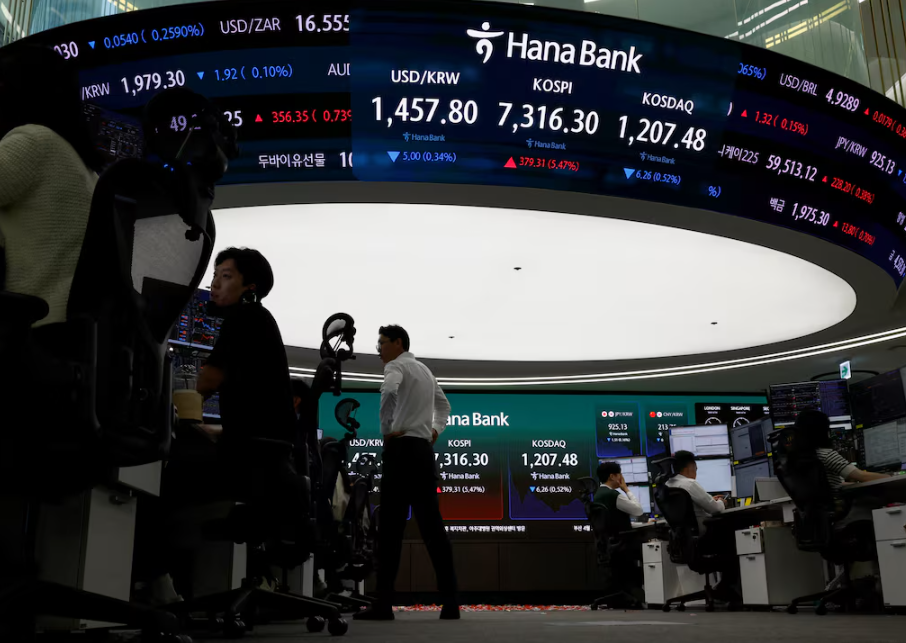
Asian markets moved cautiously on Wednesday as investors waited for the Federal Reserve‘s latest interest-rate decision, with global stocks caught between rising borrowing costs, elevated oil prices and uncertainty over the central bank’s next policy signal.
MSCI’s broadest index of Asia-Pacific shares outside Japan fluctuated between gains and losses before trading about 0.3% higher. Taiwanese shares gained, while Chinese stocks declined. Japan’s Nikkei 225 slipped 0.1%, while S&P 500 futures edged 0.1% higher.
The immediate focus was firmly on the Federal Reserve. Investors were also watching U.S. Treasury yields after the 10-year benchmark briefly moved above 5% on Tuesday for the first time in three years. By Wednesday’s Asian session, the yield had eased below that threshold.
Asian Markets Enter Fed Day in Cautious Mode
The relatively small moves across Asian markets reflected a wait-and-see approach rather than a strong directional shift. Investors had already absorbed several sessions of pressure from higher bond yields and rising crude oil prices.
The regional Asia-Pacific index had declined for four consecutive sessions before Wednesday’s modest recovery. The mixed performance showed that investors were reluctant to make large commitments before receiving fresh guidance from the Federal Reserve.
For equity markets, the Fed decision matters not only because of the rate itself but also because of what policymakers communicate about future monetary policy.
| Market Indicator | Latest Move in the Report | Why It Matters |
|---|---|---|
| MSCI Asia-Pacific ex-Japan | Up about 0.3% | Shows tentative regional recovery after four sessions of declines |
| Nikkei 225 | Down 0.1% | Reflects cautious positioning ahead of major central-bank decisions |
| U.S. 10-year Treasury yield | 4.9875% | Retreated below the 5% threshold after briefly crossing it |
| Brent crude | $107.86, down 0.8% | Energy prices remain a major inflation and growth concern |
| U.S. dollar index | 99.675 | Near a two-week high as markets await the Fed |
Fed Decision Becomes the Main Market Catalyst
The Federal Open Market Committee’s decision was scheduled for later Wednesday, followed by a press conference with Fed Chair Kevin Warsh.
Market pricing showed a very high probability of a 25-basis-point rate increase. According to the CME Group’s FedWatch tool cited in the report, traders were pricing a 92.4% probability of such a hike, compared with 59.4% a week earlier.
The sharp change in expectations illustrates how quickly financial markets have adjusted to recent inflation and energy-price developments.
JPMorgan analysts described their view going into the meeting as tactically cautious and neutral. They noted that the consensus expectation involved a 25-basis-point increase accompanied by limited forward guidance.
The communication following the decision could therefore be nearly as important as the rate move itself. Investors will be looking for clues about whether the Fed considers the latest inflation pressure temporary or persistent and how it views the appropriate path for rates from here.
Why the 5% Treasury Yield Matters
The U.S. 10-year Treasury yield briefly exceeded 5% on Tuesday, reaching its highest level since 2007 before retreating to 4.9875% in Asian trading.
Government bond yields influence financial markets well beyond the bond market itself. Higher Treasury yields can increase borrowing costs for businesses and households, while also changing the relative attractiveness of stocks and other risk assets.
For technology companies and other growth-oriented stocks, the effect can be particularly important because higher discount rates reduce the present value investors assign to future earnings.
The retreat below 5% therefore offered some relief, but the broader level remains an important market variable.
Bond Yields and Equities
When Treasury yields rise sharply, investors often reassess equity valuations. Companies with strong current cash flows may be affected differently from businesses whose valuations depend heavily on earnings expected several years in the future.
This relationship does not mean stocks must fall whenever yields rise. Corporate earnings, economic growth and investor demand also matter. However, rapid changes in benchmark yields can increase volatility across global equity markets.
Wall Street Declines as Yields and Oil Weigh on Sentiment
U.S. equities came under pressure overnight. The S&P 500 fell 0.5%, marking its second consecutive session of declines.
The decline came as the 10-year Treasury yield climbed to its highest level since 2007, while crude oil prices also remained elevated.
Tony Sycamore, market analyst at IG in Sydney, said rising Treasury yields, another increase in crude prices and debate surrounding the pace of artificial-intelligence development contributed to the cautious market mood.
The combination is significant because financial markets are dealing with several uncertainties simultaneously. Monetary policy is becoming more restrictive, energy prices are elevated and investors are reassessing the sustainability of large technology-related investments.
Oil Prices Pull Back After Tuesday’s Sharp Rise
Oil prices eased during Asian trading after making a substantial advance the previous day.
Brent crude futures were down 0.8% at $107.86 a barrel after rising 2.9% on Tuesday. The retreat followed reports that crude loadings at Saudi Arabia’s Red Sea export hub of Yanbu had been suspended and that Riyadh had cancelled some cargo deliveries to European customers.
The pullback is relatively modest compared with the recent oil rally. Crude prices remain high enough to influence inflation expectations, transportation costs and monetary-policy calculations.
For central banks, the key question is whether higher energy prices remain a temporary shock or begin feeding into broader prices and wages.
Saudi Oil Supply Concerns Keep Energy Markets on Alert
Saudi Arabia’s role in global oil supply makes disruptions around its export infrastructure particularly important for financial markets.
The suspension of crude loadings at Yanbu and cancelled European deliveries added another layer of uncertainty to an oil market already affected by geopolitical tensions and disruptions around major shipping routes.
Even when an individual disruption does not permanently remove large quantities of crude from global supply, traders can react strongly when several risks occur at the same time.
That helps explain why oil prices have remained closely connected with expectations for inflation and interest rates.
Dollar Index Nears Two-Week High
The U.S. dollar index was trading near a two-week high at 99.675.
A combination of elevated Treasury yields and expectations for tighter U.S. monetary policy can support the dollar by increasing the relative attractiveness of dollar-denominated assets.
Currency movements are particularly important for Asian economies because changes in the dollar can affect import costs, capital flows and local financial conditions.
For economies that import significant quantities of energy, a stronger dollar combined with expensive crude can create additional pressure on domestic inflation.
Trump’s Rate Preferences Add Political Pressure to the Background
U.S. President Donald Trump has repeatedly expressed a preference for lower interest rates and has publicly criticised the level of monetary policy rates.
According to the report, Trump said last month that the United States would stop trading with countries with which it has a trade deficit if the Federal Reserve did not cut rates.
Despite those statements, traders have continued to price a high probability of a rate increase. The market response demonstrates that expectations are currently being driven more strongly by economic data, inflation developments and Federal Reserve communication than by political statements about rates.
AI Debate Adds Another Layer of Uncertainty
Artificial intelligence also featured in the backdrop to the recent decline in U.S. equities. Investors are closely monitoring the enormous spending commitments being made by technology companies on AI infrastructure.
At the same time, recent public debate about the pace and risks of AI development has introduced another source of uncertainty for technology-related stocks.
The issue matters to Asian markets because many Asian economies and companies are deeply connected to the global semiconductor, electronics and technology supply chains.
A sustained change in expectations around AI investment could therefore affect semiconductor manufacturers, hardware suppliers and technology exporters across the region.
Cryptocurrencies Stabilise After Senate Setback
Digital assets stabilised after suffering a sharp decline in the previous session.
Bitcoin was broadly unchanged at $75,898.71, while ether fell 0.3% to $2,400.46.
The moves came after the U.S. Senate voted against advancing comprehensive cryptocurrency legislation backed by President Donald Trump.
The episode highlights how regulatory developments can remain an important source of volatility for digital assets. Unlike traditional markets, cryptocurrency prices can react rapidly to changes in expectations surrounding regulation, institutional participation and government policy.
What Asian Investors Are Watching on Fed Day
- Federal Reserve rate decision: Whether policymakers deliver the widely anticipated 25-basis-point increase.
- Warsh’s press conference: Any indication of how policymakers view future rate increases.
- U.S. Treasury yields: Whether the 10-year yield remains around or above the 5% level.
- Oil prices: Whether Brent remains above $100 as Middle East supply concerns continue.
- U.S. dollar: Whether the dollar’s recent strength continues following the Fed announcement.
- Technology stocks: How higher rates and the AI investment debate affect valuations.
- Regional currencies: How Asian currencies respond to movements in U.S. yields and the dollar.
Possible Market Reactions Depend on the Fed’s Message
The immediate market response could depend on the difference between what investors already expect and what the Federal Reserve actually communicates.
If the rate decision matches expectations and forward guidance remains limited, investors may focus more heavily on subsequent economic data and movements in Treasury yields.
If the Fed provides unexpectedly strong signals about future tightening, bond yields and the dollar could become more important drivers of equity-market volatility.
Conversely, a less restrictive message could ease some pressure on risk assets, although the effect would also depend on what policymakers say about inflation and energy prices.
JPMorgan analysts noted that the meeting could provide an opportunity for markets to reset their expectations for future rate increases. They also warned that a policy outcome perceived as inconsistent with market expectations could trigger a strong reaction in equities.
Why the Fed Decision Matters Beyond the United States
The Federal Reserve’s decisions influence financial conditions worldwide because the U.S. dollar and Treasury market sit at the centre of the global financial system.
Higher U.S. rates can affect international borrowing costs, currency markets and capital flows. Asian economies can therefore experience market effects even when their domestic economic conditions have not changed significantly.
For exporters, currency depreciation can sometimes improve competitiveness, while a stronger dollar can raise the local-currency cost of imported commodities. For investors, changes in U.S. yields can alter the relative appeal of emerging-market and developed-market assets.
That is why Wednesday’s Fed decision is being treated as a major global market event rather than simply a U.S. monetary-policy announcement.
Asian Markets Face a Three-Way Test
The current market environment can be understood through three interconnected forces: monetary policy, energy prices and economic-growth expectations.
| Force | Current Situation | Potential Market Channel |
|---|---|---|
| Monetary policy | Markets price a high probability of a 25-basis-point Fed hike | Influences bond yields, currencies and equity valuations |
| Energy prices | Brent remains above $100 | Can increase inflation and reduce purchasing power |
| Growth expectations | Investors remain cautious amid financial tightening | Influences corporate earnings and risk appetite |
| AI investment | Debate continues over the pace and sustainability of development | Can affect technology and semiconductor valuations |
Conclusion: Markets Wait for Clarity
Asian markets entered Wednesday with modest gains but little conviction as investors waited for the Federal Reserve’s policy decision and Chair Kevin Warsh’s press conference.
The retreat in the U.S. 10-year Treasury yield below 5% provided some relief, but the benchmark remains at historically important levels. Meanwhile, Brent crude stayed above $100 despite a modest pullback, keeping inflation risks firmly in focus.
The combination of elevated oil prices, high Treasury yields, a stronger dollar and uncertainty around technology investment has created a complicated backdrop for global equities.
The Fed’s decision will provide a new reference point for markets. Beyond the headline rate move, investors will be watching the central bank’s assessment of inflation, energy-price risks and the potential path of interest rates in the months ahead.
For breaking news and live news updates, like us on Facebook or follow us on Twitter and Instagram. Read more on Latest Business on thefoxdaily.com.






COMMENTS 0