
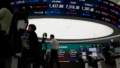
Asian share markets fell on Monday as rising oil prices, renewed Middle East supply concerns and expectations of interest-rate hikes in the United States and Japan weighed on investor sentiment. Technology and artificial intelligence-linked stocks led declines after OpenAI and Anthropic executives called for a slower pace of AI development to manage risks and protect humanity.
At the same time, crude oil prices jumped again as attacks involving Saudi Arabia and shipping in the Gulf intensified concerns about disruptions to global energy supplies. The situation was further complicated by an attack on a Saudi oil pipeline and advances by Yemen’s Houthis.
Investors are now facing a combination of higher energy costs, elevated inflation expectations and tighter monetary policy. Markets are assigning a high probability to rate increases by both the Federal Reserve and the Bank of Japan this week.
Asian Stock Market Performance
Japan’s Nikkei index fell 0.8%, while South Korea’s benchmark declined 2.1%. The MSCI index covering Asia-Pacific shares outside Japan slipped 0.8%, while China’s blue-chip CSI300 index eased 0.4%.
Declines in technology shares were particularly important because investors have become increasingly sensitive to the valuation of AI-related companies. Expectations of slower AI development added another source of uncertainty to a market segment that has been a major driver of global equities.
| Market | Reported Move | Key Pressure |
|---|---|---|
| Nikkei | -0.8% | Rate expectations and broader risk-off sentiment |
| South Korea | -2.1% | Sharp decline in AI-linked shares |
| Asia-Pacific ex-Japan | -0.8% | Oil and monetary-policy concerns |
| CSI300 | -0.4% | Regional risk-off trading |
| Nasdaq futures | -1.1% | AI-stock weakness |
| S&P 500 futures | -0.4% | Higher rates and inflation concerns |
Brent Oil Climbs Above $107
Oil prices were one of the biggest drivers of Monday’s market weakness. Brent crude futures rose 2.6% to around $107.36 a barrel, after gaining almost 9% during the previous week. U.S. crude increased 2.4% to about $102.48 a barrel.
The latest rise came as investors reacted to new strikes on Saudi Arabia and attacks involving ships in the Gulf. The developments followed an attack on a Saudi oil pipeline and growing activity by Yemen’s Houthis, raising fears that disruptions to Middle Eastern energy infrastructure and shipping could become more widespread.
The concern is not simply about the current price of oil. Markets are increasingly focused on whether supply disruptions could last for an extended period. A prolonged period of crude prices above $100 could add to inflationary pressure in economies that depend heavily on imported energy.
Strait of Hormuz and Bab el-Mandeb Add to Supply Risks
Two strategic maritime routes are particularly important to the current market outlook: the Strait of Hormuz and the Bab el-Mandeb Strait.
Threats to shipping through these waterways can increase the cost and difficulty of transporting crude oil and other energy products. Even when physical supplies remain available, uncertainty around transportation can create a risk premium in oil prices.
A planned meeting in Oman between Iran and Gulf Arab states to discuss a potential arrangement for reopening the Strait of Hormuz was postponed. That development reduced hopes for an immediate easing of shipping concerns.
For financial markets, the longer these routes remain under threat, the greater the possibility that higher energy costs will feed into inflation expectations and influence central-bank decisions.
Fed Rate Hike Bets Strengthen
U.S. monetary policy is another major factor affecting global markets. A stronger-than-expected U.S. consumer inflation report pushed investors to increase expectations for a Federal Reserve rate increase.
Markets were pricing an approximately 86% probability of a 25-basis-point Fed hike on Wednesday. Investors were also expecting another increase by December.
If delivered, the September move would represent the first Federal Reserve rate increase since mid-2023, according to the report.
The possibility of higher U.S. interest rates matters for global investors because American Treasury yields influence borrowing costs and asset valuations worldwide. Higher yields can also make dollar-denominated assets more attractive relative to riskier investments.
Goldman Sachs and JPMorgan Turn More Hawkish
The changing market outlook has also influenced major Wall Street forecasts. Goldman Sachs has shifted its expectation toward a September rate increase, while JPMorgan’s chief U.S. economist Michael Feroli expects the Fed to raise rates in both September and December.
The argument is partly about central-bank credibility. If policymakers have signalled concern about inflation and markets are already expecting an increase, failing to act could create questions about the consistency of monetary policy.
However, a September hike does not necessarily mean the Federal Reserve is beginning a long and aggressive tightening cycle. The future path will depend heavily on inflation, employment and other incoming economic data.
High Treasury Yields Put Pressure on Stock Valuations
U.S. Treasury yields have risen sharply in recent weeks. The 10-year Treasury yield was around 4.974%, while the two-year yield had increased by 26 basis points over the previous week. The 10-year yield gained 19 basis points during the same period.
Higher bond yields can make stocks less attractive at the margin because investors have an alternative source of returns from government debt. They can also increase the discount rate used to value future corporate earnings.
This issue is particularly relevant for high-growth technology and AI companies. Many of these companies are valued partly on expectations of substantial future earnings, meaning higher interest rates can place greater pressure on their valuations.
Why Goldman Sachs Still Sees a Bull Market
Despite the pressure created by higher borrowing costs, Goldman Sachs’ U.S. equity strategy team remains relatively optimistic about the broader stock market.
Goldman strategist Ben Snider said strong corporate earnings could provide support for equities even if borrowing costs increase. Historical performance also shows that the initial reaction to a new rate-hiking cycle does not necessarily determine the long-term direction of stocks.
According to the analysis cited in the report, the S&P 500 has historically produced an average three-month return of around negative 2% at the beginning of seven hiking cycles. However, its average return during the 12 months following the first hike was approximately positive 9%.
This highlights an important distinction: markets can initially struggle with tighter monetary policy while still performing well over a longer period if economic growth and corporate earnings remain resilient.
AI Stocks Face a Separate Challenge
The decline in Asian technology shares was not caused solely by interest-rate expectations. AI stocks faced additional pressure after the leaders of OpenAI and Anthropic called for a slower pace of development to manage risks associated with increasingly powerful artificial intelligence systems.
The comments introduced a new uncertainty for investors who have been heavily focused on the rapid expansion of AI infrastructure, computing capacity and related technology spending.
A slower development approach could have different effects across the technology industry. Companies providing AI infrastructure may face questions about future demand, while firms focused on responsible development and risk management could potentially face different investment priorities.
For markets, the immediate issue is that AI valuations have become highly sensitive to changes in expectations surrounding growth, investment and regulation.
Bank of Japan Rate Hike Also in Focus
The Federal Reserve is not the only central bank attracting investor attention. Markets are also pricing in a strong possibility of a 25-basis-point Bank of Japan rate increase on Friday.
Current pricing implies roughly a 76% probability that the BOJ will raise its cash rate to 1.25%.
The Japanese central bank is facing a particularly complicated environment. It must manage inflation and monetary normalization while also considering the yen’s recent movements and the effects of previous market intervention.
Investors will therefore pay close attention not only to the size of any BOJ rate increase but also to its guidance regarding future tightening.
Yen Recovers as BOJ Tightening Expectations Increase
The dollar traded around 153.98 yen on Monday. The yen has strengthened considerably over the previous two weeks, with the dollar falling roughly 4% from recent levels.
The exchange rate had previously reached around 163.99 in July, making the recent move significant.
A more hawkish BOJ could provide additional support to the yen if investors become convinced that Japanese interest rates will continue moving higher. Conversely, cautious guidance could limit the currency’s gains.
Bank of England Expected to Hold Rates
While the Federal Reserve and Bank of Japan are expected to tighten policy, the Bank of England is expected to leave its benchmark interest rate unchanged at 3.75% on Thursday.
The possibility of another split decision could nevertheless keep attention on the UK’s inflation and growth outlook.
This divergence between central banks illustrates how monetary policy is becoming increasingly dependent on individual domestic economic conditions rather than following a single global direction.
Gold Prices Stay Near $4,347
Gold was broadly flat at around $4,347 an ounce. Higher government bond yields reduced some of the appeal of gold because the precious metal does not generate interest income.
Gold can benefit from concerns about inflation, geopolitical instability and financial uncertainty, but rising yields can create an opposing force by increasing the relative attractiveness of interest-bearing assets.
The current market therefore presents a mixed environment for gold: geopolitical risks remain elevated, but higher yields are limiting some of its support.
Global Markets Face a Three-Way Pressure Point
The latest market moves can be understood through three major forces: oil prices, monetary tightening and technology valuations.
- Oil: Supply disruptions and shipping risks are pushing crude prices higher.
- Inflation: More expensive energy could make it harder for inflation to decline.
- Interest rates: Stronger inflation expectations are increasing bets on Fed and BOJ hikes.
- Bonds: Higher Treasury yields are increasing pressure on equity valuations.
- Technology: AI shares are facing both valuation pressure and concerns about the pace of development.
- Currencies: Diverging monetary policies are creating larger movements in the dollar and yen.
What Investors Should Watch This Week
The coming days could be especially important because several major central-bank decisions are scheduled alongside ongoing geopolitical developments.
Investors will closely monitor the Federal Reserve’s rate decision and guidance, the Bank of Japan’s policy announcement, movements in crude oil prices and developments around Middle Eastern shipping routes.
For equity markets, the key question will be whether higher borrowing costs can be offset by strong corporate earnings. For bond investors, the direction of Treasury yields will remain crucial. Currency traders will focus on the Fed-BOJ policy divergence and the yen’s response to Japanese tightening.
| Event or Risk | Potential Market Impact |
|---|---|
| Fed decision | Could influence U.S. yields, stocks and the dollar |
| BOJ decision | Could affect the yen and global currency markets |
| Oil above $100 | Could increase inflation and rate-hike expectations |
| Hormuz shipping risks | Could keep the energy risk premium elevated |
| AI development concerns | Could increase volatility in technology shares |
| 10-year Treasury yield | Higher yields could pressure equity valuations |
Conclusion: Oil and Rate Hikes Put Global Markets Under Pressure
Asian stocks started the week lower as investors confronted a difficult combination of rising oil prices, elevated inflation risks, AI-stock weakness and likely interest-rate hikes from the Federal Reserve and Bank of Japan.
Brent crude’s move back above $107 a barrel has become a major concern because prolonged energy disruptions could keep inflation elevated and make central banks more reluctant to ease policy. At the same time, higher Treasury yields are testing equity valuations, particularly in high-growth technology stocks.
Still, the market outlook is not uniformly bearish. Strong corporate earnings could provide support for equities, while the historical performance cited by Goldman Sachs suggests that stocks can recover after the initial adjustment to a new rate-hiking cycle.
The immediate focus will now shift to the Fed and BOJ decisions, oil-market developments and whether geopolitical tensions continue to disrupt global energy supplies. Together, these factors could determine whether the current market weakness remains a short-term correction or develops into a broader risk-off phase.
For breaking news and live news updates, like us on Facebook or follow us on Twitter and Instagram. Read more on Latest Business on thefoxdaily.com.





COMMENTS 0