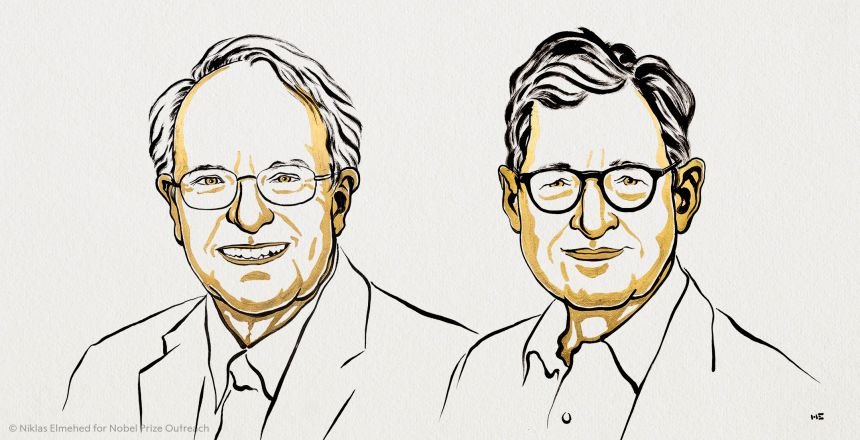
American economists Robert E. Hall and Michael Woodford have been awarded the 2026 Nobel Prize in Economics for developing economic models that help governments and central banks stabilise economies and reduce the impact of external shocks.
The Royal Swedish Academy of Sciences announced the award in Stockholm on Monday, recognising the economists’ contributions to understanding how individual and household decisions influence broader economic conditions and how policymakers can use this knowledge to maintain economic stability.
“The laureates have helped us smooth out the economy’s peaks and troughs,” the academy said in a statement, adding that their models have been “extremely helpful in dealing with the economic downturns that have affected us.”
Hall, born in Palo Alto, California, in 1943, is a professor at Stanford University. Woodford, born in Chicopee, Massachusetts, in 1955, is a professor at Columbia University. Each laureate will receive 6 million Swedish kronor, equivalent to approximately $598,000.
Why Hall and Woodford Won the 2026 Nobel Prize in Economics
The award recognises the economists’ work on economic models that provide a framework for understanding how economies respond to changing conditions and how governments and central banks can reduce fluctuations in economic activity.
Their research established a theoretical foundation for models used by policymakers to assess economic developments and design fiscal and monetary policies. These models help explain how decisions made by households and businesses can influence inflation, production, consumption and overall economic growth.
John Hassler, chair of the Committee for the Prize in Economic Sciences, said their work had provided a stable theoretical foundation for models now used by central banks and governments worldwide.
“With them, we are better equipped to deal with shocks in the economy, such as energy crises or sudden changes in how much households consume,” Hassler said.
The research is particularly relevant when economies face unexpected disruptions, including sharp changes in energy prices, shifts in consumer spending or other developments that affect economic activity. By improving policymakers’ understanding of how households and businesses respond to such changes, the models can help guide decisions intended to limit economic instability.
How Their Economic Models Help Governments and Central Banks
A central contribution of Hall and Woodford’s work is its focus on the relationship between individual economic decisions and broader macroeconomic outcomes.
Traditional macroeconomic analysis often examines variables such as inflation, production and consumption at an economy-wide level. Hall and Woodford instead drew on microeconomics to understand how the choices of individuals and households influence the wider economy.
Their models emphasise that households and businesses are forward-looking when making decisions. Consumers consider their future financial circumstances when deciding how much to save or spend, while businesses take expected future conditions into account when setting prices and making investment decisions.
These expectations matter because economic behaviour is shaped not only by current conditions but also by what people believe will happen in the future. If households expect prices to rise or incomes to change, their spending and saving decisions may shift. Similarly, businesses may adjust prices and investment plans based on their expectations of future demand and costs.
Understanding these responses can help policymakers assess how decisions about interest rates, government spending and taxation may affect economic activity.
Why Policy Communication Matters for Economic Stability
Hall and Woodford’s work also highlights the importance of how governments and central banks communicate their future policy intentions.
According to the Royal Swedish Academy of Sciences, policymakers can influence economic expectations by explaining their plans for fiscal and monetary policy. Clear communication can shape how households and businesses make decisions about spending, saving, investment and pricing.
Central banks use monetary policy, including changes to interest rates, to influence borrowing costs, demand and inflation. Governments use fiscal policy, including taxation and public expenditure, to affect economic activity and the distribution of resources.
When households and businesses understand how policymakers intend to respond to changing economic conditions, they can incorporate those expectations into their decisions. This makes communication an important part of the policy process rather than simply an explanation of decisions already taken.
The academy said the insights developed by the laureates help policymakers influence expectations and move the economy in the desired direction.
Economic Models Can Help Manage Energy Crises and Demand Shocks
The economists’ research has practical implications for responding to economic shocks, including energy crises and sudden changes in household consumption.
Sharp increases in energy prices can raise production and transport costs, contribute to inflation and reduce consumers’ purchasing power. Unexpected changes in household spending can also affect business revenues, production decisions and employment.
Economic models that incorporate forward-looking behaviour can help policymakers assess how these disruptions may spread through the economy and how different policy responses could influence the outcome.
Although such models cannot eliminate uncertainty or prevent every downturn, they provide a structured way to evaluate economic developments and the likely effects of policy decisions.
The Nobel recognition highlights the role of economic theory in developing tools that help governments and central banks respond to complex and rapidly changing conditions.
What Is the Nobel Prize in Economics?
The economics award is officially known as the Sveriges Riksbank Prize in Economic Sciences in Memory of Alfred Nobel. Unlike the original Nobel Prizes, it was not established under Alfred Nobel’s will.
Sweden’s central bank established the prize in 1968, and it was first awarded in 1969. Since then, it has recognised economists whose research has made significant contributions to understanding economic systems, markets, institutions and public policy.
With Hall and Woodford’s recognition, the total number of individuals awarded the economics prize has reached 101, according to the supplied announcement. Only three of the recipients have been women, highlighting the limited representation of women among the award’s laureates.
Fewer than half of the prizes awarded since 1969 have gone to a single recipient, reflecting the frequency with which the award recognises collaborative or complementary contributions to economic research.
2026 Nobel Awards Conclude With Economics Prize
The economics award brings this year’s Nobel announcements to a close. The other awards recognised contributions across several fields, including peace and literature.
South African judge and human rights pioneer Navi Pillay received the Nobel Peace Prize on Friday, while Canadian writer Anne Carson was awarded the Nobel Prize in Literature a day earlier, according to the supplied report.
The recognition of Hall and Woodford places the focus on the role of economic research in addressing challenges faced by governments and central banks. Their work underlines how household behaviour, business expectations and policy communication can shape economic outcomes.
As policymakers continue to confront inflation, energy price volatility and changing consumer demand, the models developed by the two American economists offer a theoretical framework for understanding economic shocks and evaluating responses aimed at maintaining stability.
For breaking news and live news updates, like us on Facebook or follow us on Twitter and Instagram. Read more on Latest Business on thefoxdaily.com.






COMMENTS 0