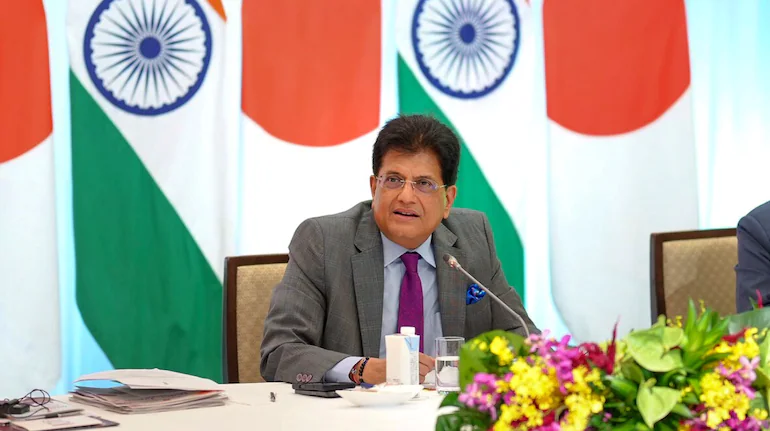
India will develop its own tunnel-boring machines if China restricts supplies of the critical equipment, Commerce and Industry Minister Piyush Goyal said on November 3. His remarks underline the government’s push to strengthen domestic manufacturing and reduce dependence on China for strategically important technologies amid Beijing’s fresh export restrictions.
Speaking at the Young Leaders Discourse Forum at Kirori Mal College in Delhi, Goyal said India would not compromise its strategic interests or seek concessions from other countries in exchange for access to critical technology. He stressed that the country had the capability to develop alternatives domestically if overseas supplies were disrupted.
“If they don’t give us tunnel-boring machines, we will develop it in India. India is not someone who will give in,” Goyal said.
China’s New Export Restrictions Raise Concerns
Goyal’s comments come after China introduced fresh export-licensing requirements for tunnel-boring machines, with the restrictions scheduled to take effect from November 18.
Tunnel-boring machines are specialised equipment used to excavate underground passages through soil and rock. They play an important role in large infrastructure projects, including underground metro systems, railway corridors and road tunnels.
Any disruption to the supply of these machines could create challenges for infrastructure developers that depend on imported equipment. Delays in obtaining specialised machinery can affect project schedules, construction costs and the pace of execution.
China’s export restrictions have therefore brought renewed attention to India’s dependence on foreign suppliers for critical industrial technologies. Goyal’s response suggests that the government sees domestic manufacturing as a potential solution if access to imported equipment becomes difficult.
India Plans to Strengthen Domestic Tunnel-Boring Technology
Developing tunnel-boring machines within India would require specialised engineering capabilities, advanced manufacturing facilities and investment in research and development. These machines involve complex mechanical systems and technology designed to operate under demanding underground conditions.
Building domestic capabilities could give Indian infrastructure companies greater control over equipment availability and reduce exposure to international supply disruptions. It could also create opportunities for Indian manufacturers and engineering firms to participate in the development of advanced construction machinery.
However, establishing a domestic manufacturing ecosystem would involve technical and commercial challenges. Indian companies would need to develop reliable machines that meet the performance requirements of large infrastructure projects.
Goyal’s remarks did not specify a timeline, investment commitment or particular domestic manufacturer for such development. His statement instead conveyed the government’s position that India would pursue indigenous alternatives if foreign supplies were restricted.
India Working to Reduce Dependence on China for Rare Earth Materials
Alongside tunnel-boring machines, Goyal highlighted efforts to reduce India’s dependence on China for rare earth materials. He said the government had encouraged domestic startups to explore alternatives after restrictions on rare earth supplies created concerns about access to essential industrial inputs.
“When they stopped rare earths, we did not go begging to them. I had a meeting with all of our startups and encouraged them that why can’t we make our motors without rare earths,” the minister said.
According to Goyal, some Indian startups have already started producing motors that do not require rare earth materials while maintaining comparable quality and efficiency.
The development could be significant for industries that use specialised motors and depend on rare earth-based components. However, wider adoption will depend on manufacturing capacity, commercial viability, performance testing and the ability to meet industrial demand.
Why Rare Earth Elements Matter to India’s Industrial Strategy
Rare Earth Elements are important inputs for several advanced technologies and industrial applications. They are used in electric vehicles, wind turbines, electronics and defence equipment, among other sectors.
China has a dominant position in the processing and supply chains of several rare earth materials. This concentration creates supply-chain risks for countries and manufacturers that rely heavily on Chinese exports.
For India, developing alternatives and strengthening domestic capabilities could help reduce exposure to external supply disruptions. It could also support the country’s ambitions in electric mobility, renewable energy, electronics manufacturing and defence production.
Developing rare-earth-free motors is one possible route to reducing dependence on these materials. If Indian startups can produce motors that deliver the required performance at competitive costs, manufacturers could gain additional sourcing options.
Nevertheless, replacing rare earth-based technologies across industries is not a simple process. Different applications have specific requirements, and alternative designs must demonstrate reliability, efficiency and commercial scalability before they can be adopted widely.
Goyal Says India Does Not Want to Damage Relations With China
Despite his strong comments on domestic technological capabilities, Goyal said India did not want to damage its relationship with China. He expressed hope that bilateral ties would improve if further obstacles did not emerge.
“India doesn’t want to spoil relations with anyone, even with China. Our relationship is good even today. If there are no more hurdles that come up, then the relationship will get better,” he said.
His remarks indicate that the government’s approach involves maintaining diplomatic and trade engagement while reducing vulnerabilities in strategically important sectors. The objective is not necessarily to end economic ties but to ensure that critical infrastructure and industrial requirements are not excessively dependent on external suppliers.
This approach is particularly relevant as India continues to expand investments in infrastructure, defence manufacturing, electronics and advanced industrial production. Reliable access to specialised machinery and essential materials remains important for these sectors.
Domestic Manufacturing Push Gains Strategic Importance
India has been seeking to strengthen its manufacturing base and reduce import dependence in areas considered important for economic and national security. The latest comments from Goyal reflect the growing importance of indigenous technology development in this strategy.
Domestic production of specialised equipment could help Indian companies build technical expertise, develop local supply chains and reduce the impact of export restrictions imposed by other countries.
However, the success of this approach will depend on sustained investment in research, skilled engineering talent, manufacturing infrastructure and collaboration between government institutions, startups and established industrial companies.
For tunnel-boring machines, the immediate challenge is developing equipment capable of meeting the requirements of India’s expanding underground infrastructure projects. In the rare earth sector, the focus is on creating alternative materials, motor technologies and reliable domestic supply chains.
What China’s Export Curbs Mean for India’s Infrastructure Plans
China’s new export-licensing requirements for tunnel-boring machines have highlighted the potential risks of relying on foreign suppliers for specialised construction equipment. If access to these machines becomes restricted, infrastructure projects could face procurement difficulties.
India’s ability to develop domestic alternatives could provide greater supply security over the longer term. It may also encourage investment in advanced engineering and machinery manufacturing, creating opportunities beyond the infrastructure sector.
At the same time, domestic production cannot be established overnight. Until Indian manufacturers can supply equipment at the required scale and performance levels, access to international suppliers will remain an important consideration for project developers.
Outlook: India Balances Trade Relations With Technological Self-Reliance
Goyal’s statements highlight India’s intention to strengthen domestic capabilities in response to restrictions on critical technology and materials. From tunnel-boring machines to rare-earth-free motors, the government is encouraging Indian companies and startups to develop alternatives to imported products.
At the same time, the minister’s comments make clear that India wants to maintain constructive relations with China and other trading partners. The broader strategy is to combine international engagement with stronger domestic manufacturing capabilities.
Whether India can reduce its dependence on Chinese supplies will depend on how quickly domestic manufacturers can develop, test and scale competitive technologies. For now, the government’s message is that restrictions on critical imports should encourage indigenous innovation rather than force India to compromise its strategic interests.
For breaking news and live news updates, like us on Facebook or follow us on Twitter and Instagram. Read more on Latest Business on thefoxdaily.com.






COMMENTS 0