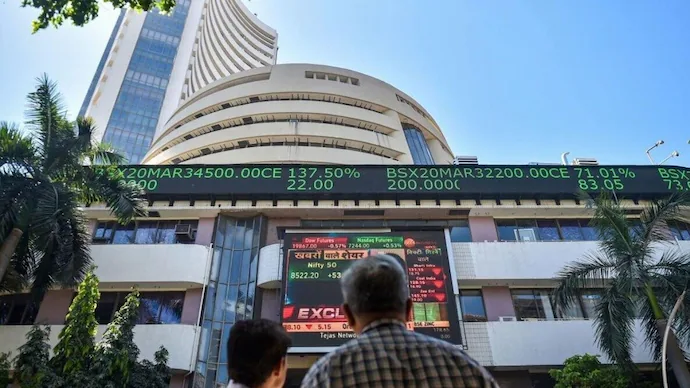
Indian stock markets opened on a volatile note on Wednesday, October 14, as the BSE Sensex and Nifty 50 surrendered early gains and slipped into marginal losses. Rising crude oil prices and continued foreign institutional investor (FII) outflows weighed on market sentiment, offsetting support from information technology stocks.
Investors also remained focused on corporate earnings following Tuesday’s strong rally, which was led by IT shares. Although buying interest in select heavyweight stocks provided some support, weakness across financial, pharmaceutical and other sectors limited the benchmarks’ gains.
The Sensex and Nifty had both climbed around 1.6% in the previous session. However, the cautious opening on Wednesday indicated that investors remained concerned about external economic pressures and the sustainability of the recent recovery.
Sensex and Nifty Trade Marginally Lower
The BSE Sensex was trading at 73,002.54 around 9:27 am, down 31.24 points, or 0.04%. The index opened at 73,049.76, compared with its previous close of 73,033.78, before moving between 72,894.41 and 73,178.98 during early trading.
The Nifty 50 was down 23.15 points, or 0.10%, at 22,698.80 around 9:28 am. The index opened at 22,715.75 and traded within an early range of 22,663.80 to 22,752.30.
Both benchmarks initially moved higher before losing momentum and entering negative territory. The mixed opening reflected uncertainty among investors as they assessed the impact of elevated oil prices, foreign fund withdrawals and the latest corporate earnings developments.
IT Stocks Lead Early Market Gainers
Information technology stocks remained among the strongest performers, extending their support for the broader market after Tuesday’s rally. Several major IT companies recorded gains during early trading.
- Tata Consultancy Services (TCS): Rose 2.25%.
- Infosys: Gained 1.74%.
- HCL Technologies: Advanced 1.68%.
- Tech Mahindra: Traded 0.35% higher.
Buying interest also supported select banking, defence and consumer stocks. Kotak Mahindra Bank rose 0.95%, Bharat Electronics gained 0.61%, and Asian Paints advanced 0.47%.
The strength in IT shares helped cushion the impact of losses elsewhere. However, gains in individual stocks were not broad enough to prevent the benchmark indices from slipping into negative territory.
Heavyweight Stocks Face Selling Pressure
Several major companies came under selling pressure during the opening session, limiting the market’s ability to sustain its initial gains.
- Bajaj Finance: Fell 1.30%.
- Eternal: Declined 0.95%.
- Sun Pharmaceutical Industries: Dropped 0.91%.
- Bajaj Finserv: Lost 0.90%.
Power Grid Corporation, Larsen & Toubro, Adani Ports and Axis Bank were also trading lower.
The weakness extended to the broader market, where the Nifty 100, Nifty 200 and Nifty 500 indices were marginally down. Mid-cap and small-cap shares also remained under pressure, with the Nifty Midcap 50, Nifty Midcap 100 and Nifty Smallcap 100 trading in negative territory.
The broad-based weakness suggested that the market’s gains were concentrated in select sectors rather than reflecting a widespread improvement in investor sentiment.
IT and FMCG Gain While Financial Stocks Decline
Sectoral performance remained mixed during early trading, with IT stocks leading the gains while financial services and public sector banks faced selling pressure.
The Nifty IT index rose 1.43%, while the Nifty FMCG index advanced 0.16%. The Nifty MidSmall IT & Telecom index also gained 0.49%, indicating continued buying interest in technology-related shares.
In contrast, the Nifty Financial Services 25/50 index fell 0.64%, and the Nifty PSU Bank index declined 0.73%. Pharmaceutical, healthcare, automobile, real estate and consumer durables stocks were also under pressure.
India VIX, which measures expected volatility in the stock market, rose 2.99% to 14.54. The increase indicated that investors were anticipating greater uncertainty in the market.
Rising Crude Oil Prices Remain a Major Concern
Elevated crude oil prices continued to weigh on sentiment in Indian equities. Brent crude was trading around $106 to $107 per barrel, keeping concerns about India’s oil import bill, inflation and broader economic conditions in focus.
India relies heavily on imported crude oil, making domestic financial markets sensitive to sharp movements in international energy prices. Higher oil costs can increase the country’s import expenditure and put pressure on businesses and consumers through more expensive fuel and transportation.
Persistently high crude prices can also complicate the outlook for inflation and corporate profitability. These concerns have become particularly important as investors assess whether Indian equities can sustain their recent gains amid global economic and geopolitical uncertainty.
Foreign Investor Outflows Continue to Weigh on Sentiment
Continued selling by foreign institutional investors remained another concern for domestic equities. Foreign fund withdrawals can put pressure on share prices, particularly when they coincide with uncertainty over global interest rates and commodity prices.
Dr V K Vijayakumar, chief investment strategist at Geojit Investments Limited, said Tuesday’s sharp rally in the Nifty had come as a surprise in an otherwise weak market and was partly driven by short-covering.
Short-covering occurs when traders who have sold stocks short buy them back to close their positions. Such buying can push prices higher, although it does not necessarily indicate a sustained improvement in underlying market sentiment.
Vijayakumar also said comments from Finance Minister Nirmala Sitharaman about reviewing stakeholder feedback on long-term capital gains (LTCG) tax and securities transaction tax (STT) had raised hopes of possible changes in equity taxation. Those expectations helped support investor sentiment during the previous session.
Rupee Gains Offer Some Relief
Measures introduced by the Reserve Bank of India to restrict speculation in the currency market had helped the rupee appreciate over the previous two trading sessions, according to Vijayakumar. The currency’s recovery also helped ease some pressure associated with foreign investor selling.
However, the broader market outlook remained vulnerable to external developments. Vijayakumar identified the US 10-year bond yield, hovering around 5.2%, and Brent crude prices near $106 per barrel as significant headwinds for Indian equities.
Higher US bond yields can make dollar-denominated assets more attractive to international investors, potentially affecting capital flows into emerging markets such as India. When combined with elevated oil prices, this can create additional pressure on domestic financial markets.
Second-Quarter Earnings in Focus
Investors are also watching corporate earnings for signs of how companies are performing amid changing economic conditions. Vijayakumar said financial services, telecommunications, metals and automobile stocks could remain relatively resilient because of expectations surrounding second-quarter earnings.
However, he cautioned that the recent market rally could struggle to sustain itself in the face of high crude oil prices and elevated US bond yields.
The earnings season is expected to remain an important driver of individual stock movements, as investors assess company results, business outlooks and management commentary. Strong results could support selected sectors, while weaker performances may increase selling pressure.
Outlook: Volatility Likely to Keep Investors Cautious
The subdued opening on Wednesday highlights the competing forces influencing Indian equities. Strength in IT stocks and expectations of corporate earnings growth are providing some support, but rising crude oil prices, foreign investor outflows and uncertainty over global interest rates remain significant concerns.
The increase in India VIX also points to heightened expectations of market volatility. Investors are likely to monitor international oil prices, foreign fund flows, currency movements and quarterly earnings as they assess the market’s near-term direction.
While selected sectors may continue to attract buying interest, the ability of the Sensex and Nifty to sustain further gains will depend on whether supportive domestic factors can offset pressure from global markets.
Disclaimer: The views, opinions, recommendations and suggestions expressed by market experts and brokerages are their own and do not necessarily reflect the views of the India Today Group. Investors should consult a qualified financial adviser before making investment or trading decisions.
For breaking news and live news updates, like us on Facebook or follow us on Twitter and Instagram. Read more on Latest Business on thefoxdaily.com.






COMMENTS 0