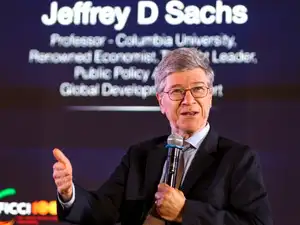
India could emerge as the world’s largest economy by the end of the 21st century, renowned economist Jeffrey D Sachs has predicted. He said the country’s long-term economic potential, combined with its demographic scale, could place it at the centre of the global economic order in the decades ahead.
Speaking at the World Symposium on “Ancient Wisdom for Modern Challenges” in Varanasi, Sachs said India’s population could be twice the size of China’s by the end of the century. He also highlighted the broader shift towards a multipolar world, in which economic and political influence would be distributed across several countries and regions rather than concentrated in one dominant power.
Jeffrey Sachs Sees India Emerging as a Major Global Economic Power
Sachs’s prediction places India at the centre of the long-term transformation of the Global Economy. He suggested that the country’s economic position could strengthen considerably over the coming decades, potentially making it the world’s largest economy by the end of the century.
India’s large population is an important part of this long-term outlook. A substantial population can provide a broad workforce, expand the domestic consumer market and create opportunities for businesses across manufacturing, services, technology and infrastructure.
However, population size alone does not determine economic strength. The ability to convert demographic potential into sustained Economic Growth depends on productivity, education, healthcare, employment opportunities, investment and infrastructure development.
India’s future economic position will therefore depend on how effectively it develops its workforce, expands productive industries and improves living standards. These factors will influence whether its demographic advantage translates into long-term economic leadership.
India’s Population Could Be Twice China’s by 2100
One of the key points in Sachs’s remarks was his projection that India’s population could be twice that of China by the end of the century. The comparison highlights the significant demographic changes expected to shape the global economy during the coming decades.
Population trends can influence the size of an economy through their effects on labour supply, consumer demand and the availability of workers across different sectors. Countries with large and productive working-age populations can benefit from stronger domestic demand and a wider talent base.
For India, the demographic opportunity could support growth in areas such as manufacturing, digital services, infrastructure, healthcare and consumer businesses. A growing economy can also create new markets for domestic and international companies.
At the same time, a larger population brings significant responsibilities. Governments must ensure that economic growth creates enough quality jobs and that public services, transport networks, housing, education and healthcare can meet rising demand.
The relationship between population growth and economic development will therefore depend on the quality of investment and policy decisions over time.
World Moving Towards a Multipolar Economic Order
Alongside his prediction about India, Sachs discussed the changing structure of global power. He said the world was moving towards a multipolar order in which no single country or region would dominate international affairs.
A multipolar system refers to a global environment where economic, political and strategic influence is shared among several major powers. This represents a shift away from arrangements in which one country or a small group of countries exercises disproportionate influence over global institutions and decisions.
The emergence of multiple influential economies could reshape international trade, investment, technology development and diplomatic relationships. Countries may increasingly build partnerships with different regions based on their economic interests and strategic priorities.
For India, such a transition could create opportunities to strengthen its international role. Its economic scale, geographical position and relationships with different parts of the world could become important factors in an increasingly distributed global system.
India’s Role in the Changing Global Economy
India’s potential rise to the top of the global economic rankings would take place alongside major changes in technology, international trade and the distribution of economic activity.
The country has opportunities to expand its role in global supply chains, attract investment and develop industries that serve both domestic and international markets. Continued improvements in infrastructure, digital connectivity and industrial capacity could support this process.
India’s services sector also provides an important foundation for its economic ambitions. Technology, finance, business services and other knowledge-based industries can contribute to productivity and exports while creating employment opportunities for skilled workers.
Manufacturing growth will also be important. Expanding domestic production capacity can help India increase industrial output, generate jobs and strengthen its position in international markets.
However, achieving sustained economic leadership will require progress across several areas, including education, research, innovation, energy security and institutional capacity. Long-term growth will depend not only on the size of the economy but also on how widely its benefits are shared.
Why the Prediction Is a Long-Term Economic Outlook
Sachs’s projection looks towards the end of the century, making it a long-term assessment rather than a forecast of India’s immediate economic position. Economic rankings can change substantially over such an extended period because of differences in population growth, productivity, investment, technological progress and global market conditions.
Several uncertainties could influence the outcome. Changes in international trade, geopolitical tensions, climate-related challenges, technological disruption and domestic economic policies may all affect the growth trajectories of major economies.
India’s ability to sustain high productivity growth and create opportunities for its expanding population will be particularly important. A large workforce can support economic expansion only when workers have access to education, skills, productive employment and adequate infrastructure.
The prediction should therefore be understood as a possible long-term scenario rather than a guaranteed outcome. The economic and demographic changes of the coming decades will determine how closely India’s growth path matches this assessment.
Varanasi Symposium Connects Ancient Wisdom with Modern Challenges
Sachs made the remarks while speaking at the World Symposium on “Ancient Wisdom for Modern Challenges” in Varanasi. The event brought attention to the relationship between traditional knowledge and the challenges facing contemporary societies.
The theme reflects broader discussions about how historical ideas and cultural traditions can contribute to debates on modern economic, social and global issues.
By linking India’s potential global economic position with the emergence of a multipolar world, Sachs’s remarks placed the country’s future within a wider discussion about changing international relationships and the distribution of global influence.
India’s Economic Future Will Depend on Productivity and Opportunity
Sachs’s prediction highlights the scale of India’s potential over the remainder of the century. A population that could be twice China’s by 2100, combined with sustained economic development, could strengthen India’s position in the global economy.
His comments on multipolarity also point to a changing international environment in which several countries and regions may play influential roles. India could become one of the major centres of economic activity as this transformation unfolds.
Whether the country becomes the world’s largest economy will depend on its ability to translate demographic scale into productivity, innovation, investment and better living standards. The coming decades will be crucial in determining how India’s economic potential develops and what role it ultimately plays in the global order.
For breaking news and live news updates, like us on Facebook or follow us on Twitter and Instagram. Read more on Latest Business on thefoxdaily.com.




COMMENTS 0