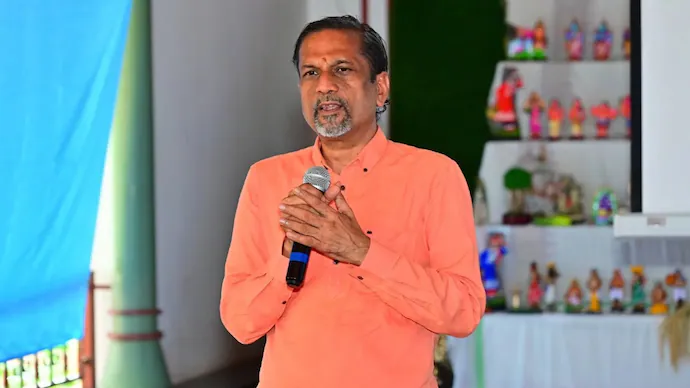
Zoho founder Sridhar Vembu has called for India to shut down business schools and redirect its attention towards startup incubators, arguing that the country needs more entrepreneurs and business creators rather than another generation of management graduates.
His comments have sparked a debate about the relevance of traditional MBA education, the role of business schools in developing entrepreneurs and whether practical startup experience should receive greater attention in India’s education system.
Vembu shared his views while responding to a post by Professor Chris Marquis of the University of Cambridge Judge Business School, who had written, “I Teach at a Business School, It’s Time to Shut Them Down”. Agreeing with the professor, Vembu said he had held a similar position for two decades.
“I agree entirely and have been saying this for 2 decades. India would do well to close down business schools and focus on startup incubators. We need large scale startup formation and a lot of experimentation,” he wrote.
Sridhar Vembu’s remarks trigger debate over MBA education
Vembu’s proposal has generated different reactions on social media, with users debating whether India needs fewer business schools or a fundamental change in how Management Education is delivered.
One user supported the idea of replacing a significant number of business schools with startup incubators. The argument was that India already has a large pool of MBA graduates but needs more people willing to take risks, develop ideas and build companies from the ground up.
Under this approach, aspiring entrepreneurs would learn by starting businesses, making mistakes and experimenting with different solutions rather than relying primarily on classroom-based management education.
However, others argued that entrepreneurship and traditional management education do not necessarily have to compete. Business schools could introduce stronger startup-focused programmes and specialisations, allowing students to use existing academic resources while developing practical business skills.
Another criticism focused on the structure of some MBA programmes in India. A social media user argued that courses often concentrate on specific management functions, including sales, recruitment and accounting, without giving students enough experience in building and operating businesses.
The discussion raises a broader question about what business education should prepare students for: managing established organisations, creating new companies or adapting to an economy in which both skills are increasingly important.
India’s startup ecosystem expands beyond major cities
The growth of India’s startup ecosystem provides important context for Vembu’s argument. Entrepreneurship is no longer concentrated exclusively in major technology centres, as recognised Startups are increasingly emerging from smaller cities and towns.
According to data shared by the Department for Promotion of Industry and Internal Trade (DPIIT), India has crossed 2.5 lakh recognised startups, operating across more than 770 districts. These businesses have collectively created over 25.42 lakh jobs.
Nearly 52% of recognised startups are based outside metropolitan cities. This indicates that entrepreneurial activity is spreading beyond established business and technology hubs, potentially creating opportunities for people who previously had limited access to startup networks.
However, a growing startup count does not automatically mean that every new business will succeed. Entrepreneurs also need access to experienced mentors, skilled workers, reliable infrastructure, customers and sufficient capital to develop their ideas into sustainable companies.
Government funding supports startup incubators
Access to early-stage funding is another important part of India’s startup ecosystem. Government-backed programmes have attempted to address the financial challenges faced by entrepreneurs, particularly during the early stages of business development.
More than 4,100 startups have received approval for funding worth over Rs 775 crore under the Startup India Seed Fund Scheme. The programme distributes support through 244 incubators across 32 states and Union Territories.
Separately, the Fund of Funds for Startups has helped channel investments worth more than Rs 28,000 crore into nearly 1,500 companies through alternative investment funds.
These initiatives highlight the role incubators can play in helping young businesses access funding and support. They can also connect founders with mentors, industry networks and resources needed to test business models and develop products.
For Vembu’s proposal to become a practical alternative to conventional management education, however, incubators would need to offer more than funding opportunities. They would also have to provide structured guidance, business expertise and an environment where aspiring founders can learn from real-world challenges.
Vembu highlights how AI could change the future of work
Vembu’s views on entrepreneurship are also connected to his concerns about the changing nature of work as artificial intelligence becomes more capable.
In a recent post, he suggested that a skilled individual using AI could potentially handle tasks that previously required a team of 10 people. The observation points to how AI tools could change productivity, team structures and the way companies organise their operations.
However, Vembu clarified that he was not predicting that most computer-based workers would lose their jobs. Instead, he expects businesses and industries to reorganise how work is distributed as employees become more capable of using AI tools.
He also suggested that AI could create opportunities for companies that previously could not afford specialist employees, including software engineers and digital marketers. With AI assistance, some smaller businesses may be able to undertake work that was once beyond their financial or technical capacity.
Why Vembu believes problem-solving skills will matter
As AI takes on more tasks, Vembu believes people will need to develop skills that go beyond operating software or completing routine assignments. He highlighted the importance of communicating goals clearly, breaking complicated problems into smaller tasks and identifying when AI-generated results are incorrect.
He described these abilities as meta-level skills, which are also important for system architects. Such capabilities help people understand broader objectives, coordinate different components of a problem and evaluate whether the final outcome meets the intended requirements.
This perspective also adds another dimension to the debate over business education. If AI changes how organisations operate, management graduates may need stronger abilities in critical thinking, problem-solving, decision-making and technology adoption.
Can startup incubators replace business schools in India?
Vembu’s proposal highlights a genuine debate about whether India’s management education system is adequately preparing students for an economy increasingly shaped by entrepreneurship and artificial intelligence.
Startup incubators can offer practical exposure that traditional classroom teaching may struggle to replicate. Working on an actual business idea allows aspiring founders to understand customer needs, test products, manage limited resources and respond to failures. These experiences can be valuable for people who want to establish their own companies.
At the same time, business schools provide structured learning in areas such as finance, marketing, operations, organisational behaviour and strategy. These subjects can be useful for entrepreneurs as well as professionals seeking careers in established companies. Closing business schools entirely could therefore remove an important source of management knowledge and professional development.
A possible middle ground would be to strengthen entrepreneurship programmes within existing institutions while expanding independent incubators. Universities and business schools could work more closely with startups, offering students opportunities to develop products, work with founders and test business models before graduation.
Ultimately, Vembu’s comments have put the focus on a larger question: whether India should continue prioritising conventional management qualifications or give greater importance to practical experience, experimentation and company creation. As the startup ecosystem expands and AI reshapes the workplace, the relationship between education and entrepreneurship is likely to remain an important part of that discussion.
For breaking news and live news updates, like us on Facebook or follow us on Twitter and Instagram. Read more on Latest Business on thefoxdaily.com.





COMMENTS 0