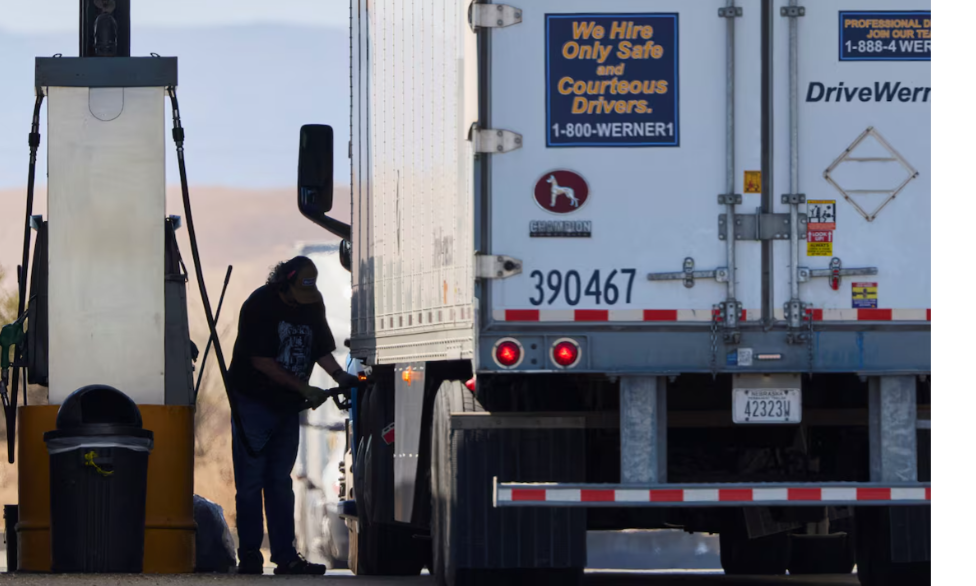
US President Donald Trump has signed an executive order expanding access to tax-exempt dyed diesel fuel as elevated diesel prices put pressure on American truckers, farmers and other businesses that depend heavily on fuel. The move comes as global energy markets face supply disruptions and as the United States approaches the November 3 midterm elections.
The order, signed by Trump on October 5 at a rally in Grand Island, Nebraska, temporarily allows broader highway use of red-dyed diesel and directs the US Treasury to defer certain federal diesel tax payments through the end of 2026. The administration says the measure is intended to provide temporary relief to fuel users affected by restricted global diesel supplies.
Diesel prices have risen sharply in recent months, reaching a record of about $6.50 per gallon in September, according to the Reuters report. The increase has added to concerns about transportation costs, food prices and the broader cost of living.
Trump Signs Executive Order on Tax-Exempt Diesel
The executive order changes the normal restrictions surrounding dyed diesel, which is commonly known as red diesel. This fuel is generally used for off-road purposes, including agricultural equipment and certain construction machinery, and is sold without the federal excise tax that applies to highway diesel.
Under the new order, the Treasury secretary is directed to determine whether certain federal tax-payment obligations can be deferred for qualifying taxpayers affected by the current fuel situation. The order covers taxes incurred between October 5 and December 31, 2026, subject to the legal authority and conditions established by the Treasury Department.
The order also directs the Internal Revenue Service to provide penalty relief in circumstances involving the highway use of dyed diesel during the specified period. The administration is separately exploring ways to eliminate the obligation to pay some of the deferred taxes.
The White House said the policy is intended to temporarily reduce costs for farmers, truckers and workers affected by higher diesel prices. 0
What Is Red-Dyed Diesel?
Red-dyed diesel is diesel fuel that is chemically similar to conventional diesel but contains a visible dye so authorities can identify fuel intended for tax-exempt uses.
In the United States, diesel used for highway transportation is generally subject to federal and state fuel taxes. Diesel intended for certain off-road purposes, such as farming, construction and other qualifying activities, can receive different tax treatment.
The red dye allows enforcement authorities to distinguish the fuel from taxed highway diesel. Using tax-exempt dyed diesel for highway purposes has normally been subject to tax liabilities and penalties.
Trump’s new order temporarily changes the enforcement and tax treatment surrounding highway use during the relief period. The administration is also encouraging states to consider corresponding policies where permitted by law.
How the Diesel Tax Relief Is Supposed to Work
The executive order gives several federal agencies responsibilities for implementing the temporary policy.
- The Treasury Department will determine the scope of tax-payment deferrals permitted under federal law.
- The IRS will provide guidance on the applicable tax and penalty relief.
- The Agriculture Department will work to ensure adequate dyed-diesel distribution in high-demand farming areas.
- The Transportation Department will coordinate with states, industry groups and labor organizations.
- The administration will encourage states to consider policies that correspond with the federal action.
The order does not simply eliminate every diesel tax automatically. Instead, it directs federal agencies to establish the specific relief available, including eligible taxpayers, locations, liabilities, deadlines and other conditions.
Why Diesel Prices Have Become a Major Concern
Diesel is particularly important to the US economy because it powers a large share of commercial transportation and agricultural machinery. Trucks transport goods across the country, while farmers rely on diesel-powered equipment for many stages of agricultural production.
When diesel prices increase significantly, the impact can spread beyond the fuel pump. Higher trucking costs can raise the expense of moving food, manufactured goods and raw materials. Businesses may then face higher operating costs, while consumers can eventually see some of those costs reflected in prices.
The current increase has occurred against a difficult global energy backdrop. The US-Israeli conflict with Iran has disrupted energy markets, while attacks on refineries in the Middle East and Russia have added pressure to global refining capacity.
The Russian invasion of Ukraine has also affected energy infrastructure and international fuel flows. Together, these developments have contributed to tighter diesel markets.
Global Supply Disruptions Are Driving Fuel Market Pressure
Diesel markets are particularly sensitive to refinery disruptions because crude oil must be processed into refined products before it can be used as transportation fuel.
Damage to refineries can therefore reduce diesel availability even when crude oil production remains relatively strong. Shipping disruptions can create an additional problem by making it more difficult or expensive to move refined products between producing and consuming regions.
The situation has been particularly challenging for markets that depend on international diesel trade. When supplies become tighter, refiners and fuel distributors can face higher costs, which can contribute to rising retail prices.
These global factors help explain why the US administration has been looking at measures beyond domestic energy production to address diesel affordability.
G7 Emergency Diesel Release Adds Another Supply Measure
Trump’s executive order follows a broader international effort to ease pressure on diesel markets.
G7 countries announced last week that they would release 100 million barrels of diesel and crude from emergency reserves. The move followed pressure from the Trump administration, which had considered restricting US diesel exports.
The exact composition of the G7 release and how much represents entirely new supply remains unclear. Some of the announced volume may be connected to broader international emergency-stockpile arrangements.
The stock release is intended to provide additional supply to the market during a period of unusually high geopolitical and transportation risks. However, emergency reserves are a temporary tool and do not directly solve longer-term refining or shipping constraints.
Trump Says He Hopes Diesel Waiver Will Not Last Long
Trump indicated while announcing the measure that he hoped the temporary waiver would not be needed for an extended period.
That reflects the administration’s expectation that the underlying supply pressures could ease. If global diesel availability improves and refinery operations recover, Fuel Prices could become less dependent on emergency government measures.
However, the timing of the order also places the policy in a politically sensitive period. The November 3 US midterm elections are approaching, and fuel prices are an important component of household and business costs.
Diesel Prices Pose a Political and Economic Challenge
High fuel prices can create political pressure because consumers experience them directly. Diesel is particularly important to businesses because it is a major operating expense for trucking, agriculture and other industries.
The Reuters report said high diesel prices represent a risk for Trump’s Republican Party ahead of the midterm elections. Republicans currently hold narrow majorities in both chambers of Congress, making the economic environment an important backdrop to the campaign.
A Reuters/Ipsos poll completed on October 5 put Trump’s approval rating at 32%, described in the Reuters report as a record low for his presidency. The poll also found that the cost of living was among Americans’ major concerns, with gasoline and diesel prices contributing to those pressures.
The administration has therefore emphasized measures intended to reduce energy costs as it approaches the election. 1
Potential Impact on Truckers and Farmers
Truckers are among the industries most directly affected by diesel prices because commercial vehicles can consume large quantities of fuel. Even a modest change in the cost per gallon can significantly affect operating expenses across long-distance transportation networks.
Farmers are another important group because agricultural machinery relies heavily on diesel. Higher fuel costs can increase the expense of planting, harvesting and transporting crops.
The executive order specifically directs the Agriculture Department to coordinate with agricultural cooperatives, rural fuel distributors and other stakeholders to ensure adequate distribution of dyed diesel in areas where demand is high.
The Transportation Department is also directed to work with states, industry representatives and labor organizations to facilitate implementation of the policy. 2
States Could Play an Important Role
Federal diesel tax relief does not automatically remove state-level fuel taxes. The White House has encouraged states to consider policies that correspond with the federal action, but any state-level response would depend on individual state laws and decisions.
This means the eventual savings available to truckers, farmers and other users could differ depending on where the fuel is purchased and how individual states respond.
The federal order also says that implementation must remain consistent with applicable law. Federal agencies are expected to issue further guidance explaining exactly how the temporary relief will operate.
Will Tax-Free Diesel Immediately Lower Fuel Prices?
The executive order is designed to reduce fuel costs for eligible users, but the effect on overall US diesel prices may depend on several factors.
Taxes are only one component of the final price paid for diesel. Wholesale fuel costs, refinery margins, crude prices, transportation expenses, inventories and regional supply conditions also influence retail prices.
As a result, reducing or deferring federal tax obligations does not necessarily mean that retail diesel prices will fall by the full amount of the tax relief.
The broader supply situation will remain important. If refinery disruptions or international shipping problems continue, underlying fuel costs could remain elevated even with temporary tax measures.
Policy Could Provide Temporary Relief, but Supply Remains Key
The diesel order addresses the cost side of the problem, while the G7 emergency-stockpile release addresses the supply side. Together, the measures represent efforts to reduce pressure on fuel markets during a period of global energy disruption.
But neither measure changes the underlying geopolitical situation. Continued attacks on energy infrastructure, disruption around major shipping routes or further refinery outages could keep diesel markets under pressure.
For that reason, traders and businesses will continue watching global refinery output, crude supplies, international fuel flows and shipping conditions alongside the new US tax policy.
What Happens Next for the Diesel Market?
The next major question is how quickly US diesel prices respond to improved supply conditions and the temporary tax relief.
The Treasury Department and other agencies are expected to provide additional guidance on the implementation of the executive order. The guidance will determine which taxpayers qualify for relief, which liabilities can be deferred and what conditions apply.
State governments will also determine whether they take corresponding action within their own legal authority.
Meanwhile, international energy markets will remain closely linked to developments in the Middle East and Russia-Ukraine conflict. Any improvement in refinery availability or global fuel transportation could ease diesel prices, while further disruptions could extend the period of elevated costs.
Diesel Prices Remain a Key Economic Indicator
The latest executive order highlights how closely US fuel prices are connected to global energy markets. Although the policy focuses on tax treatment and access to dyed diesel, the broader challenge is the availability and cost of refined fuel.
For American truckers and farmers, lower fuel expenses could provide some immediate financial relief. For consumers, the broader benefit would depend on whether lower transportation and production costs eventually reduce prices for goods and food.
For policymakers, the challenge is balancing temporary relief with the need for more stable energy supplies. As the United States approaches the November midterm elections, diesel prices will remain an important part of the economic debate.
FAQs
What did Trump do about diesel fuel?
President Donald Trump signed an executive order expanding temporary access to tax-exempt dyed diesel for highway use and directing federal agencies to provide certain tax and penalty relief through the end of 2026.
What is tax-exempt dyed diesel?
Dyed diesel, commonly called red diesel, is fuel intended for qualifying off-road uses such as agriculture and construction. It is dyed so authorities can distinguish it from fuel subject to highway fuel taxes.
When does the diesel tax relief apply?
The executive order covers certain diesel tax liabilities incurred from October 5 through December 31, 2026, subject to Treasury determinations and applicable federal law.
Will truckers be able to use red diesel?
The order temporarily provides for relief from penalties and tax obligations associated with highway use of dyed diesel during the specified period, subject to implementation guidance and applicable conditions.
Why are US diesel prices so high?
Diesel prices have been affected by restricted global fuel supplies, refinery disruptions, geopolitical conflicts and higher transportation costs. The Reuters report said prices reached about $6.50 per gallon in September.
What did the G7 announce about diesel reserves?
G7 countries announced plans to release 100 million barrels of diesel and crude from emergency reserves after pressure from the Trump administration.
Could the order lower transportation costs?
It could reduce certain federal fuel-tax costs for qualifying users, but the overall effect on transportation expenses will also depend on wholesale diesel prices, refinery capacity, crude prices and regional fuel availability.
How long will the diesel relief last?
The order establishes a temporary relief period through December 31, 2026, while directing federal agencies to issue implementation guidance and explore whether some deferred tax obligations could ultimately be eliminated.
“`3
For breaking news and live news updates, like us on Facebook or follow us on Twitter and Instagram. Read more on Latest Business on thefoxdaily.com.






COMMENTS 0