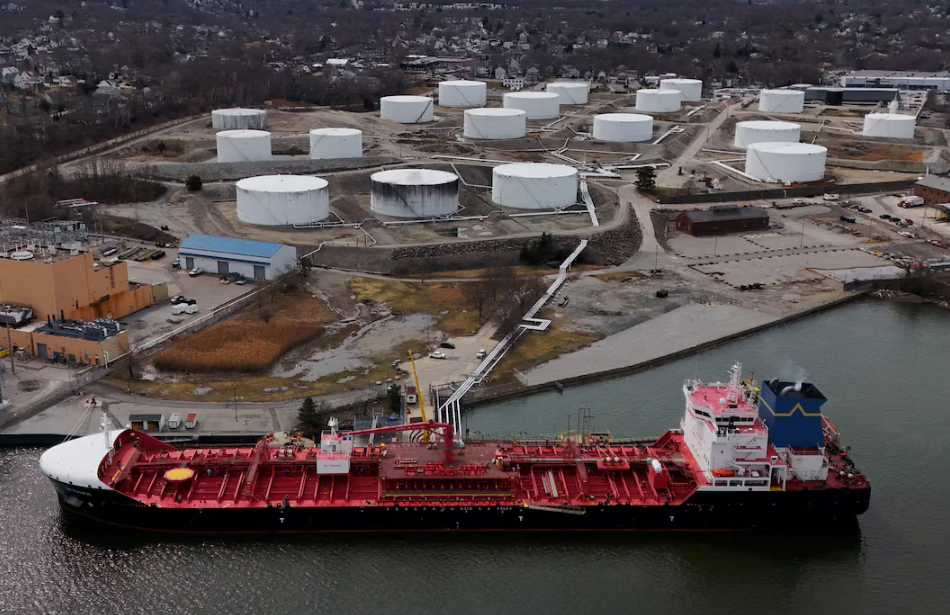
Talk of a possible U.S. Diesel export ban is widening the discount between West Texas Intermediate crude and the global Brent benchmark, as markets anticipate that American refiners could be forced to reduce crude processing if diesel supplies become trapped in the domestic market.
WTI Discount to Brent Hits Widest Level Since May
U.S. crude futures traded as much as $12.02 a barrel below Brent on Thursday, marking the widest WTI discount since May 6, according to LSEG data.
The widening gap reflects growing concern that restrictions on diesel exports could leave U.S. refiners with excess diesel inventories. If storage facilities approach capacity, refiners could have to reduce the amount of crude they process, weakening demand for U.S. crude.
The situation comes as diesel prices have surged to record levels in the United States, creating pressure for policymakers to find ways to increase domestic fuel availability.
Why a Diesel Export Ban Could Affect Crude Prices
U.S. refineries process crude oil into products including diesel, gasoline and jet fuel. Diesel exports allow refiners to sell surplus production to international markets.
If exports were restricted, more diesel would remain inside the United States. Initially, that could increase domestic diesel availability and potentially ease prices.
However, the resulting buildup of inventories could create a problem for refiners. Once storage capacity becomes limited, refiners could respond by processing less crude.
Lower refinery demand for crude would put downward pressure on U.S. crude prices relative to international benchmarks such as Brent.
Analysts See Potential 12% Cut in US Refinery Runs
Analysts have estimated that a diesel export ban could have a significant effect on U.S. refinery operations.
Wood Mackenzie estimated that a diesel export restriction could redirect roughly 700,000 barrels per day of surplus diesel and gasoil into storage.
At that pace, Gulf Coast diesel inventories could reach maximum capacity in slightly more than a month, according to the analysis.
To prevent storage facilities from overflowing, U.S. refiners could need to reduce crude processing by more than 2 million barrels per day. That would represent approximately 12% of current U.S. refinery crude runs.
US Is the World’s Largest Diesel Exporter
The potential disruption is particularly significant because the United States is the world’s largest diesel exporter.
Morgan Stanley estimates that the United States has net diesel exports of approximately 1.2 million barrels per day, compared with domestic diesel production of around 5.1 million barrels per day.
Those exports have become especially important as global fuel markets deal with disruptions to supplies from other major producing regions.
Any restriction on U.S. diesel exports could therefore have consequences beyond the American market, particularly at a time when international fuel supply chains are already under pressure.
Record Diesel Prices Drive Calls for Restrictions
The debate over diesel exports has intensified because U.S. diesel prices have reached record levels.
AAA data showed U.S. diesel prices at approximately $6.514 a gallon on Thursday, following a weekly record of $6.528 a gallon.
High diesel prices are particularly important for industries that depend heavily on fuel, including trucking, agriculture, construction and other transportation-intensive businesses.
Higher diesel costs can also feed into the prices of goods because companies may pass increased transportation and logistics expenses to customers.
Trump Backs a Ban While Administration Weighs Options
The possibility of a diesel export ban remains uncertain.
President Donald Trump said on Tuesday that he supported a ban. However, the White House on Wednesday denied reports that the administration was preparing a 90-day restriction.
Energy Secretary Chris Wright has also said that a ban would not solve the problem of surging prices.
Meanwhile, Wright has reportedly contacted executives at several major U.S. refining companies to determine whether refiners would support voluntarily limiting diesel exports.
According to people familiar with the discussions cited by Reuters, the administration is examining voluntary restraint as a possible alternative to imposing a short-term mandatory ban.
Why Refiners Could Support or Resist Export Restrictions
Refiners have competing interests when diesel prices rise.
Restricting exports could increase domestic diesel availability and potentially help lower domestic prices. But refiners also rely on international markets to sell products when domestic demand is insufficient to absorb their output.
A mandatory restriction could therefore reduce the value of diesel production and potentially force refiners to alter their operations.
The impact would depend on how quickly domestic inventories increase, how much export demand disappears and whether refiners can adjust their product mix.
WTI-Brent Spread Has Another Complication: Shipping Costs
The widening difference between WTI and Brent is not solely the result of concerns about a diesel export ban.
Higher shipping costs are also making it more difficult for U.S. crude producers and traders to take advantage of the price gap between American and international crude.
Normally, a wider WTI discount makes U.S. crude more attractive to international buyers because traders can purchase cheaper U.S. barrels and sell them in higher-priced overseas markets.
However, that arbitrage opportunity depends on transportation costs.
Iran War Pushes Up Crude Shipping Costs
Rising freight rates and limited vessel availability have reduced the attractiveness of U.S. crude exports, according to shipping analysts cited by Reuters.
The conflict involving Iran has increased shipping costs and war-risk premiums across energy markets.
Signal Maritime estimated that transporting U.S. Gulf Coast crude to Asian markets on a very large crude carrier currently costs around $50 million.
Before the war-related increase in shipping costs, the same journey reportedly cost approximately $16 million.
That dramatic increase means that a U.S. crude discount must be much larger before international buyers can make the economics of shipping American oil work.
US Crude Needs a Larger Discount to Compete Overseas
Bob Yawger, director of energy futures at Mizuho, said the WTI discount required to offset shipping costs was previously around $4 per barrel.
He estimated that the necessary discount could now be closer to $8 per barrel because of higher freight costs.
This helps explain why a large WTI-Brent spread has not automatically translated into a major increase in U.S. crude exports.
International crude currently carries additional scarcity and logistics premiums, while American barrels face higher transportation costs when competing for overseas buyers.
US Crude Exports Have Not Risen Sharply
Despite the widening price gap, U.S. crude exports have remained relatively stable.
Kpler data showed that U.S. crude exports increased by only about 45,000 barrels per day from July to August, reaching approximately 3.72 million barrels per day.
That modest increase indicates that the normal price-arbitrage mechanism is being constrained by transportation and market conditions.
Kpler data also indicated that average U.S. crude exports in September were on track to fall for a third consecutive month, potentially reaching their lowest level since before the Iran war began in February.
A Wide Price Spread Does Not Guarantee an Open Arbitrage
The relationship between U.S. and international crude prices demonstrates an important feature of global Oil Markets: a price difference does not automatically mean traders can profit from it.
When transportation costs, vessel availability and geopolitical risks rise, the cost of moving crude between markets can eliminate much of the potential profit.
As a result, WTI can trade at a substantial discount to Brent while U.S. crude exports remain relatively restrained.
This is particularly important during periods of geopolitical disruption, when shipping routes and freight rates can change rapidly.
Potential Impact on Gasoline Prices
A diesel export ban could initially appear favorable for U.S. consumers if additional diesel remains available domestically.
However, reducing refinery crude runs could eventually affect the production of other petroleum products, including gasoline.
Refineries do not simply produce one fuel. Their operations generate a combination of products, and changing crude-processing rates can influence the availability of multiple fuels.
That creates the possibility that measures designed to lower diesel prices could eventually contribute to higher gasoline prices if refinery operations are significantly reduced.
Diesel and Gasoline Markets Are Closely Connected
The economics of refining means policymakers face a difficult balancing act.
Keeping more diesel in the domestic market could increase short-term supply, but forcing refiners to reduce crude processing could reduce the production of other fuels.
The final effect would depend on refinery configurations, domestic fuel demand, inventory levels, export volumes and international prices.
This means a diesel export restriction could produce different effects over different time periods.
Global Fuel Supply Is Already Under Pressure
The U.S. debate is occurring during a period of significant disruption in global energy markets.
Supplies from the Middle East have been affected by the conflict involving Iran, while Russian diesel exports have also faced disruptions.
Russia has repeatedly imposed diesel export restrictions in response to domestic shortages that followed attacks on its oil-refining infrastructure.
As a result, U.S. diesel exports have helped compensate for some of the lost international supply.
Restricting those exports could therefore tighten fuel availability in other markets even if it increases domestic U.S. supply.
Farmers Face Particular Exposure to Diesel Prices
Diesel prices are especially important for agriculture because farm machinery and transportation rely heavily on diesel fuel.
Higher fuel costs can increase the expense of planting, harvesting and transporting crops.
For farmers operating with narrow profit margins, sustained increases in diesel prices can therefore have a meaningful impact on operating costs.
The political pressure surrounding diesel prices is partly linked to these broader economic effects, although the ultimate impact of an export restriction would depend on how markets respond.
What Traders Are Watching
Energy traders are likely to focus on several factors as the debate continues.
- Whether the U.S. government introduces a formal diesel export restriction.
- Whether refiners agree to voluntarily reduce exports.
- How quickly U.S. diesel inventories rise or fall.
- Whether refinery crude runs decline.
- How shipping costs affect U.S. crude exports.
- Whether the WTI-Brent spread continues to widen.
- How geopolitical developments affect Middle East oil and fuel supplies.
What a Diesel Export Ban Could Mean for Oil Markets
The potential ban illustrates how decisions affecting one refined petroleum product can influence the broader crude market.
If diesel exports decline sharply, U.S. inventories could rise, potentially forcing refiners to reduce crude purchases. That could widen the WTI discount to Brent even further.
At the same time, lower refinery activity could reduce the supply of gasoline and other refined products, creating upward pressure elsewhere in the fuel market.
The result would depend heavily on the duration and scale of any restriction.
Bottom Line
The possibility of a U.S. diesel export ban has widened the discount between WTI and Brent as traders anticipate a potential reduction in U.S. refinery crude processing.
WTI traded as much as $12.02 below Brent, while analysts warned that a prolonged diesel export restriction could force U.S. refiners to cut crude runs by more than 2 million barrels per day if storage capacity becomes saturated.
However, the export-ban scenario remains uncertain. The White House has denied reports of an imminent 90-day ban, while the administration is also exploring voluntary limits with refiners.
Meanwhile, elevated shipping costs linked to geopolitical tensions are making it harder for traders to exploit the WTI-Brent price difference through exports. The combination of fuel shortages, refinery constraints, shipping disruptions and geopolitical risks means U.S. energy markets could remain highly sensitive to policy decisions and international developments.
FAQs
1. Why is WTI trading below Brent?
WTI is trading at a larger discount to Brent partly because markets are pricing in the possibility of a U.S. diesel export restriction that could reduce refinery demand for crude. Higher shipping costs are also limiting the ability to export U.S. crude.
2. How large was the WTI-Brent discount?
WTI traded as much as $12.02 a barrel below Brent on Thursday, the widest discount since May 6, according to LSEG data.
3. Why could a diesel export ban reduce crude processing?
If diesel exports are restricted, excess diesel could accumulate in U.S. storage. Once storage approaches capacity, refiners could be forced to reduce crude processing to prevent inventories from becoming too high.
4. How much could U.S. refinery runs fall?
Wood Mackenzie estimated that U.S. refiners could need to reduce crude runs by more than 2 million barrels per day, equivalent to roughly 12% of current refinery crude runs, if a diesel export ban created a large surplus.
5. Could a diesel export ban lower U.S. diesel prices?
Keeping more diesel in the domestic market could increase available supply and potentially provide short-term relief to U.S. diesel prices. The ultimate effect would depend on inventory levels, refinery operations and domestic demand.
6. Could a diesel export ban increase gasoline prices?
It could create upward pressure on gasoline prices if reduced refinery crude processing also lowers production of other refined petroleum products. The effect would depend on refinery operations and market conditions.
7. Why haven’t U.S. crude exports increased sharply despite the WTI discount?
Higher shipping costs and limited vessel availability have reduced the profitability of sending U.S. crude to overseas markets. This has weakened the normal arbitrage opportunity created by a wider WTI-Brent spread.
8. Is the U.S. diesel export ban confirmed?
No. The possibility remains uncertain. President Donald Trump has expressed support for a ban, while the White House denied reports that it was preparing a 90-day ban. The administration has also been discussing possible voluntary export restraint with major refiners.
For breaking news and live news updates, like us on Facebook or follow us on Twitter and Instagram. Read more on Latest Business on thefoxdaily.com.






COMMENTS 0