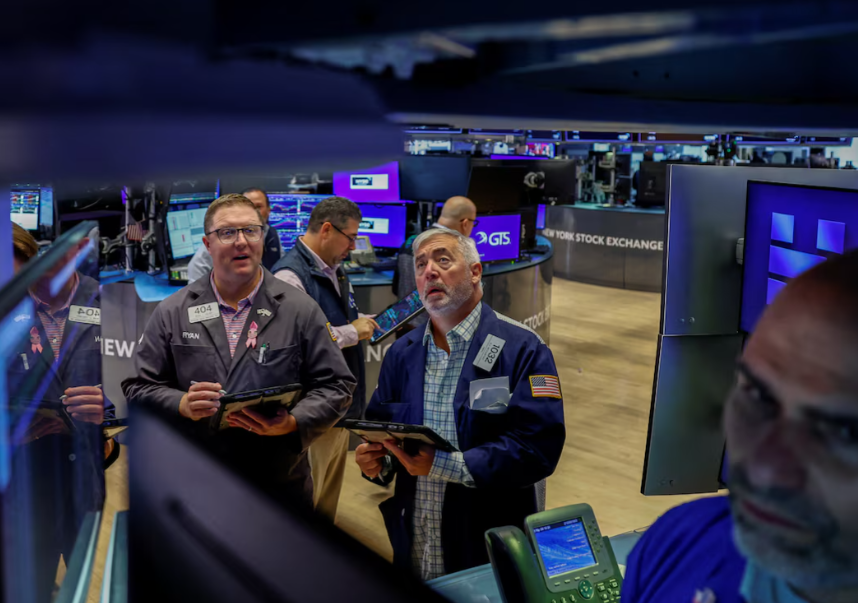
Wall Street futures climbed on Monday, September 21, 2026, as a rebound in artificial intelligence stocks, falling crude oil prices and easing Middle East tensions lifted investor sentiment. Gains across major technology companies helped push Dow Jones, S&P 500 and Nasdaq 100 futures higher, while declining Treasury yields offered additional support to equities.
The market recovery came after concerns about the sustainability of AI spending triggered a sell-off in technology shares the previous week. Investors returned their attention to continued investment in AI infrastructure, even as uncertainty surrounding US inflation, Federal Reserve interest rates and international trade remained significant.
According to Reuters, US stock futures were higher in early trading, with the Nasdaq 100 leading the advance. Oil prices fell approximately 2% to an 11-day low, while the yield on the benchmark 10-year US Treasury bond slipped below the closely watched 5% level.
Wall Street Futures Gain as Technology Stocks Lead the Market
US stock futures advanced on Monday as investors bought technology shares and responded to easing oil prices. The gains followed a difficult period for AI-related stocks, which had faced selling pressure after concerns about the technology industry’s future spending and profitability.
At 7:09 a.m. Eastern Time, futures tied to the three major US stock indexes were trading higher.
| Index futures | Change | Points gained |
|---|---|---|
| Dow Jones E-minis | 0.78% | 404 points |
| S&P 500 E-minis | 0.67% | 51.25 points |
| Nasdaq 100 E-minis | 1.04% | 310.75 points |
The Nasdaq 100 futures led the advance, reflecting the strength of technology and AI-related shares. The Dow Jones futures also rose, while S&P 500 futures benefited from gains across several sectors.
These figures represent futures trading at the reported time, rather than the final performance of the indexes during Monday’s regular session.
AI Stock Rally Returns as Investors Reassess Technology Spending
Artificial intelligence shares were among the main drivers of the futures advance. Investors appeared to shift their attention from recent warnings about AI spending to indications that companies continued investing in the technology.
The previous week’s concerns had triggered selling across parts of the AI sector. Monday’s rebound suggested that investors were reassessing those concerns, although a single trading session cannot establish whether the market has entered a sustained recovery.
Intel, Marvell and Meta shares advance
Several prominent technology companies recorded gains in early trading, according to Reuters.
- Intel: Shares rose 5.3%, adding to the positive tone among semiconductor stocks.
- Marvell Technology: Shares gained 2.2% as chip-related stocks advanced.
- Meta Platforms: Shares climbed 2.6%, contributing to the broader technology rebound.
- Dell Technologies: Shares increased 2.3%, reflecting strength among companies associated with technology infrastructure.
The gains reflected renewed investor interest in AI-related businesses, but the companies operate in different parts of the technology ecosystem. Their individual earnings, investment requirements and competitive positions remain important factors in assessing their longer-term performance.
Why AI infrastructure spending matters to investors
Artificial intelligence development depends on a broad technology ecosystem that includes semiconductors, computing equipment, data centres, networking infrastructure and software.
Investment in AI can therefore affect companies beyond those directly developing AI models. Semiconductor manufacturers may benefit from demand for computing components, while equipment and infrastructure providers can gain business from companies expanding their technology capabilities.
However, rising spending does not automatically guarantee rising profits. Investors must also consider the cost of infrastructure, competition, customer demand and how effectively businesses convert investment into revenue.
This distinction is important following the previous week’s AI-related sell-off. Markets may welcome continued spending, but investors will still need evidence that those investments can support sustainable business returns.
Accenture Shares Jump 6.1% After Anthropic AI Partnership
Accenture was among the strongest performers highlighted in the Reuters report, with shares rising 6.1% after the company partnered with Anthropic on a reported $2 billion investment in AI evaluation.
The announcement added another dimension to the technology rally by highlighting the role of professional services companies in the expanding AI market.
AI evaluation involves assessing how AI systems perform, including their reliability and suitability for particular uses. As organisations adopt AI tools, evaluation and related services can become important parts of the implementation process.
Why enterprise AI services are attracting attention
Businesses adopting AI often need more than access to a model. They may also require help integrating technology into existing systems, assessing performance, managing implementation and adapting operational processes.
This creates opportunities for consulting and technology services firms that help organisations deploy and evaluate AI systems.
Accenture’s reported partnership with Anthropic highlights this area of the market. However, the share-price increase alone does not establish the partnership’s eventual financial contribution or the returns Accenture will earn from its investment.
For investors, the longer-term question is how AI-related services translate into measurable business activity, revenue and profitability.
Crude Oil Falls 2% as Middle East Diplomatic Hopes Support Sentiment
Oil prices fell approximately 2% on Monday, reaching an 11-day low, according to Reuters. The decline came amid signs of progress in Middle East discussions, even as Washington and Tehran continued exchanging threats over the weekend.
US President Donald Trump said he would be open to meeting Iranian President Masoud Pezeshkian, who was expected to be in New York for the United Nations General Assembly.
The possibility of diplomatic engagement helped support investor sentiment, although the political and security situation remained uncertain.
Why lower oil prices can support equities
Crude oil is an important input cost for many businesses. When oil prices decline, companies that use substantial amounts of fuel may benefit from lower operating expenses, depending on their contracts and the timing of fuel purchases.
Airlines are one example. Fuel represents a significant operating cost for the industry, so falling oil prices can improve the outlook for expenses if the decline persists and other conditions remain favourable.
Lower energy prices can also ease some inflationary pressure across the economy. That can influence investor expectations about interest rates, although the overall inflation outlook depends on a wider range of goods, services and economic conditions.
Importantly, oil prices can move sharply in response to geopolitical developments. A diplomatic improvement may reduce some immediate supply concerns, but it does not guarantee that energy prices will continue falling.
Airline Stocks Rise as Fuel-Cost Pressure Eases
Energy-sensitive airline shares gained as crude prices retreated. Reuters reported that Delta Air Lines and American Airlines each advanced more than 1.5% in early trading.
The move reflected investor interest in companies that could benefit from lower fuel costs.
For airlines, the relationship between oil prices and profitability is not always immediate. Fuel purchasing arrangements, hedging strategies, ticket prices, passenger demand and operating costs all influence the effect of changing energy prices.
A sustained reduction in fuel expenses could provide support, but a one-day decline in crude oil is not enough to determine the industry’s financial outlook.
Treasury Yields Fall Below 5% as Investors Reassess Interest Rates
The yield on the 10-year US Treasury bond slipped below 5%, according to Reuters, easing one source of pressure on equities.
Treasury yields matter to stock markets because they influence borrowing costs and the returns investors can earn from government debt. Changes in yields can affect how investors value future corporate earnings, particularly for companies whose expected profits lie further in the future.
How bond yields affect technology valuations
Technology companies often attract attention because investors expect some of their growth and earnings to occur over an extended period.
When market interest rates rise, future earnings can become less valuable in present-value calculations. This can put pressure on valuations, particularly when investors are already concerned about high share prices or uncertain profitability.
When yields decline, some of that valuation pressure may ease. This can help explain why falling Treasury yields and rising technology shares sometimes occur together.
However, stock prices are influenced by multiple factors. Lower yields do not guarantee higher equity prices, especially when economic growth, inflation or corporate earnings expectations are changing.
Federal Reserve Rate Outlook Keeps Investors Cautious
Despite Monday’s gains, uncertainty about US monetary policy remained a major concern for investors.
Reuters reported that the Federal Reserve had recently raised interest rates for the first time in three years following a pickup in inflation. Markets were pricing in a 53% chance of another rate hike the following month, according to CME’s FedWatch tool at the time of the report.
This probability represented market expectations at that particular moment, rather than a confirmed Federal Reserve decision.
Austan Goolsbee warns about demand-driven inflation
Chicago Federal Reserve President Austan Goolsbee said there was “no ambiguity” about the need for higher interest rates, according to Reuters.
He also indicated that inflation pressures were extending beyond tariffs and energy prices to include strong demand.
The distinction matters because inflation can emerge from several sources. Higher energy costs may push up headline inflation, while strong demand can create broader pressure when spending grows faster than the economy’s capacity to supply goods and services.
For the Federal Reserve, assessing the source and persistence of inflation is important when determining the appropriate direction of monetary policy.
Investors will therefore be watching economic data and policymakers’ comments closely, particularly because expectations about future interest rates can influence bond yields, stock valuations and borrowing costs.
Why This Week’s Central Bank Speeches Matter
Reuters reported that at least 10 central bank policymakers were scheduled to provide commentary during the week.
These speeches could offer further information about how policymakers assess inflation, economic growth and the need for additional interest-rate changes.
Investors will be listening for whether policymakers share similar concerns about inflation or express different views about the risks facing the economy.
However, individual speeches should be interpreted in context. A policymaker’s comments do not necessarily represent a final decision by the Federal Reserve, and the policy outlook can change as new economic information becomes available.
US-Denmark Greenland Agreement Lifts Related Shares
Investor sentiment also received support from a reported diplomatic breakthrough between the United States and Denmark concerning Greenland’s status.
Reuters said the development could help ease trade tensions between the two countries. Shares of several US-listed companies with Greenland exposure advanced sharply.
| Company | Reported share-price change |
|---|---|
| Critical Metals | +27.1% |
| Greenland Mines | +90.8% |
| Greenland Energy | More than doubled |
The reported gains were substantially larger than those of the major US index futures.
However, sharp share-price movements in companies associated with a specific region do not necessarily indicate an equivalent improvement in their underlying business conditions.
Investors assessing these companies would need to consider their operations, financial resources, project development, regulatory environment and the actual implications of any diplomatic agreement.
US-China Summit Could Put Trade and AI Regulation in Focus
Another important event for markets is the expected US-China summit on Thursday.
According to Reuters, potential discussion topics could include extending the trade truce between the two countries, the Iran conflict and regulation of AI development.
US Treasury Secretary Scott Bessent and Chinese Vice Premier He Lifeng concluded talks on Sunday. During those discussions, Bessent proposed a new mechanism for AI safety notifications, Reuters reported.
Why trade relations matter for technology companies
The United States and China are important participants in global technology supply chains. Changes in trade policy can influence the movement of goods, business costs and companies’ ability to access particular markets.
Semiconductor companies and other technology businesses may be particularly sensitive to developments involving trade restrictions, supply chains and AI-related regulations.
For investors, the key question is whether discussions produce concrete agreements or merely create expectations of further negotiations.
Until specific outcomes are confirmed, the summit remains a potential source of market uncertainty rather than a guarantee of improved trade conditions.
Bitcoin Reaches a More Than Seven-Month High as Risk Appetite Improves
Bitcoin rose 4.3% to reach a more than seven-month high, according to Reuters. The cryptocurrency’s advance coincided with broader gains in risk-sensitive assets.
Shares of Coinbase and Strategy each gained more than 5% in early trading.
Bitcoin is sometimes monitored as an indicator of investor appetite for assets that can experience substantial price fluctuations. However, cryptocurrency prices are influenced by their own market dynamics, including trading activity, liquidity, regulatory developments and investor positioning.
Its rise alongside stock futures therefore provides additional evidence of improving sentiment during the session, but it does not prove that investors across all asset classes share the same outlook.
Warner Bros Shares Rise on Report About Paramount Merger Talks
Warner Bros shares advanced 7.1% after a report that Paramount had discussed concessions in advanced settlement negotiations with California’s attorney general, according to Reuters.
The discussions could help close the proposed merger between the two companies, the report said.
Merger-related share movements often depend on investors’ assessments of whether a transaction will be completed, the conditions attached to it and the financial implications for the companies involved.
However, reported settlement discussions do not establish that a transaction has received every required approval or that it will necessarily close.
Investors following the development will need to distinguish between negotiations, regulatory decisions and a completed transaction.
What Monday’s Market Rally Reveals About Investor Sentiment
Monday’s gains brought together several different market drivers: a rebound in AI shares, lower crude oil prices, declining Treasury yields and hopes for diplomatic progress.
The combination is important because markets rarely move in response to one factor alone. Technology stocks can benefit from improving spending expectations, while lower energy prices can ease cost pressures and changes in bond yields can influence valuations.
At the same time, concerns about inflation and interest rates remained unresolved.
A rebound does not necessarily signal a lasting recovery
One useful way to interpret the session is to separate short-term sentiment from longer-term fundamentals.
Short-term market sentiment can change quickly as investors react to economic data, geopolitical developments and corporate announcements.
Longer-term performance depends on factors such as company earnings, business investment, economic growth, interest rates and the sustainability of demand.
The reported futures gains show that investors were willing to buy into the market recovery on Monday morning. They do not, by themselves, establish whether the previous week’s AI-related concerns have been resolved.
Key Market Events to Watch Next
Several developments could influence the direction of US markets during the remainder of the week.
- Federal Reserve commentary: Policymakers’ views on inflation, demand and interest rates could influence bond yields and equity valuations.
- US-Iran diplomacy: Further developments could affect oil prices and investor assessments of geopolitical risk.
- US-China discussions: Trade policy and AI regulation could influence expectations for technology companies and global supply chains.
- AI investment developments: Corporate announcements and financial results could help investors assess whether AI spending is translating into sustainable business returns.
- Market performance: The final closing levels of the Dow Jones, S&P 500 and Nasdaq will show whether early futures gains carried through the regular trading session.
Conclusion: AI Optimism and Lower Oil Prices Support Wall Street Futures
Wall Street futures rose on September 21, 2026, as technology stocks recovered, crude oil prices declined and Treasury yields eased. The Nasdaq 100 futures led the advance, supported by gains in companies including Intel, Marvell, Meta and Dell.
Accenture also advanced after its reported AI evaluation partnership with Anthropic, while airline shares benefited from lower oil prices. Bitcoin reached a more than seven-month high, and companies with Greenland exposure recorded substantial gains following reported diplomatic progress between the United States and Denmark.
However, the recovery took place against a complicated economic and geopolitical backdrop. Inflation concerns, expectations of another Federal Reserve rate hike, Middle East tensions and uncertainty about US-China trade relations remain important factors for investors.
The central question for markets is whether improving sentiment will be supported by durable economic and corporate fundamentals. Continued AI investment, easing energy costs and clearer trade relations could influence the outlook, but the direction of stocks will also depend on inflation, interest rates and company earnings.
For now, Monday’s futures gains reflect a rebound in risk appetite rather than confirmation of a sustained market recovery. Investors will be watching central bank commentary, diplomatic developments and corporate news for further evidence about the direction of US financial markets.
For breaking news and live news updates, like us on Facebook or follow us on Twitter and Instagram. Read more on Latest Business on thefoxdaily.com.






COMMENTS 0