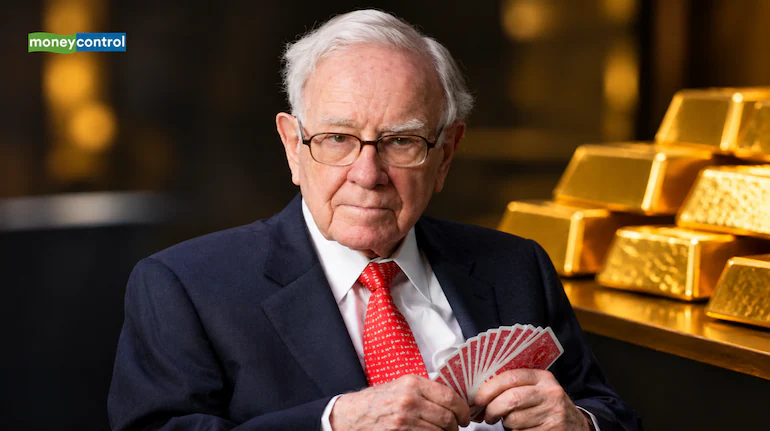
Gold Prices have fallen to their lowest level in more than a year, extending a sharp correction after a strong rally earlier in 2026. The decline has brought renewed attention to an investment argument that billionaire investor Warren Buffett has made repeatedly over the years: unlike businesses, farms and other productive assets, gold does not generate income, goods or services for its owners.
International spot gold fell to $3,785 an ounce as of 10:30 IST on November 18, its lowest level since September 2025, after declining more than 1% during the session. The metal had touched a record high of $5,594.82 an ounce on January 29, representing a fall of around 32% from that peak.
The weakness has also extended to the domestic futures market. On the Multi Commodity Exchange (MCX), gold futures for December 4 delivery opened 1.85% lower at Rs 1,31,741 per 10 grams at 09:02 IST, compared with the previous close. MCX spot gold was trading at Rs 1,33,530 per 10 grams.
According to Manav Modi, Commodities Analyst at Motilal Oswal Financial Services, hawkish remarks from US Federal Reserve officials have strengthened expectations of further interest rate hikes. Rising Treasury yields and a stronger dollar have also weighed on bullion by increasing the opportunity cost of holding an asset that does not offer regular income.
Meanwhile, a technology-led correction in equity markets has triggered selling across asset classes, with some investors reportedly liquidating precious metal positions to cover losses elsewhere.
Against this backdrop, Buffett’s long-standing preference for investments that generate cash flows, rather than assets whose returns depend primarily on finding another buyer at a higher price, has become relevant again.
What Warren Buffett Said About Investing in Gold
Buffett’s scepticism towards gold is not new. He has repeatedly described the precious metal as a relatively unattractive long-term investment because it does not produce anything or generate an income stream.
One of his most detailed explanations came at Berkshire Hathaway’s annual shareholder meeting in 2011. Buffett was asked why the company had not invested more heavily in commodities, particularly gold, despite the metal’s strong price performance at the time.
In response, he divided investments into three broad categories to explain how he evaluates different assets.
The first category consists of currency-denominated investments, such as bonds, bank deposits and cash. Their purchasing power depends partly on how governments manage their currencies and economies. Inflation can reduce the real value of money held in these instruments.
The second category includes assets that do not produce anything but are purchased in the expectation that another investor will eventually pay a higher price. Buffett identified gold as a classic example of this type of investment.
To illustrate his argument, he asked shareholders to imagine all the gold in the world being collected into a single cube measuring approximately 67 feet on each side. He estimated that the world’s entire gold stock amounted to around 165,000-170,000 metric tonnes.
His central point was that owning a large quantity of gold does not make the metal generate additional output. It does not pay interest, distribute dividends, produce crops or manufacture goods. An investor’s return depends largely on whether the market price rises and someone else is willing to purchase the metal at a higher valuation.
Buffett contrasted this with his preferred third category: productive assets.
These include businesses, agricultural land and other investments capable of generating goods, services or cash flows over time. Their value can be assessed by examining the income they are expected to produce and the costs involved in generating it.
For example, someone purchasing a farm can estimate its expected agricultural output, operating expenses and potential income. Even if the market price of the land does not increase immediately, the farm can continue producing crops and generating economic value.
The same principle guides Buffett’s approach to businesses and marketable securities. A company can earn profits, reinvest in its operations, distribute dividends and expand its productive capacity. These activities provide potential sources of investment returns beyond changes in market prices.
Why Buffett Warned Against Buying Assets Simply Because Prices Rise
Another important part of Buffett’s 2011 remarks concerned investor behaviour during periods of strong asset-price appreciation.
He explained how a sharp rally can generate excitement and encourage investors to enter an asset class simply because other people are making money from it. When an investor sees a neighbour earning substantial returns from gold, it can create pressure to participate in the rally.
This behaviour can shift attention away from an asset’s underlying characteristics. Instead of assessing its income potential, valuation or long-term usefulness, investors may focus mainly on recent price movements.
Buffett’s argument was that buying an asset simply because its price has been rising is not a reliable way to build wealth over time. A rising price does not automatically mean that an investment has become more attractive.
This observation is relevant after gold’s strong rally in 2025 and early 2026, when record prices attracted considerable investor attention. The subsequent correction illustrates how quickly market sentiment can change after an extended period of gains.
For investors, the distinction is between owning an asset because of the economic value it produces and buying it primarily in anticipation of future price appreciation. Both approaches can generate returns, but their underlying risks and sources of value are different.
Buffett’s Views on Gold Date Back to 2000
Buffett had questioned gold’s investment appeal well before his detailed explanation in 2011. At Berkshire Hathaway’s annual meeting in 2000, he was asked whether an investor should exchange Berkshire shares for gold coins.
His response reflected the same investment philosophy. He said he would rather own shares in well-managed businesses selling products that consumers regularly purchase than hold a metal that must be mined, transported, stored and insured.
Buffett also acknowledged that he had grown up in a family where gold was held in high regard, partly because his father supported the gold standard. Despite this background, he said he had never been particularly enthusiastic about gold as an investment.
He reiterated the argument in a 2005 interaction with students from the University of Kansas Business School. Buffett highlighted that gold generates no income, while investors holding physical bullion may also have to bear storage and insurance expenses.
These remarks show that his position was not simply a reaction to one particular gold-price cycle. His criticism has consistently centred on the difference between non-producing assets and investments that generate economic output.
Did Buffett’s Berkshire Hathaway Ever Invest in Gold?
There was one notable exception that attracted considerable attention in 2020. Berkshire Hathaway disclosed a holding of approximately 20.9 million shares in Canadian gold mining company Barrick Gold during the second quarter of that year.
The investment came at a time when gold prices were rising amid economic uncertainty caused by the COVID-19 pandemic. The move surprised some investors because of Buffett’s long-standing criticism of gold as an investment.
However, the position did not last long. Berkshire reduced the holding substantially in the following quarter and exited the investment by the end of 2020.
There is an important distinction between owning physical gold and investing in a gold mining company. Barrick Gold is a business involved in extracting and selling gold. Its operations can generate revenue, profits and cash flows, depending on production costs, output levels and market prices.
That makes a mining company fundamentally different from a physical gold holding. While bullion does not produce income on its own, a mining business can create economic value through its operations.
Therefore, Berkshire’s investment in Barrick Gold should not be interpreted as a complete reversal of Buffett’s broader investment philosophy. It was an investment in a business exposed to gold prices, rather than simply an allocation to physical bullion.
Why Gold Prices Are Falling in November 2026
The latest correction reflects several pressures on the precious metal. Interest rate expectations, Treasury yields and movements in the US dollar can influence gold because bullion does not offer a regular financial return.
When investors expect interest rates to rise, interest-bearing assets can become more attractive relative to gold. Higher yields increase the opportunity cost of holding bullion, particularly for investors comparing it with government securities and other fixed-income instruments.
A stronger US dollar can also weigh on internationally traded gold. Since bullion is generally priced in dollars, a stronger dollar can make it more expensive for buyers using other currencies, potentially affecting demand.
Market-wide selling can add another layer of pressure. When investors face losses in other asset classes, they may sell profitable or liquid positions to raise cash. Such selling can affect gold even when the reasons for holding the metal have not fundamentally changed.
According to Motilal Oswal Financial Services analyst Manav Modi, hawkish Federal Reserve commentary, rising Treasury yields and dollar strength are among the factors weighing on bullion. Cross-asset liquidation linked to the technology-led equity correction has also contributed to the pressure.
These factors help explain why gold can decline even during periods of economic uncertainty. Its price is influenced not only by demand for a perceived store of value but also by interest rates, currency movements, investor positioning and broader market liquidity.
What Buffett’s Gold Argument Means for Investors
Buffett’s criticism does not mean that gold has no role in an investment portfolio. Gold is often held as a store of value, a potential hedge against currency weakness and a diversification asset. Its demand can also be influenced by central bank purchases, geopolitical uncertainty and concerns about financial stability.
However, investors need to distinguish between gold’s potential portfolio benefits and its ability to generate income. Unlike shares in a profitable company or a rental property, physical gold does not produce dividends, rent or operating cash flows.
This difference also affects how investors evaluate returns. With a productive business, investors can examine earnings, cash generation, debt, growth prospects and management decisions. With physical gold, the investment case depends more heavily on the price at which the metal can eventually be sold.
Gold can still appreciate significantly when demand rises or investors seek protection from economic and financial risks. But its price can also fall sharply when interest rate expectations, currency movements or market sentiment turn against it.
The recent decline from the January record high is a reminder that even assets viewed as stores of value can experience substantial volatility. Investors who entered near the peak may face a very different outcome from those who accumulated gold at lower prices.
Gold Versus Productive Assets: The Key Difference
The central idea behind Buffett’s argument is not that every productive asset will outperform gold or that gold prices can never rise. Instead, it is that different investments create value in different ways.
A business can generate earnings through sales, improve productivity, expand its customer base and reinvest profits. Agricultural land can produce crops, while bonds can provide interest payments. These assets have identifiable sources of income, although their returns are not guaranteed and they carry their own risks.
Physical gold works differently. Its supply is limited by mining and other sources, and its market price can respond to changes in demand, inflation expectations, currency movements and investor sentiment. But the metal itself does not generate an additional stream of income for its owner.
This distinction is particularly important when comparing long-term investment strategies. Investors focused on income and compounding may place greater emphasis on productive assets, while those seeking diversification or a potential store of value may consider gold for different reasons.
What Could Influence Gold Prices From Here?
The near-term direction of gold will likely depend on how expectations for US monetary policy evolve. If Federal Reserve officials continue to signal tighter policy and Treasury yields remain elevated, bullion could face further pressure because of its non-yielding nature.
Movements in the dollar will also remain important. A sustained strengthening of the US currency could make gold less attractive to international buyers, while a weaker dollar could provide support.
Investor demand is another factor to watch. If uncertainty in financial markets increases, demand for gold as a potential safe-haven asset could recover. However, the recent technology-led equity correction shows that gold can also be sold during periods of broad market liquidation.
For domestic investors, international bullion prices are only one part of the picture. Currency movements, import-related costs and local market conditions can influence Indian gold prices. As a result, domestic prices may not move by exactly the same percentage as international spot gold.
Ultimately, the latest correction has brought Buffett’s long-standing investment philosophy back into focus. His argument remains centred on a simple distinction: gold may preserve or gain value when market demand supports it, but productive assets have the additional ability to generate income and economic output.
For investors, the choice is not necessarily between owning gold and owning businesses. It is about understanding why an asset is being purchased, what generates its returns and how much risk is involved in relying on future price appreciation.
For breaking news and live news updates, like us on Facebook or follow us on Twitter and Instagram. Read more on Latest Business on thefoxdaily.com.






COMMENTS 0