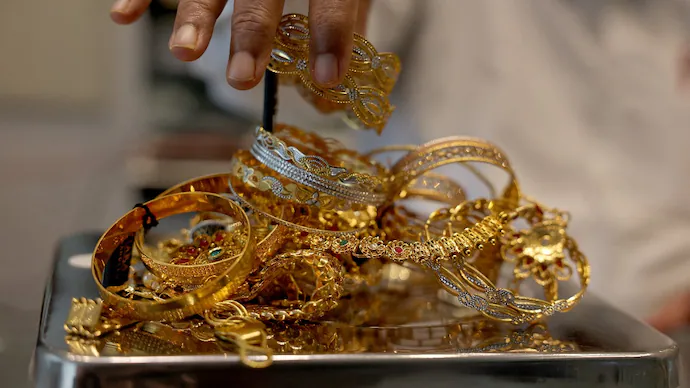
Gold and Silver Prices continued to decline on Friday, October 30, offering some relief to buyers preparing for the festive and wedding season. After remaining elevated for an extended period, both Precious Metals have come under pressure, raising hopes that jewellery and investment purchases could become more affordable.
At 11.45 am on Friday, MCX gold was trading at Rs 1,41,979 per 10 grams, down 0.43%. Silver witnessed a sharper fall, with MCX silver declining 1.88% to Rs 1,85,900 per kg.
However, the correction may not be over. Higher crude oil prices, renewed inflation concerns in the United States and expectations of another interest rate hike by the US Federal Reserve have weighed on investor sentiment towards precious metals.
Market experts believe gold and silver could fall further in the near term before finding support. This leaves buyers with an important question: should they take advantage of the current decline or wait for prices to drop further?
Why are gold and silver prices falling?
Rising crude oil prices and stronger-than-expected inflation concerns have been among the major factors putting pressure on gold and silver. Higher energy costs can push up prices across the economy, making it harder for central banks to bring inflation under control.
US consumer prices increased in September, partly because of higher gasoline and other goods prices. The latest inflation concerns have strengthened expectations that the Federal Reserve may need to raise interest rates again in December.
Higher interest rates generally create challenges for gold because the precious metal does not generate regular interest income. When interest-bearing investments become more attractive, investors may reduce their exposure to gold, putting downward pressure on its price.
Geopolitical uncertainty has added another layer of complexity. Crude oil prices have risen amid concerns that the US could resume military strikes on Iran, raising fears of potential disruptions to energy supplies. A further increase in oil prices could intensify inflationary pressures and influence the Federal Reserve’s monetary policy decisions.
Dr Renisha Chainani, Chief Research Officer at Augmont, said the Federal Reserve has kept the possibility of another rate hike open as it continues to tackle persistent inflation.
She said the US personal consumption expenditures price index rose 0.5% in the latest reported month, marking its biggest increase since March. According to the CME FedWatch Tool, traders were pricing in approximately a 75% chance of a December rate hike.
Gold and silver price outlook: Could the correction deepen?
The near-term outlook for both precious metals remains weak, with analysts warning that prices could decline further before finding a stable support level.
According to Chainani, gold has fallen below the important $4,000 level, equivalent to approximately Rs 1,42,000. If the weakness continues, the metal could move towards $3,950, or around Rs 1,40,000, followed by $3,900, or approximately Rs 1,38,000, over the next 10 to 15 days.
Silver has also broken below its $52.5 support level, equivalent to approximately Rs 1,92,000. The next potential downside target is around $50, or roughly Rs 1,80,000.
Despite the possibility of further declines, Chainani sees the current correction as a potential accumulation opportunity for medium-term investors.
She identified the $3,900-$3,950 range for gold and $50-$52 range for silver as important support and accumulation zones. According to her assessment, both metals could establish a base around these levels before recovering by 10-15% over the coming weeks.
For the broader upward trend to regain strength, gold would need to sustain itself above $4,100, while silver would need to move above $58, she added.
MCX gold technical outlook: Key support and resistance levels
Ponmudi R, CEO of Enrich Money, also highlighted continued weakness in domestic Gold Prices. He said MCX gold opened near Rs 1,42,225 and was trading around Rs 1,41,840, down 0.53% at the time of his assessment.
Gold has slipped below the Rs 1,43,000-Rs 1,43,700 range, which is now acting as an immediate resistance zone. This means the metal may face selling pressure if it attempts to recover towards those levels.
The next resistance is placed between Rs 1,45,300 and Rs 1,46,000. A sustained move above these levels could indicate improving buying interest.
On the downside, immediate support for MCX gold lies in the Rs 1,40,000-Rs 1,41,000 range. If selling pressure intensifies and this support fails to hold, the next potential support zone is between Rs 1,37,500 and Rs 1,38,300.
These levels will be important for traders assessing whether the current decline is a temporary correction or the beginning of a deeper fall.
Should investors buy gold and silver now or wait?
The decline in gold and silver prices may appear attractive to investors who have been waiting for a better entry point. However, the possibility of further weakness means that buying the entire quantity at current levels could involve unnecessary short-term risk.
For short-term traders, waiting for prices to stabilise around the identified support zones may be a more cautious approach. Gold could test Rs 1,40,000 before potentially moving towards Rs 1,38,000, while silver could decline towards Rs 1,80,000 if the current selling pressure continues.
Investors with a medium- to long-term horizon may consider staggered purchases rather than committing their entire investment at once. Spreading purchases across different price levels can reduce the risk of entering the market at an unfavourable point and provide flexibility if prices fall further.
Festive and wedding-season buyers may have different priorities. People who need gold or silver jewellery for an upcoming occasion may not be able to wait indefinitely for the market to reach its lowest level. Buying in parts could help them take advantage of the correction while avoiding the pressure of predicting the exact market bottom.
What should buyers watch before making a decision?
The next major moves in gold and silver will depend partly on developments in the global economy and financial markets. US inflation figures will remain important because persistent price pressures could strengthen expectations of higher interest rates.
Crude oil prices are another factor to monitor. A sustained increase in energy costs could add to inflation concerns and influence the Federal Reserve’s policy outlook. Developments involving Iran and the potential impact on energy supplies could also affect market sentiment.
Investors should additionally watch the Federal Reserve’s interest-rate signals and whether gold and silver can hold their respective technical support levels. A recovery above key resistance levels could indicate that buying interest is returning, while a break below support could open the door to further losses.
Gold and silver prices: A buying opportunity or more downside ahead?
The latest decline has brought some relief to gold and silver buyers, but it is too early to conclude that prices have reached their bottom. Analysts expect further weakness in the near term, with gold potentially testing Rs 1,40,000 and then Rs 1,38,000, while silver could move towards Rs 1,80,000.
At the same time, the medium-term outlook could improve if the metals establish a base around the support levels identified by analysts. For long-term investors, gradual buying may offer a way to navigate the uncertainty without trying to time the market perfectly.
For jewellery buyers, the decision will depend on their purchase timeline and budget. The important point is to avoid making decisions based solely on a single day’s price movement. Inflation, crude oil prices, interest-rate expectations and technical support levels will all play a role in determining whether the current correction deepens or becomes an opportunity for a recovery.
For breaking news and live news updates, like us on Facebook or follow us on Twitter and Instagram. Read more on Latest Business on thefoxdaily.com.






COMMENTS 0