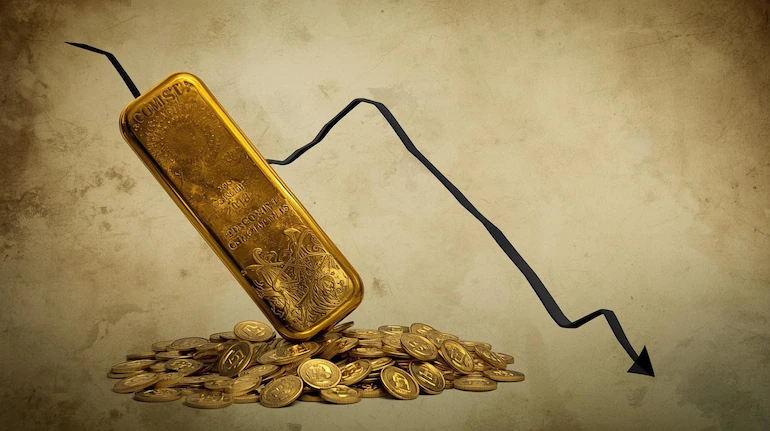
Gold and Silver Prices declined in early trading on Thursday, November 19, as a stronger US dollar, rising Treasury yields and hawkish signals from the US Federal Reserve increased pressure on precious metals. On the Multi Commodity Exchange (MCX), domestic gold futures fell nearly 1% to around Rs 1.29 lakh per 10 grams, while silver futures slipped below Rs 1.60 lakh per kilogram.
The decline came amid growing expectations that the Federal Reserve could raise interest rates further to tackle persistent inflation. Higher interest rates and rising bond yields generally reduce the attractiveness of gold and silver because these metals do not offer regular interest income.
International bullion prices also remained under pressure, with spot gold trading near $3,711 an ounce and silver hovering around $45 an ounce. However, escalating geopolitical tensions in the Middle East could provide some support by encouraging investors to seek safe-haven assets.
Market experts have cautioned Indian investors against rushing to buy during the correction. They suggest that staggered purchases, controlled exposure and clear risk limits may be more appropriate while global prices and interest-rate expectations remain volatile.
Gold and Silver Prices on MCX on November 19
Domestic precious metal futures opened lower on Thursday, reflecting weakness in international bullion markets and continued pressure from the US dollar and Treasury yields.
- MCX gold futures: Gold contracts for December 4 delivery opened 0.75% lower at Rs 1,28,842 per 10 grams at 9:01 am IST.
- MCX silver futures: Silver declined 0.48% to Rs 1,59,960 per kilogram at 9:01 am IST.
- Previous spot prices: MCX spot gold stood at Rs 1,30,921 per 10 grams, while silver was at Rs 1,69,016 per kilogram in the previous session.
The early decline in domestic futures reflected the broader weakness in precious metals. Gold approached the Rs 1.29 lakh level, while silver moved below the Rs 1.60 lakh mark, putting both metals under pressure at the start of Thursday’s session.
Domestic bullion prices are influenced by international prices, the rupee-dollar exchange rate, import-related costs and local market conditions. Consequently, Indian investors may experience price movements that differ from those in international markets.
International Gold and Silver Prices Remain Under Pressure
Precious metals also traded lower in international markets. Spot gold, represented by XAU/USD, declined 0.38% and traded just above $3,711 an ounce. Spot silver fell 0.29% to around $45 an ounce.
On Wednesday, COMEX gold futures declined 0.24% to $3,732.80 an ounce, while silver fell to $45.01 an ounce at 21:47 GMT, according to the supplied market figures.
The weakness followed a broader correction across precious metals. Gold had moved close to a 14-month low, while silver experienced substantial selling pressure. Both metals were trading around their lowest levels since September 2025, according to market commentary cited by experts.
The international price trend is particularly important for Indian buyers because domestic bullion prices are closely linked to global benchmarks. When international prices decline, domestic prices can also come under pressure, although currency movements may change the extent of the impact.
Why Are Gold and Silver Prices Falling?
The latest decline in bullion prices is largely linked to changing expectations about US monetary policy. Higher-than-expected inflation and hawkish comments from Federal Reserve officials have strengthened expectations of additional interest rate increases.
Minutes from the Federal Reserve’s October meeting indicated growing concern among policymakers about persistent inflation. This has encouraged investors to reassess the possibility of further monetary tightening.
When interest rates rise, government bonds and other interest-bearing investments may become more attractive compared with gold and silver. Since precious metals do not provide regular interest payments, higher yields increase the opportunity cost of holding them.
A stronger US dollar adds another layer of pressure. Gold and silver are internationally priced in dollars, so a stronger dollar can make these commodities more expensive for buyers using other currencies. This may affect demand and contribute to lower international prices.
On Thursday morning, the US dollar index was trading 0.12% higher at 103.93. The increase reflected continued support for the US currency amid expectations of a tighter monetary policy.
Hawkish Federal Reserve Signals Weigh on Bullion
According to Manav Modi, Commodities Analyst at Motilal Oswal Financial Services, gold and silver extended their decline as hawkish Federal Reserve commentary reinforced expectations of further monetary tightening.
Modi noted that gold was hovering near a 14-month low, while silver remained under pressure after a broad-based decline across precious metals. He identified rising Treasury yields and a stronger dollar as important factors weighing on bullion prices.
These developments influence investor decisions because higher bond yields can make interest-bearing assets more attractive. Investors who expect better returns from bonds or other financial instruments may reduce their exposure to gold and silver.
The monetary policy outlook has therefore become a key factor for precious metals. Even when investors remain concerned about geopolitical risks, expectations of higher interest rates can limit buying interest in bullion.
Technology Stock Sell-Off Adds to Precious Metal Pressure
Another factor contributing to the recent decline is the technology-led correction in equity markets. According to Modi, weakness in technology stocks has triggered cross-asset liquidation, prompting some investors to sell precious metals to cover losses in other parts of their portfolios.
Cross-asset liquidation occurs when investors sell holdings across different asset classes to raise cash or manage losses. This can create selling pressure in markets that might otherwise attract investors during periods of uncertainty.
Gold is traditionally considered a safe-haven asset, but it does not always rise when equity markets decline. During periods of widespread selling, investors may liquidate gold and other investments to meet financial obligations or reduce overall portfolio risk.
This helps explain why precious metals have faced pressure despite uncertainty in global financial markets.
Why Is Silver Falling Faster Than Gold?
Silver has experienced sharper selling pressure than gold, partly because its market characteristics differ from those of the yellow metal. While gold is primarily viewed as a monetary and investment asset, silver also has significant industrial applications.
Silver is used in several industrial sectors, making its price more sensitive to expectations about manufacturing activity and economic demand. When investors become concerned about global economic conditions, silver can face pressure from both financial market sentiment and expectations for industrial consumption.
Silver also tends to experience greater price volatility than gold. This means that its gains and losses can be more pronounced during periods of changing investor sentiment.
Vikram Subburaj, CEO of Giottus, said bullion was undergoing a sharp correction, with selling accelerating across international and Indian markets. He identified the reassessment of the Federal Reserve’s interest-rate outlook as the immediate trigger.
Subburaj said the October meeting minutes highlighted policymakers’ concerns about persistent inflation, strengthening expectations of further rate increases. The resulting rise in the dollar and Treasury yields has reduced the appeal of non-yielding precious metals.
Silver’s exposure to industrial demand and its higher volatility have contributed to its sharper decline compared with gold.
Geopolitical Tensions Could Support Safe-Haven Demand
Despite the pressure from monetary policy expectations, geopolitical developments in the Middle East could provide some support to precious metals.
Modi pointed to regional media reports suggesting that Iran’s Islamic Revolutionary Guard Corps launched missiles and drones at warships near Qeshm Island that were allegedly involved in an attack on the island. The reports followed earlier accounts of explosions and smoke in the region.
However, the targets, damage and casualties remained unconfirmed in the information provided. Any assessment of the incident’s wider impact therefore depends on further verification and developments.
Geopolitical uncertainty can increase demand for gold because investors often use the metal as a store of value during periods of instability. If tensions escalate, safe-haven buying could provide a counterweight to the pressure created by higher interest rates and a stronger dollar.
Modi said markets would continue to monitor Federal Reserve commentary, Treasury yields, dollar movements and developments in the Middle East. He added that geopolitical risks could offer some support against the prevailing monetary policy headwinds.
Gold and Silver Rates in Mumbai on November 19
Retail bullion rates in Mumbai also reflected the price levels prevailing on Thursday, November 19. The reported rates were:
- 24-carat gold: Rs 1,29,940 per 10 grams.
- 22-carat gold: Rs 1,19,020 per 10 grams.
- Silver: Rs 1,600 per 10 grams.
- Silver: Rs 1,60,737 per kilogram.
Retail rates may differ from exchange-traded futures prices because of local taxes, dealer margins, making charges and other applicable costs. Buyers should check the latest rates with local jewellers before making a purchase.
Should Investors Buy the Dip in Gold and Silver?
The recent decline may appear attractive to investors looking to increase their exposure to precious metals at lower prices. However, market experts have warned against trying to identify the exact bottom during a rapid correction.
Subburaj said volatility was likely to remain high and advised Indian investors to avoid rushing into the market. He highlighted three approaches that could help investors manage uncertainty:
- Staggered buying: Instead of investing the entire amount at once, investors can spread purchases over different periods to reduce the risk of entering the market at an unfavourable price.
- Measured exposure: Investors should keep their allocation to precious metals within a level consistent with their financial goals and risk tolerance.
- Clear risk limits: Investors should establish how much volatility they can tolerate and avoid making decisions based only on short-term price movements.
These approaches do not guarantee profits or prevent losses. However, they may help investors avoid making rushed decisions during periods of sharp market movements.
The direction of bullion prices will also depend on whether the Federal Reserve continues to signal higher interest rates, whether the US dollar remains strong and how Treasury yields behave. A stabilisation in these indicators could improve conditions for precious metals, while further monetary tightening expectations could extend the pressure.
What Indian Investors Should Watch Next
Indian gold and silver prices will remain influenced by international bullion movements and the rupee-dollar exchange rate. Even if global Gold Prices stabilise, a weaker rupee could increase the cost of imported bullion in India. Conversely, a stronger rupee could soften the impact of international price movements.
Investors should also monitor the Federal Reserve’s communication for indications of its next interest-rate decisions. Any change in expectations about inflation or monetary tightening could influence the dollar, bond yields and precious metals.
Geopolitical developments in the Middle East remain another important factor. An escalation could renew safe-haven demand, although the extent of any price response would depend on the nature and duration of the disruption.
For now, gold and silver are caught between two opposing forces: monetary policy expectations are weighing on prices, while geopolitical uncertainty could support demand. With volatility likely to remain elevated, investors may benefit from a disciplined approach rather than attempting to predict the exact market bottom.
For breaking news and live news updates, like us on Facebook or follow us on Twitter and Instagram. Read more on Latest Business on thefoxdaily.com.






COMMENTS 0