- This Was Not a Symbolic Business Delegation
- Why China Still Matters So Much to American Companies
- Why Nvidia CEO Jensen Huang’s Presence Was Especially Important
- Elon Musk’s China Relationship Is Deeply Strategic
- Apple Cannot Easily Separate From China
- Wall Street Wants Greater Access to China’s Financial Markets
- The AI Race Is Quietly Driving Diplomacy
- Trump Also Needs Economic Wins
- China Also Gains From the Visit
- The Real Story Is Economic Interdependence
- What Could Come Out of the Visit?
- Conclusion: Trump’s CEO Delegation Shows Business Still Drives US-China Relations
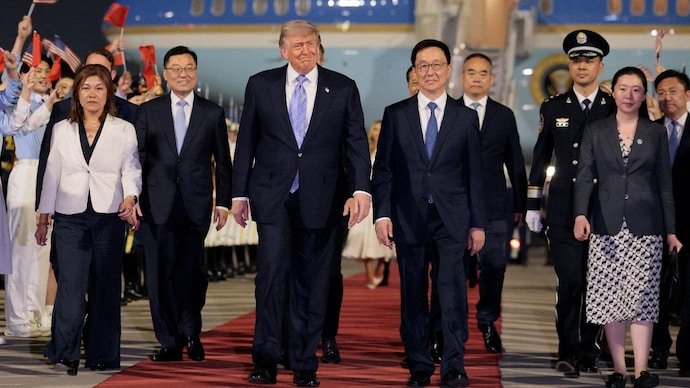
When US President Donald Trump arrived in Beijing accompanied by some of America’s most influential CEOs, the message was unmistakable: this was not merely a political visit it was an economic mission.
Travelling with Trump were corporate heavyweights including Tesla CEO Elon Musk, Nvidia chief Jensen Huang, Apple CEO Tim Cook, BlackRock’s Larry Fink, and senior executives from Meta, Goldman Sachs, Boeing, Visa, Mastercard, and several other global giants.
The sheer scale of the delegation immediately raised questions about the real purpose behind the visit.
At a time when US-China relations remain strained by trade disputes, Technology restrictions, geopolitical rivalry, and supply-chain tensions, why would America’s most powerful business leaders travel together with Trump to Beijing?
The answer lies in a complex mix of economics, Geopolitics, artificial intelligence competition, Manufacturing dependence, financial market access, and political strategy.
Despite years of aggressive rhetoric between Washington and Beijing, the trip highlights a reality both countries cannot easily escape:
The United States and China remain deeply economically interconnected.
This Was Not a Symbolic Business Delegation
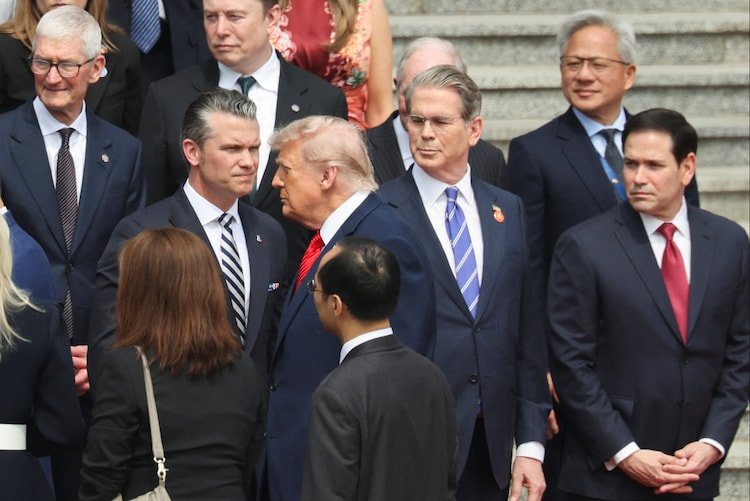
Unlike ceremonial trade visits of the past, the Beijing trip appears to have been highly transactional.
Reports suggest companies joining the delegation were expected to arrive with specific business objectives or “tangible asks” that could potentially lead to:
- Regulatory approvals
- Market access
- Investment permissions
- Supply-chain agreements
- Technology cooperation
- Licensing breakthroughs
In other words, CEOs were not simply accompanying Trump for political optics or photo opportunities.
Most of them had billions of dollars at stake.
The visit effectively turned into a high-level business negotiation platform where corporate America attempted to directly engage Chinese leadership alongside diplomatic discussions.
Why China Still Matters So Much to American Companies
One of the biggest insights from the delegation is that even after years of “decoupling” debates, China remains essential to many US corporations.
For different industries, China represents:
- A massive consumer market
- A manufacturing powerhouse
- A critical supply-chain hub
- A source of industrial materials
- A center for electronics production
- A rapidly growing AI ecosystem
Many American companies may want to reduce overdependence on China, but fully replacing China’s industrial ecosystem remains extremely difficult.
That explains why so many CEOs personally joined the trip.
For some companies, regulatory progress in China could unlock billions of dollars in future revenue.
Why Nvidia CEO Jensen Huang’s Presence Was Especially Important
Nvidia CEO Jensen Huang may have been one of the most strategically important figures in the delegation.
Nvidia sits at the center of the global artificial intelligence boom, and China remains one of the world’s largest markets for AI-related technology.
However, the company has faced increasing difficulties selling advanced chips in China because of US export restrictions aimed at limiting Beijing’s access to cutting-edge semiconductor technology.
Nvidia reportedly wants greater clarity and approvals surrounding sales of advanced AI processors such as the H200 series.
This matters enormously because:
- China is a huge AI market
- Chinese tech firms need advanced chips
- AI demand continues growing rapidly
- Semiconductor competition is becoming geopolitical
For Nvidia, China is not just another overseas market.
It is central to the future of global AI commercialization.
That is why Huang’s participation attracted intense attention.
Elon Musk’s China Relationship Is Deeply Strategic
Tesla CEO Elon Musk also has major interests tied directly to China.
Unlike many Western automakers that struggled in the Chinese market, Tesla achieved significant success there, largely due to its Shanghai Gigafactory and strong local demand.
But Musk’s relationship with China goes beyond electric vehicles.
Tesla is reportedly seeking Chinese approval for wider deployment of its Full Self-Driving assistance technology.
That approval could be enormously valuable because China is the world’s largest automobile market.
At the same time, Tesla remains connected to Chinese suppliers for:
- Battery materials
- Solar manufacturing equipment
- Industrial components
- Supply-chain infrastructure
Reports suggesting Tesla plans to purchase billions of dollars worth of solar equipment from Chinese suppliers highlight another reality:
Even American tech champions still rely heavily on Chinese industrial ecosystems.
This creates a complicated balancing act for Musk as US-China tensions continue rising.
Apple Cannot Easily Separate From China
For Apple CEO Tim Cook, China remains both an enormous manufacturing base and one of Apple’s most important consumer markets.
Few companies illustrate US-China economic interdependence better than Apple.
Although Apple has expanded production into countries like India and Vietnam, China still plays a central role in:
- iPhone manufacturing
- Component assembly
- Supplier ecosystems
- Consumer sales
- Retail expansion
Any deterioration in US-China relations directly affects Apple’s operational stability.
Cook’s presence therefore reflects how critical maintaining workable ties with Beijing remains for global technology companies.
Wall Street Wants Greater Access to China’s Financial Markets
The delegation was not limited to technology executives.
Major financial firms also joined the trip because China’s financial sector remains one of the world’s biggest long-term growth opportunities.
Executives from Goldman Sachs, Citi, Blackstone, Visa, Mastercard, and BlackRock all have strong reasons to pursue deeper Chinese market access.
China’s financial system remains heavily regulated, but gradual opening measures have created opportunities in:
- Asset management
- Consumer payments
- Investment banking
- Credit services
- Capital markets
Visa and Mastercard, in particular, have long sought wider participation in China’s domestic payments ecosystem.
Even limited regulatory approvals could create massive long-term business opportunities.
| CEO | Company | Key China Interest |
|---|---|---|
| Elon Musk | Tesla | Self-driving approvals and supply chains |
| Jensen Huang | Nvidia | AI chip access and semiconductor sales |
| Tim Cook | Apple | Manufacturing and consumer market stability |
| Larry Fink | BlackRock | Financial market expansion |
| David Solomon | Goldman Sachs | Investment banking access |
| Ryan McInerney | Visa | Payments market entry |
| Michael Miebach | Mastercard | Joint venture expansion |
The AI Race Is Quietly Driving Diplomacy
One of the most important themes behind the trip is the global artificial intelligence race.
The United States and China are competing intensely for leadership in:
- AI infrastructure
- Semiconductors
- Cloud computing
- Automation
- Advanced manufacturing
This competition has transformed technology policy into National Security policy.
That is why semiconductor executives, AI firms, and technology companies are increasingly involved in geopolitical discussions once dominated mainly by diplomats and Defense officials.
The delegation shows how closely intertwined business strategy and geopolitics have become.
Corporate decisions involving chips, cloud systems, or supply chains now carry major national-security implications.
Trump Also Needs Economic Wins
Trump’s decision to bring top CEOs to Beijing is also politically strategic.
The US economy is facing:
- Inflation concerns
- Market volatility
- Energy-price uncertainty
- Global supply-chain instability
- Economic fallout linked to geopolitical conflicts
Against that backdrop, Trump likely wants to demonstrate that his administration can still deliver economic opportunities for American businesses.
Even modest breakthroughs involving investments, market access, or regulatory approvals could be presented as economic victories.
The business-heavy delegation also helps signal that the White House remains engaged with corporate America despite broader geopolitical tensions.
China Also Gains From the Visit
The trip is not only beneficial for Washington or US corporations.
China also has strong incentives to maintain stable business relationships with major American companies.
Beijing is currently dealing with:
- Slower economic growth
- Property-sector weakness
- Foreign investment concerns
- Technology restrictions
- Supply-chain diversification pressure
Hosting influential American CEOs allows China to project an image of continued economic openness despite geopolitical friction.
It also creates opportunities to prevent further corporate migration away from Chinese manufacturing and markets.
In many ways, the summit reflects a mutual reality:
Neither side can fully afford complete economic separation.
The Real Story Is Economic Interdependence
Perhaps the biggest takeaway from the Beijing delegation is that global economic decoupling remains far more complicated than political slogans suggest.
Even amid:
- Trade wars
- Tariffs
- Technology bans
- Geopolitical rivalry
- Military tensions
American corporations still view China as too large, too important, and too integrated into global supply chains to ignore.
Meanwhile, China still values access to:
- American technology
- Global finance
- International investment
- Corporate partnerships
This creates a strange modern reality where competition and cooperation exist simultaneously.
The US and China are strategic rivals, yet economically intertwined.
What Could Come Out of the Visit?
Analysts do not necessarily expect dramatic trade deals immediately.
However, the summit could still produce meaningful outcomes such as:
- Regulatory approvals
- Improved business communication channels
- Supply-chain agreements
- Market-access concessions
- Reduced uncertainty for investors
For major corporations, even small regulatory progress in China can translate into massive long-term financial opportunities.
That is why so many CEOs were willing to personally travel alongside Trump.
Conclusion: Trump’s CEO Delegation Shows Business Still Drives US-China Relations
Donald Trump’s Beijing visit revealed something many geopolitical headlines often overlook: despite rising strategic tensions, economic realities continue pulling the United States and China together.
The presence of Elon Musk, Jensen Huang, Tim Cook, Larry Fink, and numerous other top executives was not symbolic theater. It reflected the enormous commercial stakes tied to the US-China relationship.
From AI Chips and self-driving technology to financial markets and manufacturing supply chains, American corporations still depend heavily on access to China.
At the same time, China remains interested in preserving ties with influential global companies even as geopolitical competition intensifies.
The trip ultimately highlights a defining feature of modern geopolitics: economic rivalry and economic dependence now exist side by side.
And in that complicated relationship, CEOs have become almost as important as diplomats.
For breaking news and live news updates, like us on Facebook or follow us on Twitter and Instagram. Read more on Latest Business on thefoxdaily.com.




COMMENTS 0