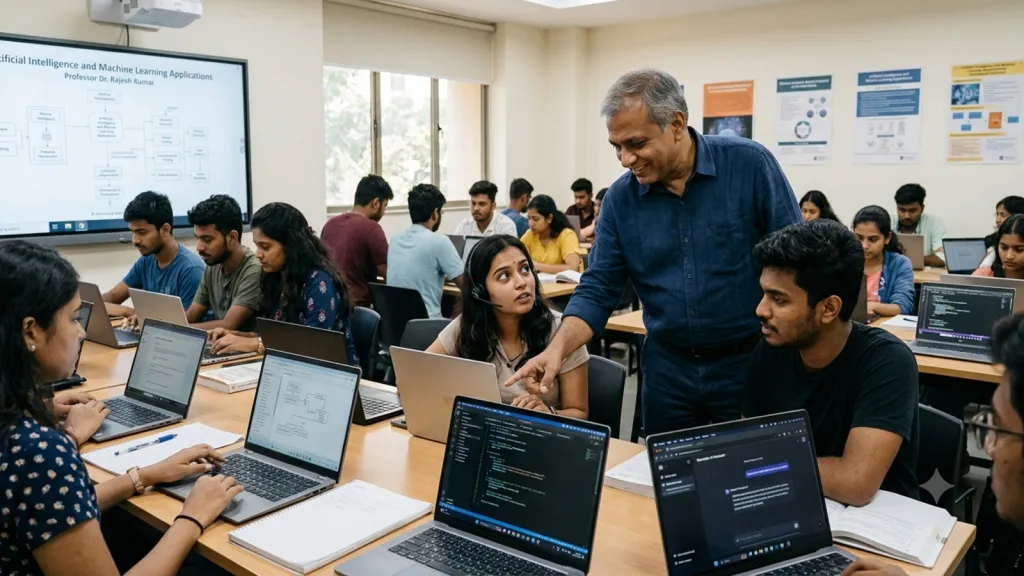
Artificial Intelligence (AI) is changing how students learn, complete assignments and prepare for examinations, prompting Higher Education institutions to rethink their academic policies. In India and abroad, universities and business schools are gradually moving away from blanket restrictions towards controlled AI use, with an emphasis on critical thinking, independent reasoning and responsible decision-making.
Institutions such as the Indian Institute of Science Education and Research (IISER) Pune, the Indian School of Business (ISB), the Indian Institute of management (IIM) Ahmedabad and IIM Bangalore are experimenting with different approaches. Some allow faculty members to decide when students can use generative AI, while others are testing AI-assisted assessments and tools designed to evaluate how effectively students apply what they have learned.
The shift does not mean students can simply outsource their learning to chatbots. Instead, institutions are trying to teach students how to use AI critically, verify its outputs, identify errors and retain the ability to solve problems independently.
IISER Pune: AI Allowed by Default, With Safeguards
IISER Pune has introduced a policy under which AI use is permitted by default unless a teacher or PhD supervisor explicitly prohibits it in writing. Introduced during the current semester, the policy gives faculty members the flexibility to decide whether generative AI should be encouraged or restricted, depending on a course’s learning objectives.
Professor Sutirth Dey, chairperson of IISER Pune’s AI Committee, said faculty members provide students with instructions about where AI can be used and where it should not be used.
The approach allows different courses to adopt different rules rather than following a single restriction across the institution. An assignment designed to develop research skills, for example, may benefit from AI assistance, while an examination intended to test a student’s unaided understanding may require independent work.
In one assignment, students were encouraged to use AI to develop a research project. In a bioinformatics course, students could use AI to write programmes for data analysis, but they were required to solve similar problems without AI during examinations.
The distinction is intended to separate programming ability from subject knowledge. Students can use AI to handle the coding component of an assignment while still demonstrating that they understand the underlying bioinformatics concepts when working independently.
However, AI is not permitted across all assessments. Most quizzes, mid-semester examinations and end-semester examinations at IISER Pune continue to be conducted without AI.
The policy therefore combines flexibility in coursework with restrictions where faculty members believe unaided performance is necessary to evaluate learning.
IIM Ahmedabad: Rethinking the Traditional Case-Study Method
At IIM Ahmedabad, the growing use of AI is prompting faculty members to reconsider how the traditional case-study method is taught and assessed.
Management students often work with lengthy business cases that require them to identify problems, analyse evidence and recommend solutions. AI tools such as ChatGPT and Gemini can help students summarise these cases and prepare preliminary analyses before classroom discussions.
However, the availability of similar AI tools also creates a challenge: students may increasingly produce similar answers, making it harder for faculty members to distinguish independent analysis from generic, AI-generated responses.
Professor Bharat Bhasker, director of IIM Ahmedabad, said the institute has changed its classroom approach, with many professors encouraging students to use AI tools to summarise cases and prepare for discussions.
The institute has purchased 1,500 licences for AI tools for students, faculty members, research associates and others. The initiative is intended to improve classroom participation while shifting the focus away from merely summarising information towards applying knowledge.
Under this approach, AI can help students prepare more efficiently, but the value of classroom learning increasingly lies in what they do with that information. Students still need to explain their reasoning, assess competing arguments and apply management concepts to complex situations.
Bhasker has emphasised that AI is also challenging faculty members to think beyond what has already been documented in a case study. The aim is to encourage deeper discussions and strengthen students’ ability to make decisions when there is no straightforward answer.
He has also stressed the continuing importance of human judgement in business, saying that critical financial decisions require a human mind. The approach reflects a broader effort to ensure that AI supports management education without replacing the judgement that future managers are expected to develop.
IIM Bangalore: Students Use Their Own Chatbots in Exams
IIM Bangalore has taken a different approach by allowing students to use AI in a controlled examination setting. Instead of simply asking students to answer questions with a general-purpose chatbot, the institute has experimented with students building and deploying their own chatbots.
According to a report by The Financial Express, during the June-July term, 78 MBA students from core Business Analytics and general MBA elective cohorts built and deployed their own chatbots to answer midterm questions on Generative AI.
Professor Subhabrata Majumdar developed a password-protected testing platform using AI-assisted coding tools. The chatbots were restricted to assigned course materials, preventing them from accessing external information.
This restriction was intended to keep the assessment focused on the material students had studied rather than their ability to obtain answers from outside sources. It also created a controlled environment in which students could demonstrate how they configured and used their AI systems.
Students were given a month to experiment with and evaluate different versions of their chatbots before submitting one for grading. The assessment focused on prompt engineering, parameter tuning and how effectively students applied course concepts.
The platform used a no-code retrieval-augmented generation workflow. This allowed students without coding backgrounds to participate without being disadvantaged by a requirement to build a system entirely through programming.
The experiment represents a different way of assessing learning in the AI era. Instead of treating AI only as a tool that students might misuse, the assessment makes students responsible for configuring a system, limiting its information sources and evaluating its performance.
ISB Hyderabad and Mohali: Faculty Decide Where AI Fits
The Indian School of Business has chosen not to impose a uniform, institution-wide restriction on AI use. Instead, individual faculty members can decide whether AI is permitted, restricted or prohibited in particular courses, assignments, group projects and research activities.
Professor Vishal Karungulam, academic director at ISB’s Centre for Learning and Teaching Excellence and LAB – Office of Experiential Learning, said the approach reflects the need to prepare students for workplaces where generative AI is becoming increasingly relevant while developing responsible use and critical judgement.
The policy allows instructors to match AI rules to the skills they want students to develop. An assignment designed to assess independent reasoning may restrict AI use, while another focused on applying technology to a business problem may permit students to use it as part of their work.
ISB faculty members are also experimenting with interactive AI simulations, personalised course tutors and AI-based companions modelled on business-case protagonists. These tools allow students to explore complex scenarios and ask questions without being handed ready-made answers.
Interactive simulations can give students opportunities to test different decisions and examine their consequences. Personalised tutors and AI companions can also support learning by helping students investigate particular concepts or perspectives.
The central objective is to use AI to encourage exploration rather than make it a substitute for learning. By allowing faculty members to determine where the technology fits, ISB is attempting to balance workplace preparation with academic standards.
Harvard: AI Policies Expand Across Courses
Universities outside India are also adjusting their teaching and assessment policies in response to the spread of generative AI.
An analysis by Harvard’s student newspaper, The Harvard Crimson, of 20 popular Harvard College courses found that nearly all had adopted policies regulating AI use by fall 2025. Before fall 2022, none of the courses examined had such policies.
A faculty survey reported by the newspaper highlighted the range of approaches being adopted. Among respondents, 34 per cent permitted AI use with strong restrictions, while 35 per cent allowed it with some restrictions.
Meanwhile, 24 per cent prohibited AI use entirely, up from 20 per cent the previous year. Only 4 per cent allowed unrestricted use, down from 8 per cent.
The findings illustrate how institutions are developing more specific rules rather than treating AI as either universally acceptable or universally prohibited. Restrictions can differ according to the purpose of an assignment, the skills being assessed and the expectations of individual courses.
Harvard has also introduced an AI module into its first-year Expository Writing course and developed a chatbot to advise incoming students on course planning. According to The Harvard Crimson, the university announced plans to provide access to Anthropic’s Claude while ending its institution-wide ChatGPT Edu pilot.
These developments show that AI is being incorporated into both academic learning and student support. At the same time, the spread of course-level policies reflects continuing efforts to define appropriate use and maintain academic standards.
University of Melbourne: Using AI While Protecting Academic Standards
The University of Melbourne is also piloting AI to support student learning while preserving meaningful interaction between students and teachers.
Professor Gregor Kennedy, deputy vice-chancellor for education, said the university was exploring how AI could support learning without undermining the role of educators.
The university is adapting assessments to verify that graduates have acquired the knowledge and skills required by their programmes. This approach places emphasis on demonstrating learning outcomes rather than relying solely on assignments that AI tools may be able to complete.
The university has also established a restriction on the use of generative AI by teaching staff for marking assessments and allocating grades. This separates the use of AI to support learning from its use in determining students’ academic results.
The Melbourne approach highlights another dimension of the debate: institutions must consider not only how students use AI but also how educators use it in teaching and assessment. Maintaining confidence in grading requires clear standards and processes that allow students’ performance to be evaluated appropriately.
Can AI Weaken Students’ Analytical and Critical-Thinking Skills?
One of the central questions facing universities is whether AI strengthens students’ ability to learn or encourages dependence on automated answers.
The Higher Education Policy Institute’s Student Generative AI Survey 2026 in the United Kingdom points to contrasting experiences. Some students report that AI frees up time for deeper learning and critical thinking, while others risk relying on it as a crutch.
These different experiences underline the importance of how AI is used. A student who uses AI to explore alternative explanations, identify gaps in an argument or test an initial idea may engage more deeply with a subject. A student who accepts an answer without checking it may miss the reasoning needed to understand the topic independently.
Higher education institutions therefore face the challenge of ensuring that AI enhances learning rather than diminishes it. Policies need to account for the benefits of assistance while preserving opportunities for students to demonstrate their own knowledge and judgement.
ISB is redesigning assignments to place greater emphasis on problem-framing, synthesis and decision-making rather than data compilation. Students are expected to test AI-generated suggestions against peer-reviewed research and established theoretical frameworks.
The school also uses in-person discussions and case defences to assess independent reasoning. Experiential learning and interactions with companies expose students to real-world problems in which they must navigate uncertainty and consider competing factors.
These methods make it harder for an assessment to rely solely on a polished written answer. Students must demonstrate that they understand the material, can defend their conclusions and know how to evaluate information generated by AI.
AI Is Changing Assignments and Grading
AI is influencing not only how students complete assignments but also how faculty members design and evaluate them.
At IISER Pune, Professor Sutirth Dey said that when students are explicitly permitted to use AI, faculty members can incorporate checks for errors produced by the technology. In one example, an assignment was graded partly on whether it contained hallucinated references.
AI-generated references can appear credible even when they are inaccurate or do not support the claims being made. Requiring students to identify and avoid such errors makes verification part of the assessment rather than treating AI output as inherently reliable.
Dey also explained that faculty members who permit AI-assisted coding in bioinformatics can set more complicated questions. They can focus on the scientific problem and students’ understanding of the subject rather than allowing programming difficulties to prevent them from attempting the task.
This approach changes the role of assessment. Instead of simply checking whether students can produce an answer, instructors can examine whether they understand the methods used, whether their results are reliable and whether they can explain the underlying concepts.
It also places greater responsibility on students to evaluate AI-generated material. Using the technology effectively requires more than producing a response: students must determine whether the output is accurate, relevant and appropriate for the problem they are solving.
Faculty Productivity and AI Literacy Remain Challenges
AI adoption is also raising questions about faculty productivity, institutional support and the training required to use the technology effectively.
A 2025 global survey by the Singapore-based Digital Education Council covered 1,681 faculty members across 52 higher education institutions in 28 countries. The survey found that 64 per cent expected AI to significantly change the role of instructors, while 86 per cent anticipated using AI in teaching in the future.
However, the survey also identified gaps in institutional readiness. Around 80 per cent of respondents reported a lack of clarity within their institutions about how AI could be applied in teaching. Only 6 per cent fully agreed that their institutions provided sufficient resources to develop faculty members’ AI literacy.
The findings suggest that interest in AI does not automatically translate into effective classroom use. Faculty members need guidance on how to select appropriate tools, design assessments and establish clear rules for students.
At ISB, faculty members reported productivity gains of 10-20 per cent on routine academic and administrative tasks across 37 pilot deployments spanning eight scenarios. These results indicate that AI may help reduce time spent on some repetitive activities, although the reported gains relate to the pilots described.
At IISER Pune, formal feedback on the impact of AI adoption was not yet available. Informal feedback suggested that students and faculty members were generally comfortable with the policy, with no adverse reactions reported so far.
The contrast highlights the importance of evaluating AI adoption over time. Institutions need to assess not only whether the technology saves time but also whether it improves learning, preserves academic standards and helps students develop the skills their courses are designed to teach.
What the Changing AI Rules Mean for Students
The approaches adopted by IISER Pune, IIM Ahmedabad, IIM Bangalore, ISB, Harvard and the University of Melbourne show that there is no single model for AI use in higher education.
Some institutions allow faculty members to set rules according to course objectives. Others are experimenting with controlled AI-assisted examinations, student-built chatbots, interactive simulations and redesigned assignments that test reasoning rather than information collection alone.
For students, the practical implication is that AI permission cannot be assumed to apply to every assignment or examination. The rules may differ between courses, instructors and assessment formats. Students must understand the specific instructions governing each task and comply with any restrictions.
When AI use is permitted, students may still be expected to verify references, assess the reliability of outputs, explain their reasoning and demonstrate that they understand the material. Producing a convincing answer is not necessarily sufficient if the assessment is designed to test independent judgement.
For faculty members, the challenge is to design assessments that reflect the skills students are expected to acquire. This may involve oral discussions, case defences, supervised examinations, controlled access to course materials or assignments that require students to evaluate AI-generated suggestions.
The broader shift is from asking whether AI should be allowed at all to determining when it can support learning and when students must demonstrate their abilities without assistance. As institutions continue to experiment, the central objective remains the same: preparing graduates to use emerging technology responsibly without losing the analytical, subject-specific and independent-thinking skills required in education and professional life.
For breaking news and live news updates, like us on Facebook or follow us on Twitter and Instagram. Read more on Latest Education on thefoxdaily.com.






COMMENTS 0