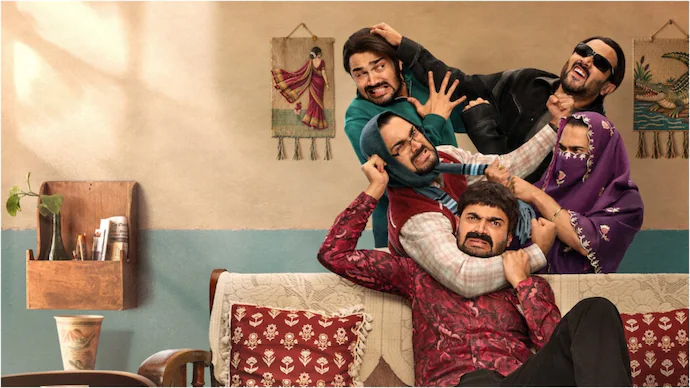
Creating a comedy series around a large ensemble is one challenge. Playing most of that ensemble while also writing the story is quite another. In Dhindora Season 2, Bhuvan Bam takes on both responsibilities, returning to a fictional world populated by eccentric relatives, unlikely friendships, romantic complications and people who seem to have a talent for turning ordinary situations into complete chaos.
The second season picks up after the lottery win that changed the fortunes of Bhuvan’s family. But sudden wealth does not necessarily bring clarity or happiness. Instead, it opens the door to another series of misunderstandings, questionable decisions and family disputes. As the characters move into a village filled with colourful personalities, the story expands into a larger comedy involving old relationships, social hierarchies and a rather unusual competition.
Across eight episodes, Bam plays nearly eight characters and also receives writing credits for the story and screenplay. The result is a show that feels unmistakably his, from its cheeky wordplay to its unpredictable comic detours. Not every joke works, and the narrative occasionally struggles to accommodate its many characters. Yet the combination of performance, humour and social commentary makes this a largely enjoyable return.
Dhindora Season 2 takes the family into a new village adventure
The story begins with the consequences of Bhuvan’s parents winning the lottery. After the unexpected windfall, the family is left to figure out what to do with the money. A dream sequence featuring Babloo and Janki offers a glimpse into the events surrounding the previous season, before Titu Mama becomes central to the new complications.
The family discovers that Janki has handed the money over to Titu, who has already managed to spend it. The development sets up another round of comic confusion, but the season’s story soon widens beyond the lottery episode.
After a gap of 15 years, Titu’s wife Kavita returns to the picture. Played by Sanjeeda Shaikh, she is pregnant and has gone back to her father’s home. The couple had eloped, leaving her father deeply unhappy with their decision. However, after he suffers a heart attack, Kavita decides to return and seek his forgiveness.
Her return brings the characters together in the same village, where family relationships become increasingly complicated. Kavita’s father, played by Kanwaljit Singh, is a deeply patriarchal man who believes strongly in family hierarchy and traditional expectations. With his daughter expecting a child, he is already hoping for a grandson, revealing the gender preferences that continue to shape his worldview.
The situation becomes even more entertaining when Vishdhar, played by Kabir Duhan Singh, enters the story. He is Titu’s friend and also the man who betrayed him by marrying Kavita. Their complicated history gives the show another source of rivalry, eventually leading to a competition with the deliberately provocative name BDSM, short for Bhojan Dabdaba Shakti Mukabla.
The premise captures the series’ willingness to mix family drama with absurd comedy. A seemingly ordinary village gathering can quickly become a competition involving exaggerated egos, old grudges and jokes that are designed to make viewers pause for a moment before recognising the double meaning.
Bhuvan Bam’s multiple characters remain the show’s biggest attraction
The most remarkable aspect of Dhindora Season 2 is the scale of Bam’s performance. Playing multiple roles is not new in comedy, but the challenge becomes greater when several characters belong to the same fictional world and may appear in scenes involving one another.
Bam plays Titu Mama, members of Bhuvan’s family and other characters who have their own personalities, speech patterns and comic rhythms. The performances are sufficiently distinct that viewers can usually follow who is speaking without constantly thinking about the actor behind the roles.
That separation is essential to making the comedy work. Each character needs a recognisable identity, especially when the same performer is responsible for creating their reactions and interactions. A difference in voice alone would not be enough. Their physical mannerisms, expressions and approach to humour also need to establish clear distinctions.
Bam handles this demanding exercise with impressive confidence. His familiarity with the characters helps the performances feel connected to the larger world rather than like unrelated comic sketches. The end credits, which reveal just how many roles carry his name, underline the extent of his involvement.
He is not simply the lead performer carrying the show. As its creator and writer, he also shapes the situations in which these characters find themselves. That level of creative control gives Dhindora a consistent comic identity, even when its storyline takes unexpected turns.
Cheeky wordplay and double entendres keep the comedy unpredictable
Dhindora has always relied on a particular kind of humour: deliberately silly, occasionally outrageous and often built around wordplay that can catch viewers off guard. The second season continues that approach without appearing particularly interested in making every joke respectable or predictable.
The BDSM competition is an obvious example of the show’s fondness for double meanings. The full form, Bhojan Dabdaba Shakti Mukabla, gives the title a connection to the village setting while inviting the kind of mischievous interpretation that Bam’s comedy frequently encourages.
There are also plenty of pop culture references and unexpected gags. The series takes playful shots at personalities such as Mukesh Khanna and Sunil Pal, while a joke about the film Naadaniyaan adds another layer of contemporary entertainment commentary.
Some of the humour comes from the village’s eccentric characters rather than from the central plot. A child obsessed with violent video games gets called Vanga, while someone is addressed as Sonu Sood because everybody wants to meet them. The references are deliberately random, reflecting the show’s preference for comic surprise over a tightly controlled narrative.
Even the setting contributes to the absurdity. A crocodile living in James Bond and a haunted house are among the unusual details that give the village an unpredictable character. There is rarely a shortage of things happening, although the constant stream of gags can sometimes make the series feel overcrowded.
Dhindora 2 addresses consent and caste discrimination through comedy
Underneath its deliberately chaotic humour, the series makes room for observations about social behaviour and inequality. Some of its strongest moments come when a joke exposes an uncomfortable assumption rather than simply delivering a punchline.
One exchange involving Kavita and Titu stands out. Kavita remarks that it is the first time someone has asked for her consent. Titu responds that he is not from Gurgaon. The line is delivered as a joke, but its meaning reaches beyond the immediate comic situation. It points towards the normalisation of behaviour in which women’s consent is not treated as an essential part of personal relationships.
The scene works because the humour does not completely hide the issue. Instead, it makes the audience recognise the uncomfortable reality behind the exchange. The show does not turn the moment into an extended lecture, allowing the dialogue to carry its social observation.
Caste discrimination also enters the narrative through the behaviour of upper-caste characters who refuse to sit and eat with people from lower castes. The continued practice of untouchability is presented as part of the village’s social environment, exposing how deeply unequal customs can shape everyday interactions.
These details add substance to a series that might otherwise have remained focused entirely on family misunderstandings and outrageous situations. The contrast between the characters’ comic behaviour and the serious social practices around them gives the story another dimension.
There is a balance to be maintained when comedy addresses subjects such as caste and consent. The joke should expose the prejudice or challenge the behaviour rather than make the affected person the target. Dhindora’s more pointed exchanges are effective when they direct attention towards the social assumptions that deserve scrutiny.
Sanjeeda Shaikh brings emotional depth to Kavita’s story
Sanjeeda Shaikh is a welcome addition to the ensemble as Kavita. Her character arrives with an emotional history that is more complicated than the show’s comic situations initially suggest. She has returned to her father’s home after years of separation, and her pregnancy adds another layer to the family dynamics.
Shaikh brings warmth and emotional weight to the role, helping the romantic track feel more substantial amid the surrounding madness. Kavita is not merely a new face introduced to create more comic misunderstandings. Her relationship with Titu and her attempt to reconnect with her father give her a meaningful place in the story.
The casting also gives the season an opportunity to explore a relationship that carries unresolved history. Titu and Kavita’s past is shaped by elopement, separation and betrayal, while Vishdhar’s presence complicates the equation further.
Kabir Duhan Singh makes an entertaining entrance as Vishdhar. His introduction is staged with the exaggerated grandeur associated with larger-than-life action heroes. Villagers speak about him with a mixture of fear and admiration, while explosions provide the dramatic background. The sequence is an amusing imitation of the kind of heroic entry often seen in mainstream commercial cinema.
The original music and romantic numbers provide another welcome change of pace. They break up the rapid succession of jokes and family confrontations, giving the characters some breathing room. The musical moments also help establish the emotional side of the story without completely abandoning the show’s comic identity.
Where Dhindora Season 2 loses momentum
For all its energy, the series is not without problems. Its greatest strength, the sheer number of characters and comic situations, also becomes a limitation. With so many subplots competing for attention, the central narrative occasionally loses focus.
Some scenes continue longer than necessary, and tighter editing could have improved the overall rhythm. The show frequently introduces a new gag, reference or eccentric character before the previous situation has fully settled. This creates a lively atmosphere, but it can also make the story feel overstuffed.
Not every joke lands, either. The series relies heavily on wordplay and pop culture references, which means some comic moments are more effective than others. When a gag depends on an unexpected interpretation, its success can vary depending on the viewer’s familiarity with the reference.
The eight episodes, each approximately 30 minutes long, make the season relatively easy to watch. Still, a shorter runtime does not automatically guarantee consistent pacing. A few sections could have been trimmed without losing the show’s eccentric personality.
There is also a learning curve for viewers who are unfamiliar with Bam’s YouTube universe. Dhindora is built around recurring characters and relationships, so newcomers may need time to understand the family connections, established personalities and running jokes. Some references are designed to reward long-time followers rather than introduce every character from scratch.
For existing fans, however, those callbacks are part of the appeal. Familiar faces and recurring character traits create a sense of continuity, making the new season feel like another chapter in an already established comic universe.
Is Dhindora 2 worth watching?
Dhindora Season 2 is best enjoyed by viewers who appreciate comedy that is loud, unpredictable and comfortable with being a little ridiculous. Its humour may not appeal to everyone, particularly those who prefer tightly structured storytelling or jokes that rely less on pop culture references and double entendres.
But the series has enough personality to make its return worthwhile. Bhuvan Bam’s ability to play multiple characters without making them feel interchangeable is an impressive achievement. His writing also gives the show room to move beyond familiar family comedy, bringing in observations about consent, caste discrimination and patriarchal expectations.
Sanjeeda Shaikh adds emotional depth, while the supporting performances and eccentric village setting keep the story lively. The music and romantic moments offer a useful counterpoint to the constant comedy.
The uneven pacing and crowded subplots prevent the season from becoming a consistently sharp piece of storytelling. Yet its occasional excess is also part of its identity. Dhindora 2 is chaotic, cheeky and sometimes too busy for its own good, but it remains entertaining more often than not.
Verdict: Bhuvan Bam is quite literally the one-man army behind Dhindora Season 2. Between his multiple performances, mischievous writing and the show’s willingness to mix absurd comedy with meaningful social observations, there is plenty for returning fans to enjoy. It may not get every joke or subplot right, but this madcap family entertainer makes for a fun return to Bam’s fictional universe.
For breaking news and live news updates, like us on Facebook or follow us on Twitter and Instagram. Read more on Latest Entertainment on thefoxdaily.com.




COMMENTS 0