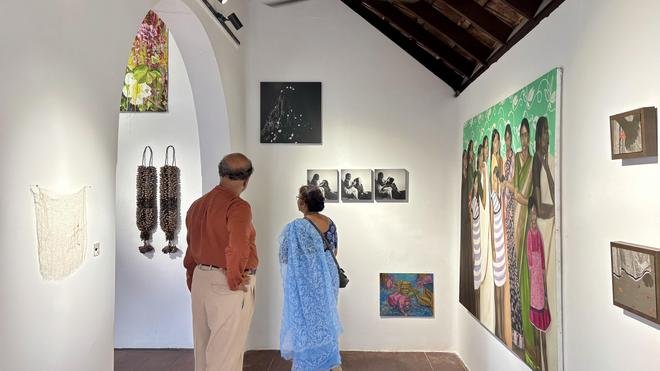
Flowers are usually associated with beauty, celebration and freshness. Yet in art, their meaning can be far more complex. A flower can represent the beginning of a relationship, the memory of someone who is gone, the fragility of life or the emotional wounds left behind by experience.
That wider idea is at the heart of the Flower Show art exhibition in Thiruvananthapuram, currently being presented at Neighbour Gallery. Bringing together works by 32 artists, the exhibition uses flowers as a recurring visual motif while opening a broader conversation about love, loss, pain, prejudice, memory and mortality.
Why flowers work so well as a subject in contemporary art
Few natural objects carry as many contrasting meanings as a flower. It can be delicate yet resilient, temporary yet culturally enduring, beautiful yet closely associated with death.
This ambiguity gives artists enormous creative freedom. A rose may suggest romance, while a fading petal can evoke ageing or loss. A garland can signify celebration in one context and mourning in another.
The Flower Show exhibition uses this symbolic flexibility to move beyond conventional floral imagery. The flower becomes a visual language through which artists can discuss emotions and experiences that are difficult to express directly.
From celebration to mourning: the flower’s double life
The most powerful aspect of floral symbolism is its connection with both beginnings and endings.
Flowers are commonly given during birthdays, weddings, anniversaries and celebrations. They can communicate affection when words feel insufficient.
But the same flowers can also appear at funerals. Wreaths and floral offerings mark grief, remembrance and farewell. The object does not fundamentally change; its meaning changes because the human situation around it changes.
This contrast provides an important entry point into the exhibition. Rather than presenting flowers as symbols with fixed definitions, the artists explore how context can transform the meaning of a familiar object.
Love becomes more than a romantic theme
Flowers are often visual shorthand for romance and affection. However, their emotional significance can extend far beyond romantic relationships.
Flowers can represent family connections, friendship, attachment to a place, childhood memories or the emotional relationship people maintain with someone who is no longer present.
A flower associated with a particular person or moment may acquire meaning that has little to do with its botanical characteristics. The Flower Show exhibition therefore offers an opportunity to look at flowers through the lens of relationships rather than decoration.
Loss and mortality are written into the life of a flower
A flower naturally carries a story of impermanence. It emerges, blooms, changes and eventually fades. That cycle makes it a simple but powerful metaphor for human mortality.
The exhibition’s exploration of loss becomes especially compelling when viewed through this natural cycle. A fresh flower and a fading flower may be physically similar, but emotionally they can communicate completely different experiences.
An artist does not necessarily need to depict grief literally. A damaged, disappearing or isolated flower can suggest absence and vulnerability through metaphor.
Memory: when an ordinary flower becomes personal
Flowers are frequently connected to specific occasions, places and people. Their fragrance can trigger memories unexpectedly, while images of flowers can preserve moments long after the actual plants have disappeared.
In this context, a flower can operate almost like an archive. It can hold traces of a relationship, a landscape, a childhood experience or a cultural ritual.
For an exhibition audience, this creates an unusual relationship between artist and viewer. The artist may begin with a flower, but the viewer may finish the interpretation with a completely different personal memory.
Flowers can also reveal social attitudes and prejudice
The exhibition moves beyond familiar themes such as beauty and romance by engaging with ideas including prejudice. This gives the floral motif a wider social dimension.
Nature does not assign social status to flowers, but people do. Certain flowers are considered luxurious, while others are regarded as ordinary. Some are associated with particular communities, rituals or occasions.
That difference between natural existence and human interpretation creates space for artists to examine how societies classify, value and judge.
A flower can therefore become a metaphor for people who are similarly categorised by appearance, background or social expectations.
The strength of a shared motif
Bringing together 32 artists around a common motif creates an interesting artistic challenge. If every artist presented flowers purely as decorative objects, the exhibition could quickly become repetitive.
The broader themes explored through the Flower Show exhibition point toward a different approach. The flower functions as a common starting point rather than a common conclusion.
One artist may approach flowers through intimacy, another through grief, while another may use the motif to question social attitudes. The subject remains recognisable, but its emotional and conceptual meaning can change from one artwork to another.
Why the Thiruvananthapuram setting matters
The Flower Show exhibition is being held at Neighbour Gallery in Thiruvananthapuram, placing the showcase within the city’s contemporary art environment.
Flowers already occupy an important place in Kerala’s cultural life. They are associated with festivals, rituals, religious practices, celebrations and family traditions.
That familiarity gives floral imagery an especially rich set of associations. A flower may be connected not only with nature but also with a particular ceremony, season, place or memory.
Contemporary artists can use this familiarity either to reinforce traditional meanings or to challenge them.
Decorative flowers versus flowers as contemporary art
| Decorative floral imagery | Flowers as an art motif |
|---|---|
| Focuses mainly on beauty and presentation | Can explore beauty alongside deeper ideas |
| Often has an immediate visual purpose | May require interpretation and reflection |
| Meaning is often linked to an occasion | Meaning can shift according to context |
| Flowers are primarily visual elements | Flowers can represent memory, loss, identity or change |
The hidden power of impermanence
Perhaps the strongest idea connecting the exhibition’s themes is impermanence.
Flowers do not remain in one state. A bud becomes a bloom, the bloom matures and eventually fades. That process mirrors many human experiences: relationships evolve, memories change, people leave and societies transform.
In a world increasingly dominated by digital images that can be preserved indefinitely, the physical fragility of flowers offers a striking contrast. A photograph can remain online for years, while the flower photographed may have disappeared within days.
This creates a fascinating tension between preservation and disappearance. Art can preserve an image of something that nature refuses to preserve permanently.
Why memory is especially powerful in floral art
Memory is rarely a perfect record. It is selective, emotional and often triggered by sensory details.
Flowers can activate memory through their appearance, colour, fragrance and association with particular occasions. Even an image of a flower can create a response that extends beyond the artwork itself.
This is one reason floral imagery can remain emotionally effective without relying on literal storytelling.
What visitors can take away from the exhibition
The most valuable outcome of a thematic exhibition is not necessarily learning one fixed message. It is learning to look differently.
Visitors may begin by noticing colour, shape and composition. But the themes explored by the artists can encourage deeper questions: Why is this flower here? What does it represent? Is it celebrating something, mourning something or remembering something?
These questions turn passive viewing into active interpretation.
They also demonstrate why art exhibitions can remain relevant even when their subjects are ordinary. The power does not always come from the rarity of the object. Sometimes it comes from changing the way we understand something we thought we already knew.
A broader lesson for contemporary art
The Flower Show exhibition illustrates how familiar objects can be used to discuss complex emotional and social realities.
Flowers are especially effective because they occupy an unusual position between nature and culture. They grow naturally, yet humans have surrounded them with rituals, meanings and expectations.
That makes them more than botanical subjects. They are cultural objects.
A bouquet can communicate affection without a written message. A garland can mark a celebration. A wreath can signal mourning. A flower placed beside a photograph can preserve a memory.
The same basic form can therefore participate in radically different human experiences, giving artists a powerful visual vocabulary for contemporary storytelling.
Conclusion: when a flower becomes a story
The Flower Show art exhibition in Thiruvananthapuram demonstrates that flowers can carry meanings far beyond decoration. At Neighbour Gallery, the motif becomes a pathway into questions of love, loss, pain, prejudice, memory and mortality, bringing together the perspectives of 32 artists.
Its most compelling idea is also its simplest: flowers are temporary, but what humans associate with them can endure.
A flower can mark a beginning, remember an ending or preserve an emotion that words cannot fully explain. By placing such a familiar subject at the centre of contemporary artistic inquiry, the exhibition encourages visitors to look beyond petals and colour and consider the stories people attach to them.
That is ultimately what makes Flower Show distinctive. It does not ask viewers merely to admire flowers. It asks them to think about why flowers matter and what they reveal about beauty, memory, relationships, change and loss.
For breaking news and live news updates, like us on Facebook or follow us on Twitter and Instagram. Read more on Latest Entertainment on thefoxdaily.com.


COMMENTS 0