Hyderabad’s relationship with art is changing. The city that once struggled to sustain a visible contemporary art ecosystem is now experimenting with galleries, public art, installations, performance, workshops, unconventional exhibition spaces and digital platforms.
The transformation is not simply about having more places to see paintings. It is about changing where art belongs and who gets to encounter it.
For decades, Hyderabad’s artistic identity was strongly connected to regional traditions, figurative painting and cultural narratives. Today, a younger generation of artists, curators, collectors and audiences is pushing those boundaries. Contemporary practices are entering cafés, neighbourhoods, public spaces and new gallery formats, while artists are simultaneously returning to local histories, Telugu culture and Telangana’s visual vocabulary for inspiration.
The result is an art scene caught between two productive forces: a desire to connect with the global contemporary art world and an equally strong interest in defining what makes Hyderabad and Telangana visually distinctive.
From an art-starved city to a growing creative ecosystem
It is difficult to imagine Hyderabad’s current creative ambitions without considering how limited its organised art ecosystem once was.
Artist Laxma Goud, now 86, has recalled that roughly five decades ago there was little art activity in the city and very few practising artists. That historical gap is important because it explains why Hyderabad’s present transformation cannot simply be described as a mature art market expanding.
It is, in many ways, an ecosystem being built almost layer by layer.
Artists need studios and audiences. Galleries need collectors. Collectors need confidence and access. Young artists need opportunities to exhibit. Audiences need reasons to enter galleries. Curators need spaces where experimental work can be presented. Institutions need sustained programming rather than occasional events.
Hyderabad’s challenge has therefore never been merely a shortage of artistic talent. The bigger question has been how to connect artists, spaces, audiences and markets into something sustainable.
The pioneers who helped shape Hyderabad’s visual identity
Hyderabad’s contemporary art story has not emerged from nowhere. Artists such as Pakala Tirumal Reddy, Laxma Goud, Surya Prakash, Thota Vaikuntam and Devraj Dakoji were among the figures who helped shape the city’s artistic vocabulary.
Their practices also demonstrate how strongly regional identity has influenced Hyderabad’s art.
Laxma Goud and Thota Vaikuntam, for example, developed visual languages deeply connected to the people, culture and landscapes of the region. Surya Prakash helped introduce abstract approaches to a city whose art culture was more strongly associated with figurative and traditional forms.
The story of a collaborative studio established by Laxma Goud, Surya Prakash and Devraj Dakoji in a Himayatnagar garage is particularly revealing. What began as an attempt to work collectively became part of a larger search for artistic independence and identity.
It illustrates an important truth about developing art scenes: infrastructure often begins with artists creating their own opportunities before formal institutions catch up.
Regional identity is becoming an advantage, not a limitation
One of the most interesting changes in Hyderabad’s art landscape is the changing perception of regional aesthetics.
For a long time, artists working outside India’s established metropolitan art centres could face the pressure to make their work legible to audiences elsewhere. Global contemporary art often came with its own vocabulary, references and expectations.
Hyderabad is increasingly finding a different balance.
Artists can engage with contemporary practices without abandoning local narratives. Telangana’s people, landscapes, histories, folklore, colours and cultural traditions can become sources for contemporary work rather than simply markers of regional identity.
This is significant because globalisation does not necessarily require artistic uniformity.
In fact, the opposite may be true. As international audiences become familiar with visual languages from different parts of India, distinct regional perspectives can become valuable precisely because they offer something that cannot be easily replicated elsewhere.
The Deccan legacy gives Hyderabad a distinctive foundation
Hyderabad’s artistic character is also inseparable from its Deccani cultural history.
The city has developed through layers of Telugu, Deccani, Islamic, Persian and other cultural influences. Its architecture, language, food, crafts and visual traditions reflect this historical complexity.
That layered identity provides contemporary artists with an unusually rich archive.
Instead of treating heritage as something frozen in museums, artists can reinterpret it through painting, sculpture, photography, installation, video and performance.
This creates a useful bridge between history and contemporary practice. The past becomes raw material rather than simply a subject of nostalgia.
Why Hyderabad’s art scene is moving beyond the gallery
Perhaps the biggest change is geographical.
Art is no longer confined to conventional gallery interiors.
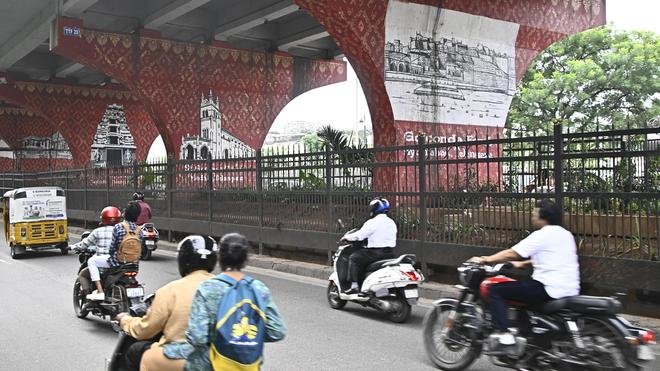
Public murals, installations, experimental exhibitions, café workshops, performance events and neighbourhood art projects are bringing visual culture into everyday environments. Public-art initiatives have also turned parts of the city into informal exhibition spaces.
This matters because traditional galleries can feel intimidating to people who have never visited one. A mural encountered while walking through a neighbourhood requires no invitation, ticket or prior knowledge.
It simply appears in everyday life.
That is one reason public art can be so effective at expanding an audience. It changes the question from “Why should I visit an art gallery?” to “Why is there art here?”
But visibility is not the same as engagement
There is an important distinction Hyderabad’s growing art scene will have to confront.
Putting art in public spaces makes it more visible. It does not automatically make audiences more engaged with it.
A person may photograph a mural, post it on social media and move on without knowing who created it or what it means.
That is where galleries and carefully curated exhibitions remain important. They can provide context, allow audiences to spend sustained time with artworks and create opportunities for conversations with artists and curators.
The future of Hyderabad’s art ecosystem may therefore depend less on choosing between galleries and public art and more on making the two systems complement each other.
Social media has changed the way Hyderabad discovers art
Social media has become another major force in this transformation.
An artist no longer has to depend entirely on a gallery to reach an audience. Instagram, digital portfolios, online exhibitions and visual storytelling can introduce artists to viewers, collectors and institutions far beyond Hyderabad.
This democratises visibility, particularly for emerging artists who may not yet have representation.
But there is a paradox.
The same platforms that make art easier to discover can also make it harder to experience deeply. Endless scrolling encourages rapid consumption, while serious art often demands patience.
A painting may take months to create but only seconds to scroll past.
That tension between digital visibility and physical engagement is likely to remain one of Hyderabad’s biggest challenges as its art ecosystem expands.
A younger audience is changing the gallery experience
There are signs, however, that Hyderabad’s audience is changing.
Recent gallery activity suggests that students, young professionals and first-time visitors are increasingly treating art spaces as destinations rather than specialised places meant only for collectors.
This is an important cultural shift.
When a gallery becomes part of a weekend itinerary alongside cafés, restaurants, cinemas and cultural events, art becomes less intimidating. The visitor does not need to arrive as an expert. Curiosity becomes enough.
That could prove more important for Hyderabad’s long-term art ecosystem than simply increasing the number of exhibitions.
New spaces are trying to build the ecosystem from the ground up
Several initiatives illustrate this broader change.
Dhi Contemporary, for example, positions itself around young and emerging artists and combines exhibitions with performances, film screenings and site-specific projects. Its stated aim includes connecting Hyderabad audiences with changing global contemporary-art practices.
EkChitra has also recently opened a permanent space in Madhapur after years of working through unconventional locations. Its approach connects contemporary art with Hyderabad’s histories, literature, cinema, poetry and emerging voices.
Meanwhile, newer platforms such as HYD.ART are combining exhibitions, artist programmes, collector engagement and digital access in an effort to connect Hyderabad more closely with India’s wider contemporary art market.
These developments suggest that the city is no longer waiting for one major institution to define its art identity. Instead, multiple smaller and mid-sized initiatives are creating pieces of the ecosystem themselves.
Hyderabad’s art economy is growing alongside its cultural confidence
An art ecosystem cannot survive on exhibitions alone. It also requires collectors, buyers, institutions and people willing to invest in artists over the long term.
Hyderabad’s expanding business and technology economy provides a potentially important audience for contemporary art.
The city has a large community of entrepreneurs, professionals and high-income residents who are increasingly exposed to global cultural experiences. As their interest in design, architecture, travel and culture grows, art can become part of the same lifestyle ecosystem.
But the emergence of collectors should not be confused with the development of a mature art culture.
A healthy ecosystem needs people who buy art, but it also needs people who write about it, curate it, teach it, research it and simply spend time looking at it.
The real test: can Hyderabad create sustained attention?
This may be the most important question facing the city’s art scene.
Hyderabad has demonstrated that it can generate activity. The next challenge is turning activity into continuity.
A successful exhibition should not be an isolated event. It should lead to conversations, new collaborations, future exhibitions and stronger relationships between artists and audiences.
Similarly, a public mural should ideally become part of a larger conversation about the neighbourhood, its history or its people rather than functioning only as beautification.
And a digital platform should ideally lead viewers towards deeper engagement rather than simply generating another scrollable image.
Hyderabad compared with established Indian art centres
| Established art centres | Hyderabad’s emerging model |
|---|---|
| Long-established gallery networks | Growing network of galleries and independent platforms |
| Deep collector and institutional ecosystems | Expanding collector base and cultural audience |
| Strong national and international visibility | Increasing national visibility with global ambitions |
| Large concentration of established art institutions | Mix of galleries, public projects, independent spaces and digital platforms |
| More mature art-market infrastructure | Developing infrastructure with room for experimentation |
The comparison suggests that Hyderabad does not necessarily need to imitate Mumbai or Delhi. Its opportunity may lie in developing a model suited to its own cultural and economic character.
The opportunity hiding in Hyderabad’s regional identity
Hyderabad’s greatest artistic opportunity may be the very thing that once appeared to set it apart from the country’s dominant art centres: its regional character.
The visual language of Telangana, the stories of the Deccan, local crafts, urban transformation and the contrasts between old Hyderabad and its rapidly expanding technology corridors can provide contemporary artists with an enormous field of subjects.
The city itself is undergoing dramatic change. Historic neighbourhoods coexist with high-rise developments, technology campuses and new commercial districts. Traditional cultural practices exist alongside global lifestyles.
That tension is fertile territory for artists.
The Hyderabad of tomorrow will not look exactly like the Hyderabad of the past, and contemporary art can become one of the ways the city records that transformation.
Prediction: Hyderabad’s next art boom may happen outside traditional art districts
If the current trajectory continues, Hyderabad’s art ecosystem is likely to become increasingly decentralised.
Instead of depending entirely on a small cluster of conventional galleries, artistic activity may spread through cafés, cultural centres, studios, public spaces, design communities, educational institutions and mixed-use creative venues.
The result could be an art culture that is less formal but more visible in everyday life.
However, decentralisation will only strengthen the ecosystem if it is accompanied by stronger documentation, critical writing, curatorial practice and opportunities for sustained interaction with artists.
Otherwise, Hyderabad risks producing plenty of art activity without building the deeper cultural infrastructure needed to preserve and understand it.
What Hyderabad still needs
The city’s progress is real, but several gaps remain.
- More sustained exhibition programmes: Artists need regular opportunities rather than occasional showcases.
- Stronger art criticism: A growing scene needs serious writing, discussion and documentation.
- Better public engagement: Exhibitions need programmes that help first-time audiences understand contemporary art.
- More artist residencies: Long-term support can give emerging artists time and space to develop ambitious work.
- Greater collector education: New collectors need opportunities to understand artistic practices rather than treating art purely as décor or investment.
- Better links between local and global networks: Hyderabad can benefit from international exposure while retaining its regional voice.
The city is learning to see itself differently
Perhaps the most important development is not the number of galleries or exhibitions but the changing confidence of the city itself.
Hyderabad no longer has to choose between being regional and being contemporary. Its artists can work with global ideas while drawing deeply from local experience.
That combination could become the city’s strongest artistic identity.
The future Hyderabad art scene may not be defined by one famous gallery, one institution or one artistic movement. Instead, it could emerge through a network of artists, independent spaces, collectors, public projects, digital platforms and increasingly curious audiences.
Conclusion: Hyderabad is building an art ecosystem in its own image
Hyderabad’s art scene is finding new ways to make itself seen because the city is gradually redefining what an art ecosystem can look like.
From the pioneering efforts of earlier generations to today’s experimental galleries, public art projects and digital platforms, the transformation has been gradual rather than sudden. The city is building infrastructure while simultaneously discovering its artistic identity.
The most promising part of that journey is the balance between regional identity and global engagement. Hyderabad does not need to erase its history to become contemporary. Its Deccani heritage, Telangana narratives and local visual traditions can become the foundation for a distinctly modern artistic language.
The bigger challenge now is to turn visibility into lasting engagement.
If Hyderabad can build stronger connections between artists, audiences, galleries, collectors, institutions and public spaces, its art scene could move beyond being an emerging cultural story and become one of India’s most distinctive contemporary art ecosystems.
For a city that once had relatively few places for art to be seen, that would be a remarkable transformation.
For breaking news and live news updates, like us on Facebook or follow us on Twitter and Instagram. Read more on Latest Entertainment on thefoxdaily.com.



COMMENTS 0