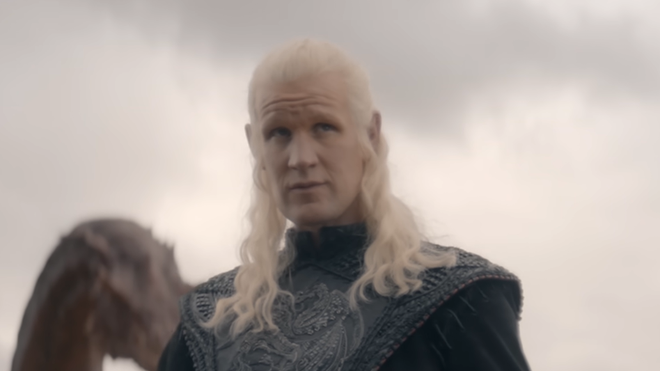
This House of the Dragon Season 3 review finds a season that understands one of the franchise’s most important lessons: in Westeros, winning a battle rarely means winning the war. The First Battle of Tumbleton finally brings the kind of large-scale dragon warfare the series has been building toward, but its real strength lies in what happens around the spectacle. Matt Smith and Emma D’Arcy give the season’s central conflict an increasingly tragic emotional dimension, while the political consequences of the battle push the Dance of the Dragons toward a future that looks considerably darker than either side wants to admit.
Based on George R.R. Martin’s Fire & Blood, HBO’s House of the Dragon continues to explore the civil war between rival branches of House Targaryen. Season 3 enters a particularly dangerous stage of that conflict, where armies, dragons, shifting loyalties and personal grief begin colliding with frightening speed.
The First Battle of Tumbleton is therefore more than a major action sequence. It represents a turning point. The war is no longer something that can be contained by royal decrees, family negotiations or carefully calculated military movements. Dragons have become weapons of mass destruction, and once they are unleashed, even the people who believe they control them can lose control of the consequences.
House of the Dragon Season 3: What happens?
At its core, Season 3 continues the brutal struggle for the Iron Throne between the Greens and the Blacks. But the conflict has evolved considerably from the political maneuvering that dominated the early episodes of the series.
By this stage, the characters have endured enough loss that the war has become deeply personal. Every military decision carries emotional baggage, and every death creates another reason for revenge.
The First Battle of Tumbleton captures this escalation particularly well. What initially resembles another strategic confrontation quickly becomes something much more chaotic. Armies collide, loyalties fracture and dragons transform the battlefield from a conventional medieval conflict into something almost apocalyptic.
That escalation is important because House of the Dragon has always been more interested in the consequences of power than in power itself. The series does not simply ask who deserves the throne. It asks what people are willing to destroy in order to possess it.
The First Battle of Tumbleton is the season’s major spectacle
For viewers who have been waiting for the Dance of the Dragons to become an enormous visual spectacle, the First Battle of Tumbleton delivers.
The battle works because the dragons are not treated merely as oversized fantasy weapons. Their presence fundamentally changes the logic of warfare.
A conventional army can defend a position, establish formations and retreat when necessary. A dragon can erase those assumptions almost instantly. Its arrival changes the battlefield’s geography, the soldiers’ psychology and the calculation of every commander involved.
The result is a battle that feels less like a traditional medieval siege and more like the sudden arrival of an uncontrollable natural disaster.
That is exactly where House of the Dragon differs from many fantasy blockbusters. The dragons may be spectacular, but the series consistently tries to make their power frightening rather than merely cool.
Why Tumbleton matters beyond the action
The smartest aspect of the Tumbleton storyline is that the battle is not presented as an isolated set piece.
Its significance extends beyond who wins and who loses on the day.
The battle demonstrates how fragile political authority has become. Once a kingdom is divided by competing claims to legitimacy, local populations and military forces can begin interpreting events according to their own interests.
This creates a dangerous feedback loop. The crown needs armies to maintain authority. Armies need commanders. Commanders need loyalty. But loyalty becomes increasingly difficult to guarantee when everyone believes the political order may collapse.
Tumbleton therefore becomes a miniature version of the larger civil war: a conflict that begins with competing claims to legitimate rule and gradually turns into a struggle in which survival itself becomes the objective.
Matt Smith remains one of the show’s strongest weapons
Matt Smith continues to give Daemon Targaryen an unpredictable energy that makes every scene involving him feel potentially dangerous.
Daemon is fascinating because he is never simply heroic or villainous. He can be courageous, selfish, loyal, cruel, intelligent and reckless, sometimes within the same sequence.
That ambiguity becomes more valuable as the war progresses. The longer Daemon remains surrounded by violence, the harder it becomes to separate his personal ambitions from the political cause he claims to serve.
Smith understands that Daemon does not need to announce his emotions. A glance, hesitation or sudden change in tone can suggest more than an extended speech.
That restraint gives the character an increasingly haunted quality.
Earlier versions of Daemon could dominate a scene through swagger. The later character is more interesting because the swagger is beginning to look like armor.
Emma D’Arcy brings devastating restraint to Rhaenyra
Emma D’Arcy’s performance as Rhaenyra remains the emotional center of the series.
Rhaenyra’s tragedy is that she has spent much of her life believing that claiming the throne would prove something about her worth, legitimacy and ability to rule. Yet the war repeatedly demonstrates that possessing a claim and successfully exercising power are two very different things.
D’Arcy plays that contradiction without turning Rhaenyra into a conventional tragic heroine.
There is still determination in her. There is still political calculation. But there is also exhaustion.
As the consequences of the civil war accumulate, Rhaenyra increasingly resembles someone attempting to hold together a collapsing structure with whatever remains available.
That emotional deterioration makes the character more compelling than a simple quest-for-the-throne narrative would have allowed.
Daemon and Rhaenyra: The emotional core of the season
The relationship between Daemon and Rhaenyra has always been complicated by politics, family history and ambition. Season 3 pushes that complexity further.
They are united by blood, marriage and political necessity, but they do not necessarily experience the war in the same way.
Rhaenyra is increasingly forced to think about legitimacy, governance and the consequences of her decisions. Daemon is more naturally drawn toward direct action.
That difference creates tension even when they are technically fighting on the same side.
The tragedy is that the war has made compromise increasingly difficult. By the time characters begin considering reconciliation, they have already lost too much to trust that reconciliation will last.
This is one of the show’s strongest recurring themes: violence does not simply remove people from the board. It changes the people who remain.
The tragedy of the Dance of the Dragons
The phrase “Dance of the Dragons” sounds almost romantic. The reality is anything but.
The series has gradually stripped away the fantasy glamour surrounding the Targaryen dynasty and replaced it with something closer to political horror.
Dragons once represented the extraordinary power of House Targaryen. During the civil war, that power becomes the mechanism through which the dynasty destroys itself.
This is the central irony of the entire story.
The Targaryens possess the most powerful weapons in Westeros, yet their greatest threat comes from within their own family.
That makes the war more tragic than a conventional battle between good and evil. Both sides contain people who believe they are defending legitimate principles. Both sides commit actions that make future peace more difficult. And both sides increasingly become victims of the machinery they helped create.
How Season 3 builds on the earlier seasons
| Season | Primary dramatic focus | How it leads to Season 3 |
|---|---|---|
| Season 1 | Family, succession, marriage and the origins of the Targaryen succession crisis | Establishes the personal relationships and political divisions behind the civil war |
| Season 2 | Escalation of the Dance and increasing military confrontation | Turns political rivalry into open warfare |
| Season 3 | Consequences, major battles and the collapse of political control | Shows how difficult it becomes to stop a war once violence has become self-sustaining |
This progression is important because House of the Dragon is fundamentally a story about escalation.
Season 1 asks who should rule. Season 2 asks how that claim will be defended. Season 3 increasingly asks what remains after the mechanisms used to defend the claim begin destroying the kingdom itself.
The political story is just as important as the dragons
One potential weakness of a season built around major battles is that spectacle can overwhelm politics. Fortunately, House of the Dragon remains interested in the machinery behind the violence.
Armies do not move simply because a character wants them to. Political decisions have consequences, rumors spread, alliances shift and ordinary people become increasingly important to the stability of the realm.
This is where the series retains the DNA of Game of Thrones while establishing its own identity.
The original series often focused on a sprawling collection of families and competing kingdoms. House of the Dragon narrows the lens. Its central conflict is essentially a family argument that has become a national catastrophe.
That intimacy makes the consequences more uncomfortable.
What makes the First Battle of Tumbleton different from earlier battles
The series has already shown that dragon combat can be devastating. What makes Tumbleton different is the sense that the conflict has reached a stage where conventional political expectations no longer apply.
Earlier battles could still be interpreted through strategy. Tumbleton increasingly feels like the result of systems breaking down.
That distinction gives the episode its tragic energy.
The audience is not simply watching soldiers fight. It is watching a political order lose the ability to determine what happens next.
Once that happens, victory itself becomes unstable.
The human cost behind the spectacle
The show’s most effective scenes are often those that remind viewers that battles are experienced differently depending on where a person stands.
For monarchs, a battle can be a strategic calculation. For commanders, it can be a test of leadership. For soldiers, it is survival. For civilians, it can mean the destruction of homes, communities and any sense of safety.
House of the Dragon increasingly emphasizes that gap.
It is one reason the dragons remain frightening. Their scale creates a distance between the people who deploy them and the people who suffer their consequences.
That is a familiar idea in political storytelling: those who possess enormous power are rarely the same people who experience its full cost.
Why the performances matter more than the spectacle
Visual effects can create a spectacular dragon battle, but they cannot create emotional consequences by themselves.
That is why Smith and D’Arcy remain so important to the show’s success.
Without the characters’ emotional investment, Tumbleton would simply be an expensive action sequence. With it, the battle becomes another step toward an ending that viewers already understand will be painful.
That sense of inevitability is one of House of the Dragon‘s greatest strengths.
The audience knows this is a story about a dynasty tearing itself apart. The question is not whether the consequences will be severe. It is how severe they will become and who will survive them.
The show’s biggest strength: tragedy without easy heroes
Fantasy television often depends on clear heroes and villains. House of the Dragon deliberately complicates that structure.
The Greens and Blacks both contain characters capable of compassion and cruelty. Political legitimacy is disputed from multiple perspectives. Personal relationships constantly interfere with strategic decisions.
That ambiguity makes the tragedy more effective.
If one side were completely righteous, the war would become a conventional struggle for justice. Instead, the series suggests that a political system capable of producing this conflict is itself part of the problem.
The characters are trapped inside a culture that treats succession, masculinity, bloodline and power as existential questions.
They are not simply fighting over a chair.
They are fighting over the meaning of their entire dynasty.
Where Season 3 may divide viewers
The increasing scale of the conflict may not satisfy viewers who preferred the intimate political intrigue of the first season.
There is also a risk inherent in expanding the story’s battlefield focus: when major events happen in rapid succession, individual losses can become difficult to process.
That is both a storytelling challenge and a deliberate reflection of war.
Still, the season works best when it pauses after the spectacle and allows characters to confront what has happened. Those quieter moments prevent the dragons from becoming visual attractions disconnected from the emotional story.
House of the Dragon Season 3 compared with Game of Thrones
| Element | House of the Dragon | Game of Thrones |
|---|---|---|
| Central conflict | Targaryen civil war | Multiple competing claims for political power |
| Primary scale | A concentrated family conflict expanding into civil war | A sprawling continental struggle |
| Role of dragons | Central military and political weapons | Initially rare, later increasingly important |
| Core tragedy | A powerful dynasty destroying itself from within | Political fragmentation and the collapse of competing powers |
| Emotional emphasis | Family, inheritance, grief and legitimacy | Survival, loyalty, ambition and political identity |
The comparison highlights why House of the Dragon should not be judged simply as another version of Game of Thrones. Its narrower family focus gives the story a different kind of tragedy.
What works best in House of the Dragon Season 3
- Matt Smith’s performance: Daemon remains unpredictable, charismatic and increasingly haunted by the consequences of his choices.
- Emma D’Arcy’s Rhaenyra: The performance captures the exhaustion and determination of a ruler struggling to maintain control.
- The First Battle of Tumbleton: The battle provides spectacle while advancing the political and emotional story.
- The dragon warfare: The creatures remain terrifying because the series understands their destructive scale.
- The political consequences: Military victories rarely solve the underlying succession crisis.
- The tragic structure: The season understands that the most powerful characters can still be powerless against the consequences of their own decisions.
What the season is really saying about power
Underneath the dragons, crowns and armies, House of the Dragon remains a story about the illusion of control.
The Targaryens believe that dragons make them different from ordinary rulers. In one sense, they are correct. Dragons give them extraordinary military power.
But extraordinary power does not guarantee political stability.
In fact, it can make instability more destructive.
When two factions possess weapons capable of devastating entire armies, compromise becomes more difficult because every side believes it has the ability to win outright.
That is the cruel paradox of the Dance of the Dragons. The very power that should make the Targaryens impossible to challenge becomes the instrument through which they weaken themselves.
Why the finale feels tragic rather than triumphant
The promise of a traditional fantasy finale is usually victory. The heroes defeat the enemy, the kingdom survives and the audience receives emotional closure.
House of the Dragon has never operated according to that formula.
Its victories are usually temporary. Its triumphs contain the seeds of later disasters. A character can win a battle and still lose the larger war. A political victory can destroy a relationship. A dragon can save an army while making peace impossible.
That is why the season’s finale feels more poignant than celebratory.
The First Battle of Tumbleton delivers the promised spectacle, but the larger story keeps pointing toward consequences that cannot be avoided simply because one faction has gained an advantage.
Final verdict: A thrilling chapter in a war that was never going to end well
This House of the Dragon Season 3 review concludes that the season succeeds when it treats spectacle as a consequence of character rather than a replacement for character.
The First Battle of Tumbleton is a major visual achievement, but the dragons are not what ultimately make the story compelling. The emotional performances of Matt Smith and Emma D’Arcy give the conflict its human center, while the political fallout makes every victory feel temporary.
Season 3 also deepens the show’s central irony. The Targaryens possess creatures capable of changing the balance of power across Westeros, yet they remain trapped by the oldest weaknesses of human politics: pride, fear, ambition, grief and the desire to control what cannot be controlled.
That is what makes the season’s tragedy work.
Verdict: House of the Dragon Season 3 is a gripping blend of political tragedy, character drama and dragon-fueled spectacle. Matt Smith and Emma D’Arcy provide the emotional firepower, while the First Battle of Tumbleton delivers the blockbuster scale. But the real achievement is darker: the series makes every victory feel like another step toward an ending where nobody can truly win.
What comes next for House of the Dragon?
The direction established by Season 3 suggests that the remaining story can only become more emotionally and politically destructive. As the Dance of the Dragons continues, the question will increasingly shift from who can claim the Iron Throne to whether the Targaryen dynasty can survive the consequences of its own civil war.
That is a particularly strong foundation for the story’s final movement. The audience has already seen how quickly political disagreements can become military conflict. The next challenge is watching what remains after that conflict has consumed the people, relationships and institutions that once gave the Targaryen dynasty its power.
In Westeros, the throne has always promised control. House of the Dragon continues to make the more devastating argument: sometimes the pursuit of power is precisely what makes control impossible.
For breaking news and live news updates, like us on Facebook or follow us on Twitter and Instagram. Read more on Latest Entertainment on thefoxdaily.com.

COMMENTS 0