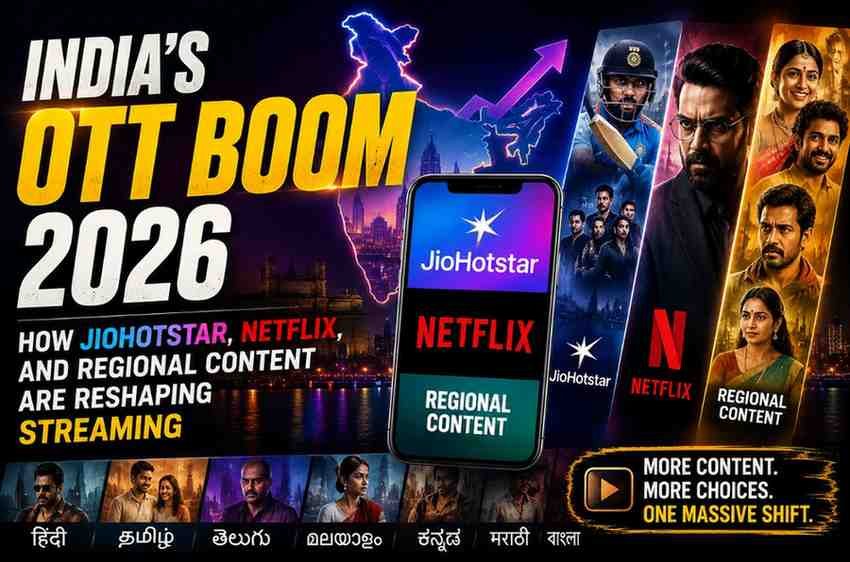
India’s Streaming story began with a data revolution and is now racing toward a content arms race with no clear finish line. In 2026, the country that went from prohibitively expensive mobile internet to half a billion OTT viewers in under a decade is now the most fiercely contested streaming battleground on the planet. OTT revenues in India are projected to reach ₹21,032 crore approximately $2.55 billion by 2026, growing at a 14.1 percent CAGR according to the EY FICCI report. The platforms fighting for that revenue are spending hundreds of millions on content, slashing prices, forming merger alliances, and betting heavily on one strategic insight that is reshaping everything: India does not watch in one language, and any platform that thinks it does will lose.
Who are the key players? JioHotstar, Netflix, Amazon Prime Video, ZEE5, SonyLIV, and a rising tier of regional-first platforms all competing for the attention of 601 million OTT users. What changed in 2025 and 2026? The merger of JioCinema and Disney+ Hotstar created a single behemoth, Netflix cracked the India code with curated content, and regional languages officially overtook Hindi as the primary driver of paid subscriptions. When did India’s streaming market stop being a promising frontier and start being a proven battlefield? The answer is right now. Where is the money flowing? Into Tamil, Telugu, Kannada, Malayalam, Bengali and increasingly into the living rooms of smaller cities and towns through connected television. Why does all of this matter beyond entertainment? Because India’s OTT explosion is reshaping advertising, cinema, telecom bundling, and the global content industry simultaneously.
To understand the OTT war of 2026, you have to understand what happened in 2016. Before Reliance Jio launched its affordable mobile data network, video streaming on a smartphone was a luxury most Indians could not economically justify. Mobile data was expensive, internet speeds were inconsistent, and the concept of paying a monthly subscription for entertainment was alien to a population accustomed to free-to-air television and piracy.
Jio changed all of that in one move. By offering dramatically cheaper data plans at scale, it effectively granted hundreds of millions of Indians their first practical access to video streaming. The downstream effect was not gradual it was a flood. Platforms that had been carefully building small subscriber bases suddenly found themselves deluged with new users who had smartphones, affordable data, and hours of daily commute time to fill.
By 2024, India had crossed 50 million paid OTT subscriptions across major platforms a figure that significantly understates actual viewership, given that family sharing routinely means five to eight viewers per subscription. By 2026, total OTT audiences in India have reached approximately 601 million, with projections suggesting the user base will cross 549 million individual subscribers by year end. The platform that best positioned itself to capture this audience was, predictably, the one that helped create it.
The most significant structural event in Indian OTT history occurred on February 14, 2025, when JioCinema and Disney+ Hotstar formally merged under Reliance Industries’ JioStar venture to create JioHotstar. The merger united what had been the two most powerful content libraries in Indian streaming Disney’s global catalogue (Marvel, Star Wars, Pixar), Star India’s vast Hindi and regional entertainment archive, Viacom18’s originals, and, most critically, the IPL cricket rights under a single platform and a single corporate owner.
The numbers that resulted from this consolidation are staggering. JioHotstar now claims over 300 million paid subscribers, a figure that dwarfs every other streaming platform in the country. Amazon Prime Video India sits at approximately 65 million subscribers, bolstered by its longstanding strategy of bundling streaming with Prime’s delivery and shopping membership. Netflix India, despite years of slower Indian growth, has reached roughly 20 million subscribers but is growing faster than any rival gaining four percentage points of market share in a single quarter in early 2026.
| Platform | Subscribers (2026 Est.) | Market Share Q1 2026 | Key Content Strength | Strategic Edge |
|---|---|---|---|---|
| JioHotstar | 300 million+ | Dominant by volume | IPL/cricket, Disney content, regional originals | Telecom bundling with Jio; widest reach |
| Amazon Prime Video | ~65 million | 23% (Q1 2026) | Hindi originals, multilingual films, global titles | Prime ecosystem bundling, aggressive pricing |
| Netflix India | ~20 million | 22% (Q1 2026) | Curated originals, prestige content, South Indian films | Brand cachet, quality-over-quantity curation |
| ZEE5 | Significant regional base | Growing | Regional language originals across 12+ languages | Deepest regional-language catalogue |
| SonyLIV | Substantial | Stable | Sports, reality TV, Hindi originals | Exclusive cricket series, premium drama |
| MX Player | Massive free-tier base | AVOD leader | 150+ original shows, ad-supported free content | Zero-cost entry point, Tier 2 and 3 city reach |
What these subscriber numbers obscure is more interesting than what they reveal. As of Q1 2026, Prime Video leads India’s streaming market share at 23 percent, with Netflix just one percentage point behind at 22 percent a gap so narrow that a single quarter of strong content performance could flip the ranking. The Indian market is bifurcating: JioHotstar commands volume, but Netflix is quietly setting the terms of the premium tier.
The Regional Language Revolution: Hindi Is No Longer King
If there is a single trend that defines Indian OTT in 2026, it is the irreversible rise of non-Hindi content. In December 2025, ZEE5 reported that regional languages outside Hindi now account for more than 50 percent of India’s paid OTT subscriptions. The language barrier in Indian streaming, long cited as a structural challenge for the market’s growth, has effectively collapsed.
The catalyst was not a platform decision it was an audience one. The global success of South Indian cinema over the past five years, led by blockbusters that outperformed Bollywood both domestically and internationally, demonstrated conclusively that Tamil, Telugu, Kannada, and Malayalam content had audience scale that the industry had dramatically underestimated. Streaming platforms that had treated regional language content as a niche add-on were forced to recognize that they had the priority hierarchy precisely backwards.
JioHotstar responded with the most aggressive bet in the market. The platform committed $444 million over five years to acquire and produce premium South Indian content a figure that rivals the content budgets of mid-sized global streaming services. The investment is explicitly designed to move beyond film licensing and into building long-term original franchises in Tamil, Telugu, Malayalam, and Kannada. Netflix has simultaneously acknowledged the strategic imperative of regional investment, acquiring major South Indian titles and commissioning multilingual originals. Amazon Prime Video is producing large-scale multilingual content as standard practice rather than exception.
Investments in regional content across the industry are expected to exceed ₹5,000 crore annually by 2028. The audience data justifies every rupee: over 50 percent of Indian OTT viewership now comes from non-Hindi content, and that proportion is still growing.
India’s OTT story has been almost entirely told as a mobile phenomenon and for good reason, given that smartphones remain the primary viewing device for the vast majority of Indian streamers. But 2025 introduced a subplot that could reshape the market’s economics significantly: the explosion of Connected Television.
CTV penetration in India grew by 85 percent in 2025, reaching over 129 million users across 45 million households. Twenty one percent of India’s 601 million OTT audience now uses a connected television to stream content, up from just 13 percent in 2024. More surprisingly, over 55 percent of CTV viewers come from towns with populations under one million not the metros and major cities that conventional wisdom assumed would lead the adoption curve.
Why does this matter? Because CTV viewers watch differently from mobile viewers. Sessions are longer, household viewing is collective rather than individual, and advertising formats are more premium. Addressable advertising on CTV in India is expected to exceed 16 percent of total television advertising revenues by 2026. For platforms looking to build sustainable revenue beyond subscription fees, CTV represents a significant and rapidly scaling opportunity.
The OTT industry globally has spent the past three years grappling with what analysts politely call “subscription fatigue” the point at which consumers, confronted with monthly bills from four or five streaming services simultaneously, begin auditing and cancelling. India has its own version of this problem, complicated by a price sensitivity that makes it acute.
The industry’s response has been a proliferation of hybrid monetisation models. Amazon Prime Video in India converted its entry-level offering into an AVOD (advertising-supported) service in June 2025, accepting advertising revenue in exchange for a lower or zero subscriber barrier. MX Player continues to operate an entirely ad-supported model, making it the largest free-to-access streaming library in the country and the de facto entry point for first-time OTT users in Tier 2 and Tier 3 cities. Netflix, meanwhile, has pushed its ad-supported tier globally, with ad revenues expected to roughly double in 2025.
Telecom bundling remains the most powerful distribution mechanism in the Indian market. Jio’s deep integration between its mobile subscriber base and JioHotstar is structurally difficult for rivals to replicate a customer paying for a Jio postpaid plan who receives JioHotstar access as part of the package is not making an active streaming subscription decision. Airtel and Vi have their own streaming bundles with Prime Video and SonyLIV. The battle for OTT subscribers in India is increasingly being fought at the telecom billing level, not the streaming app level.
Here is the strategic insight that most coverage of India’s streaming wars glosses over: subscriber counts and catalogue size are increasingly poor proxies for platform health. The metric that actually predicts retention and therefore long-term revenue is whether a platform consistently produces content that people talk about, recommend, and return to watch.
Ormax Media’s rankings of most-watched Indian OTT content tell a story that should alarm catalogue-hoarding platforms. Netflix, despite having a significantly smaller Indian content library than JioHotstar, regularly places multiple titles in the top 20 most-watched shows suggesting that its curation-first strategy is outperforming the volume-first approach on the dimension that ultimately matters most. The Indian market rewards programmes that culturally cut through, not platforms that simply own more of them.
MX Player’s 150-plus original show slate is the most dramatic example of volume-first strategy — and while it successfully maintains a vast free-user base, converting those users to premium subscribers remains the platform’s defining challenge. Volume without cultural resonance generates traffic but not loyalty.
The Indian OTT market is maturing rapidly, which means the era of explosive percentage growth is giving way to something more measured but more sustainable. OTT revenues for broadcasters are projected to grow 10 to 15 percent annually in the near term — strong, but not the frenzied pace of the market’s earlier years. By 2030, the India OTT market is projected to reach $3.21 billion, roughly doubling from its 2024 valuation. Total OTT subscriptions across all platforms are expected to reach 150 million by 2027.
Several specific developments are highly probable within this window. South Indian content will become the primary battleground for premium subscriber acquisition, as JioHotstar’s $444 million bet forces rivals to match or concede the space. At least one of the global platforms — most likely Netflix — will make its first meaningful bid for premium Indian cricket rights, which have historically been the most reliable subscriber acquisition tool in the market. The connected television segment will continue growing at a pace that forces platforms to redesign their content and advertising strategies for the large-screen, shared-viewing context. And consolidation among smaller regional platforms many of which are presently under-capitalised relative to their content ambitions is likely.
Conclusion: India’s Streaming Market Is Growing Up and Getting Complicated
The Indian OTT market of 2026 is not the same story it was three years ago. The early-growth narrative affordable data unlocks hundreds of millions of new viewers, everyone wins — has been replaced by something more interesting and more competitive. Platforms that thrived on subscriber volume are discovering that volume without retention is expensive. Platforms that thrived on premium positioning are discovering that India’s price sensitivity demands more accessible entry points. Everyone has discovered, somewhat belatedly, that India’s linguistic diversity is not a complication to be managed but a content opportunity to be aggressively exploited.
The real winner of India’s streaming wars will not be determined by who has the most subscribers today. It will be determined by who builds the deepest cultural relationship with the most linguistically diverse audience in the world. That requires understanding that the viewer in Chennai and the viewer in Kolkata and the viewer in Lucknow are not watching the same content, are not paying the same price point, and are not equally reachable through the same distribution channel.
India’s OTT explosion is real, it is sustained, and it is reshaping the country’s media landscape in ways that will compound over the next decade. Streaming is no longer where India’s entertainment future is headed. It has arrived. The only question left is which platforms are smart enough and nimble enough to grow with it.
For breaking news and live news updates, like us on Facebook or follow us on Twitter and Instagram. Read more on Latest Entertainment on thefoxdaily.com.





COMMENTS 0