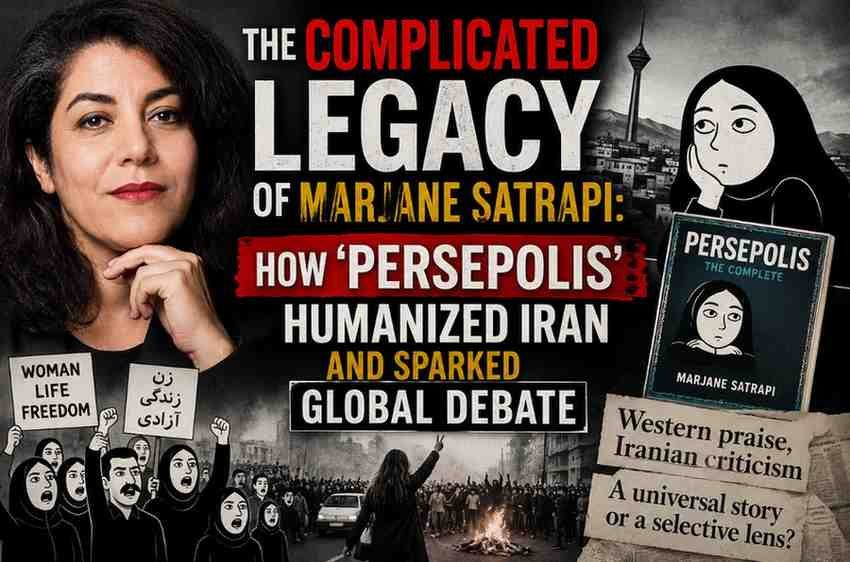
Few graphic novels have altered cultural conversations as profoundly as ‘Persepolis’. Through stark black-and-white illustrations and deeply personal storytelling, Marjane Satrapi transformed memories of her childhood during the Iranian Revolution into one of the most influential memoirs of the 21st century.
For many readers outside Iran, ‘Persepolis’ served as their first encounter with everyday Iranian life beyond headlines, political rhetoric, and stereotypes. Satrapi humanized a country often viewed through the lens of geopolitics and conflict. Yet the extraordinary success of her work also created a paradox.
While her memoir highlighted the experiences of women living under religious and political restrictions, critics and scholars have long debated how Western audiences and governments appropriated her narrative to reinforce simplified perceptions of Iran.
The result is a legacy that remains both powerful and deeply complicated.
How ‘Persepolis’ Revolutionized Graphic Storytelling
When ‘Persepolis’ appeared in the early 2000s, graphic novels were still fighting for literary recognition. Satrapi’s memoir proved that comics could address history, identity, exile, and trauma with extraordinary sophistication.
The story followed her childhood during the Islamic Revolution, the Iran-Iraq War, and her experiences living abroad. But unlike many political memoirs, it balanced tragedy with humor, irony, and emotional honesty.
Its simplicity became its strength.
By presenting history through the eyes of a child, Satrapi made complex political events accessible without sacrificing emotional depth.
Humanizing Iran Beyond Headlines
One of Satrapi’s greatest achievements was dismantling stereotypes.
Western audiences accustomed to viewing Iran through images of protests, wars, and diplomatic crises suddenly encountered ordinary people who listened to music, argued with parents, dreamed about the future, and struggled with the contradictions between tradition and modernity.
Her work emphasized that Iranians were not abstractions but individuals with hopes, fears, and everyday lives.
This humanization proved particularly significant during the years after September 11, when discussions surrounding the Middle East were often dominated by fear and political polarization.
Women at the Center of Resistance
At its heart, ‘Persepolis’ is also a story about women.
Satrapi chronicled how political and religious policies affected women’s bodies, clothing, education, and freedom of expression. Through personal experiences and family stories, she showed that resistance often occurred through everyday acts rather than grand gestures.
Her female relatives emerged not as victims but as resilient individuals navigating difficult circumstances.
These portrayals challenged simplistic narratives and highlighted the complexity of women’s lives under authoritarian systems.
Why ‘Persepolis’ Resonated Globally
The memoir transcended national boundaries because it explored universal themes:
- Identity and belonging.
- Exile and displacement.
- Family relationships.
- Growing up amid political upheaval.
- The conflict between personal freedom and social expectations.
- Memory and nostalgia.
Readers who had never visited Iran recognized emotions that felt profoundly familiar.
That universality helped turn Satrapi into one of the most celebrated voices in contemporary literature.
The Complexity of Representation
Success, however, brought complications.
As ‘Persepolis’ became a global cultural touchstone, many Western readers treated Satrapi’s experiences as representative of Iran itself.
This created tension because no single memoir can capture the diversity of a nation with millions of people, multiple identities, and varying political perspectives.
Some scholars have argued that Western audiences selectively embraced aspects of Satrapi’s work that aligned with existing assumptions while overlooking the nuances and contradictions embedded within her storytelling.
Ironically, a memoir intended to humanize complexity occasionally became simplified in international discourse.
Comparison: Media Narratives vs Satrapi’s Storytelling
| Traditional Media Coverage | Satrapi’s Perspective |
|---|---|
| Focus on governments | Focus on ordinary people |
| Political headlines | Personal memories |
| Generalizations about society | Individual experiences |
| Conflict and ideology | Human relationships |
| External viewpoints | Insider perspective |
This contrast explains why ‘Persepolis’ became so influential.
The West’s Relationship With ‘Persepolis’
One of the enduring debates surrounding Satrapi involves the ways her work has been interpreted in Europe and North America.
Some critics argue that Western institutions embraced ‘Persepolis’ because it reinforced narratives about oppression in Iran while paying less attention to Satrapi’s critiques of Western policies and colonial attitudes.
Satrapi herself repeatedly rejected simplistic binaries.
She criticized authoritarianism in Iran while also questioning Western hypocrisy and interventionism. Her worldview resisted easy categorization.
Yet public discourse often prefers certainty over complexity.
Exile and the Burden of Representation
Living in exile creates unique challenges for artists.
They often become unofficial ambassadors for countries they no longer inhabit fully.
Satrapi’s identity as an Iranian living in France placed her between cultures. She belonged to both and neither.
That in-between existence shaped much of her work and contributed to its emotional power.
But it also meant that audiences frequently expected her to speak on behalf of all Iranians—a burden no artist can realistically bear.
The Influence of ‘Persepolis’ on Feminist Conversations
Long before the “Woman, Life, Freedom” movement captured international attention, Satrapi’s work had already illuminated the everyday realities faced by many women under restrictive systems.
Her stories emphasized that oppression is rarely experienced only through laws. It also manifests through social expectations, surveillance, and cultural pressures.
Importantly, ‘Persepolis’ portrayed women as active participants in resistance rather than passive victims.
This perspective helped shape conversations about feminism, identity, and agency across cultures.
An Insight Often Overlooked: Satrapi Was Fighting Simplification, Not Just Repression
Many discussions focus solely on Satrapi’s criticism of political and religious oppression.
But perhaps her deeper mission was to resist simplification itself.
She rejected stereotypes about Iran.
She rejected simplistic portrayals of the West.
She rejected ideological binaries.
And she rejected the idea that identities could be reduced to labels.
That commitment to complexity may be her most important contribution.
Why ‘Persepolis’ Still Matters Today
More than two decades after its publication, ‘Persepolis’ remains remarkably relevant.
In an era shaped by misinformation, polarization, and social media soundbites, Satrapi’s work reminds readers that history is lived through individual experiences.
It also demonstrates the power of storytelling to challenge stereotypes and build empathy.
Young readers continue discovering the memoir not merely as a historical document, but as a meditation on identity, memory, and belonging.
The Future of Her Legacy
Marjane Satrapi’s influence extends beyond literature.
She helped elevate graphic novels into serious artistic forms, inspired countless creators, and opened conversations about Iran that continue today.
As debates around representation and identity evolve, her legacy will likely remain a subject of discussion rather than consensus.
Perhaps that uncertainty is fitting.
Satrapi’s work was never about offering simple answers.
It was about embracing uncomfortable truths.
Conclusion
Marjane Satrapi’s legacy is both extraordinary and complicated. Through ‘Persepolis’, she gave voice to the lived experiences of women and families navigating political upheaval, exile, and repression. Her memoir humanized Iran for millions while challenging stereotypes that had long dominated global discourse.
Yet the international success of her work also revealed the risks of reducing one individual’s experiences to the story of an entire nation. That tension continues to shape conversations surrounding her influence.
Ultimately, Satrapi’s greatest achievement may lie not in providing definitive answers, but in insisting on complexity. In a world increasingly drawn to simplistic narratives, ‘Persepolis’ remains a powerful reminder that people and nations are always more complicated than headlines suggest.
For breaking news and live news updates, like us on Facebook or follow us on Twitter and Instagram. Read more on Latest Entertainment on thefoxdaily.com.

COMMENTS 0