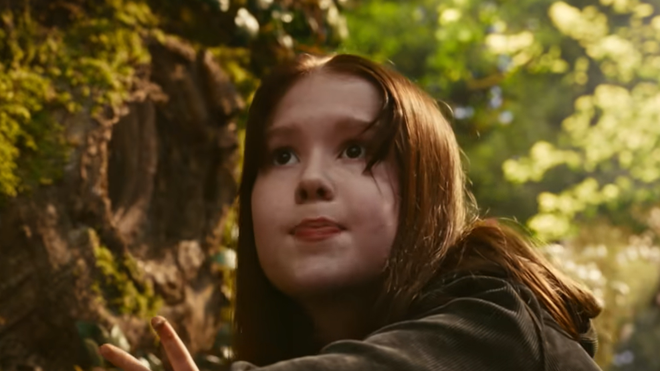
The Magic Faraway Tree Movie Review: Enid Blyton’s beloved fantasy world gets a big-screen makeover with Andrew Garfield and Claire Foy leading a talented ensemble cast. The adaptation takes audiences into the mysterious Faraway Tree, where strange characters, magical lands and unexpected adventures await above the ordinary world.
At first glance, The Magic Faraway Tree might seem like a straightforward children’s fantasy. But the film has a more interesting idea underneath its colourful surface: it explores what happens when a family accustomed to modern technology is forced to reconnect with imagination, nature and each other.
The story follows the Thompson family as they leave their familiar life behind and move to the countryside. Their children struggle with the sudden change, but everything begins to look different when they discover the extraordinary Faraway Tree. What appears to be an ordinary woodland discovery becomes an entrance to a series of fantastical worlds filled with unusual characters and unpredictable adventures.
What Is The Magic Faraway Tree About?
The Magic Faraway Tree is based on Enid Blyton’s famous Faraway Tree stories. The central concept is wonderfully simple: a gigantic magical tree contains a pathway to different lands at its summit.
The film follows the Thompson family as they adjust to a major change in their lives. Instead of remaining focused exclusively on the children’s adventures, the story also examines the pressures faced by their parents.
That gives the adaptation a useful emotional foundation. The magical tree becomes more than a spectacular fantasy location. It becomes a place where the family can rediscover curiosity and learn to experience life outside the controlled environment they previously knew.
The constantly changing worlds also provide the movie with plenty of opportunities for visual invention. Each new destination can introduce different characters, rules and challenges, allowing the filmmakers to maintain a sense of unpredictability.
Andrew Garfield Brings Warmth to the Family Story
Andrew Garfield plays Tim Thompson, one of the film’s central adult characters. His performance helps give the fantasy story an emotional anchor.
Garfield has the ability to move comfortably between humour and vulnerability, which suits a family adventure that needs to entertain children without making its adult characters feel superficial.
Rather than behaving like the stereotypical perfect movie father, Tim is part of a family experiencing genuine uncertainty. The relocation changes the family’s routine, and the discovery of the Faraway Tree introduces an entirely new dimension to their lives.
Garfield’s presence is particularly valuable for adult viewers. Family films work best when parents watching alongside their children have characters and performances that feel substantial enough to hold their attention.
Claire Foy Adds Emotional Depth
Claire Foy plays Polly Thompson, bringing a different energy to the family dynamic.
Polly’s character provides one of the movie’s strongest connections to contemporary life. Her relationship with technology and the decisions surrounding her professional life introduce questions about privacy, responsibility and the consequences of technological progress.
This gives the film more substance than a simple good-versus-evil fantasy. Technology is not presented as something that should automatically be rejected. Instead, the story raises questions about how much of our lives should be controlled, monitored or replaced by technology.
That theme makes The Magic Faraway Tree surprisingly relevant to modern families.
The Faraway Tree Is the Real Star
While Garfield and Foy provide the human centre, the Faraway Tree itself is arguably the film’s most memorable creation.
The tree works because it combines familiarity with mystery. A tree is something children can immediately understand, but Blyton transforms it into a gateway to worlds that operate according to completely different rules.
That simple concept creates an endless sense of possibility.
The characters never know exactly what awaits them at the top. A new land can be strange, funny, dangerous or completely absurd. This unpredictability is an important part of the original Faraway Tree experience and gives the movie much of its charm.
Silky, Moonface and the Eccentric Residents
The film’s supporting characters bring much of its humour and personality.
Among the most recognisable figures are Silky, Moonface and Saucepan Man. Their unusual personalities make the Faraway Tree feel different from the polished fantasy kingdoms commonly found in modern blockbuster cinema.
Nicola Coughlan plays Silky, while Nonso Anozie portrays Moonface. Their performances help establish the playful tone of the magical world.
The characters are deliberately eccentric, and that eccentricity is important. The Faraway Tree should not feel like another generic fantasy universe filled with perfectly designed creatures. Its charm comes partly from being weird.
That strange quality gives the adaptation its own identity.
Rebecca Ferguson’s Dame Snap Adds a Darker Edge
Rebecca Ferguson takes on the role of Dame Snap, bringing a more intimidating presence to the story.
Her character provides an important contrast to the lighter personalities inhabiting the Faraway Tree. Without a threatening force, the adventure could become little more than a sequence of colourful encounters.
Dame Snap introduces tension and reminds the characters that the magical world is not completely harmless.
The balance between comedy, wonder and danger is essential for children’s fantasy. Young audiences need genuine stakes, but the atmosphere should remain accessible rather than overwhelmingly frightening.
Production Design Makes the Fantasy Feel Tangible
One of the strongest elements of The Magic Faraway Tree is its production design.
The filmmakers have an opportunity that many fantasy adaptations would envy: Blyton’s world already has a strong visual identity. The challenge is turning descriptions that existed in children’s imaginations into physical cinematic environments.
The result is a world designed around discovery rather than realism.
The Faraway Tree feels like a place where almost anything could happen. The different lands introduce visual variety, while the tree itself remains the central landmark connecting the adventures.
This approach is especially important in an era when audiences are accustomed to computer-generated fantasy environments. The film benefits from allowing its world to retain a slightly theatrical and storybook quality.
The Slippery Slip Is Pure Childhood Fantasy
Few elements capture the playful spirit of the Faraway Tree better than the Slippery Slip.
The idea is wonderfully childish: instead of simply climbing down a tree, characters can use a magical slide to return from their adventures.
It is precisely the kind of detail that makes Blyton’s fantasy appealing. The concept does not need a complicated explanation. It is fun because it sounds fun.
That simplicity is something modern fantasy films sometimes overlook. Not every magical idea needs an elaborate mythology. Sometimes a giant tree with a magical slide is enough.
A Modern Story Hidden Inside a Classic Fantasy
The most interesting aspect of the movie is its conversation between old-fashioned childhood adventure and modern technology.
Blyton’s original stories emerged from a period when children’s entertainment was much less connected to digital devices. The new film arrives in a completely different cultural landscape.
Children now have access to smartphones, streaming services, online games and algorithm-driven entertainment from an early age.
Against that background, the Faraway Tree becomes almost a metaphor for uncontrolled imagination.
You cannot scroll through the Faraway Tree. You cannot skip directly to the most exciting part. You have to climb it, explore it and experience whatever happens next.
That distinction gives the film a surprisingly contemporary message.
Why the Technology Theme Matters
The movie’s technology storyline gives it an opportunity to discuss an issue that many families are already facing: the balance between convenience and privacy.
Smart devices can make everyday life easier, but they also raise questions about how much personal information people are willing to exchange for that convenience.
By placing this concern alongside the Faraway Tree, the film creates an interesting contrast between two kinds of worlds.
One is designed to make life predictable and efficient. The other is built around uncertainty and discovery.
The film does not need to declare one completely good and the other completely bad. Its stronger point is that children and adults need spaces where not everything is automated, measured or controlled.
The Magic Faraway Tree vs Modern Fantasy Blockbusters
| Element | The Magic Faraway Tree | Typical Fantasy Blockbuster |
|---|---|---|
| Core appeal | Imagination and discovery | Large-scale spectacle |
| World-building | Whimsical and unpredictable | Often built around detailed fantasy mythology |
| Characters | Eccentric and playful | Usually shaped around traditional heroes and villains |
| Family themes | Central to the story | Often secondary to the adventure |
| Modern relevance | Technology, family and childhood | Usually focused on the fantasy conflict |
This difference could become one of the film’s biggest advantages. It does not have to compete directly with enormous fantasy franchises on their own terms.
Its strength lies in intimacy, humour and the feeling of discovering something strange for the first time.
Does the Film Capture the Spirit of Enid Blyton?
The biggest challenge facing any adaptation of a beloved children’s book is balancing nostalgia with modernization.
A completely faithful recreation could feel dated to contemporary audiences. A radical reinvention, meanwhile, could leave longtime fans wondering why the original material was used at all.
The Magic Faraway Tree attempts to occupy the middle ground.
The iconic characters and fantasy concepts remain recognisable, while the family storyline introduces themes that feel more relevant to modern audiences.
That approach makes sense because the enduring appeal of Blyton’s stories is not necessarily tied to the exact social environment in which they were written. The deeper appeal is the fantasy of discovering a secret world where children can explore beyond adult supervision.
What Works Best in The Magic Faraway Tree
- The central concept: The Faraway Tree remains an irresistibly simple and imaginative fantasy idea.
- The cast: Andrew Garfield and Claire Foy give the family story credibility, while the supporting cast embraces the eccentricity of the source material.
- The production design: The magical environments provide the visual wonder expected from a family fantasy.
- The humour: The strange residents of the tree create opportunities for physical comedy and playful interactions.
- The family themes: The story has more emotional substance than a simple treasure-hunt adventure.
- The technology angle: The contrast between digital convenience and imaginative exploration gives the adaptation contemporary relevance.
Where the Movie’s Greatest Risk Lies
The film’s greatest challenge is also inherent in its premise: there are so many fantastical possibilities that the story could become episodic.
When characters can continually enter new worlds, the adventure risks feeling like a collection of loosely connected episodes rather than one satisfying cinematic journey.
The emotional story therefore needs to remain strong enough to connect the individual adventures.
This is where the Thompson family becomes particularly important. Their relationships provide the continuity that the magical worlds themselves cannot always provide.
Why The Magic Faraway Tree Matters for Today’s Children
Beyond its entertainment value, the film arrives at an interesting moment for children’s storytelling.
Modern children are surrounded by entertainment that is fast, personalised and constantly available. The Faraway Tree represents almost the opposite experience.
It rewards patience. It requires exploration. It contains surprises that cannot be completely predicted.
That makes the story feel almost radical in its simplicity.
The movie’s strongest underlying message is not that technology is the enemy. It is that imagination remains valuable even when technology can provide an answer to almost everything.
Children still need stories that encourage them to wonder what might be around the next corner.
Final Verdict: Is The Magic Faraway Tree Worth Watching?
The Magic Faraway Tree works best when it embraces the qualities that made Enid Blyton’s stories distinctive: curiosity, eccentric characters, playful danger and the thrill of entering a world where ordinary rules no longer apply.
Andrew Garfield and Claire Foy provide a strong emotional foundation, while Nicola Coughlan, Nonso Anozie, Rebecca Ferguson and the wider ensemble add personality to the magical adventure.
Its biggest strength is not the scale of its fantasy but the warmth of its imagination. The movie understands that the Faraway Tree does not need to become the next gigantic cinematic universe. It simply needs to make audiences believe, for a little while, that somewhere beyond the familiar world there might be a magical tree waiting to be climbed.
For longtime Enid Blyton readers, that is the source of the film’s nostalgia. For younger audiences, it may become something equally valuable: an introduction to the idea that adventure does not always require a screen.
Overall, The Magic Faraway Tree is a charming family fantasy that combines classic children’s storytelling with contemporary themes, colourful production design and a talented cast. Its greatest achievement is reminding audiences that sometimes the most exciting journey begins when you simply decide to climb a tree.
For breaking news and live news updates, like us on Facebook or follow us on Twitter and Instagram. Read more on Latest Entertainment on thefoxdaily.com.






COMMENTS 0